Braised Lamb Shanks with Fresh Rosemary
A wonderful blend of flavors—perfumes the whole house. Perfect for company, since it can be made the day before. Everyone raves about it! I've doubled and tripled the recipe with success. It's from a 1998 Bon Appetit.
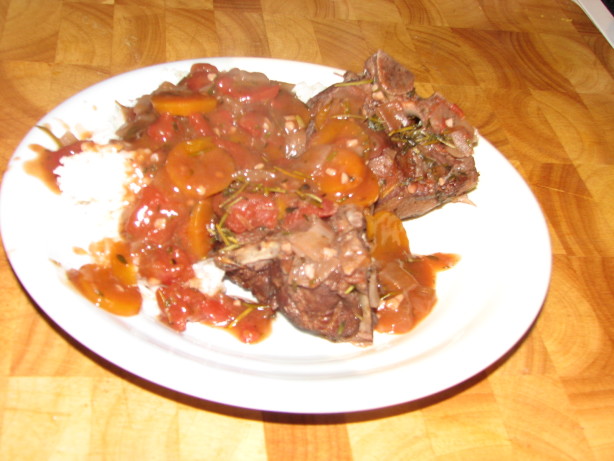
A wonderful blend of flavors—perfumes the whole house. Perfect for company, since it can be made the day before. Everyone raves about it! I've doubled and tripled the recipe with success. It's from a 1998 Bon Appetit.
- 2 tablespoons olive oil
- 2 medium onions chopped
- 2 teaspoons fresh thyme chopped
- 6 lamb shanks (i have also used leg of lamb, ask the butcher to cut it in 1 1/
- 3 large carrots peeled and cut into 1/2 inch thick rounds
- 10 cloves garlic cloves, minced
- 1 750-ml bottle dry red wine (sangiovese is good)
- 1 28-oz can diced tomatoes with juice (28 oz can)
- 1 14.5-oz can low sodium chicken broth
- 1 14.5-oz can beef broth
- 5 teaspoons fresh rosemary chopped
- 2 teaspoons lemon zest grated
- Carbohydrate 17.5943833333333 g
- Cholesterol 366.610588235294 mg
- Fat 42.1595907843137 g
- Fiber 3.23325000031789 g
- Protein 29.7197467647059 g
- Saturated Fat 20.6025109215686 g
- Serving Size 1 1 Serving (648g)
- Sodium 713.457578431372 mg
- Sugar 14.3611333330154 g
- Trans Fat 4.51247906862746 g
- Calories 661 calories
Step-by-step
- Sprinkle lamb with salt and pepper.
- Heat oil in heavy, large pot over medium-high heat.
- Working in batches, add lamb to pot and cook until brown on all sides, about 8 minutes.
- Transfer to bowl.
- Remove all but about 2 tablespoons of oil from pan.
- Add onions, carrots, and garlic to pot and saute till golden, about 10 minute.
- Stir in all remaining ingredients.
- Return lamb to pot, pressing down to submerge.
- Bring liquid to boil, reduce heat to medium low, and cover.
- Simmer until meat is tender, about 2 hours.
- Uncover pot; simmer till meat is very tender, about 30 minutes.
- (Can be made 1 day ahead. Chill until cold, cover, and keep chilled. Rewarm over medium heat before continuing.) Transfer lamb to platter; tent with foil.
- Boil juices in pot till thickened, about 15 minutes.
- Season with salt and pepper and spoon over lamb.
The Wine Foundation
Dry red wine performs the heaviest lifting in this dish, acting as both a searing deglazing agent and an acidic braising medium that breaks down tough collagen over hours of heat. Sangiovese provides high acidity and moderate tannins, but any dry red with a tart backbone works. Substituting a sweeter wine will throw off the savory balance of the chicken and beef broths entirely. While the ingredient list specifies a full 750-milliliter bottle, cooks working with smaller portions must scale the liquid carefully or risk drowning the meat instead of braising it.
Scaling and Equipment Strategy
Multiplying this dish for a crowd requires careful attention to vessel geometry because crowding the pot prevents proper browning. Working in batches over medium-high heat ensures the meat develops a deep Maillard crust rather than steaming in its own juices. When doubling the quantities, ensure the heavy pot has enough diameter to hold all six pieces flat without stacking them precariously. If the pan is too narrow, thermal circulation fails, and the carrots at the bottom may scorch before the connective tissue renders down.
The Make-Ahead Advantage
Cooking this preparation a full day in advance allows fats to solidify cleanly at the surface for easy removal after chilling. Overnight resting also permits the garlic, rosemary, and thyme to fully penetrate the muscle fibers. Reheat the cold pot gently over medium heat until the liquid liquefies completely before transferring the meat to a platter. Reducing the remaining strained juices rapidly for 15 minutes concentrates the natural gelatin, yielding a glossy sauce that clings evenly to the back of a spoon.


