Chicken Ginger Stir-Fry
I love the fresh gingerroot in this recipe. Other vegetables (cauliflower, Chinese cabbage, snow peas) can also be added. Serve over a bed of brown rice.
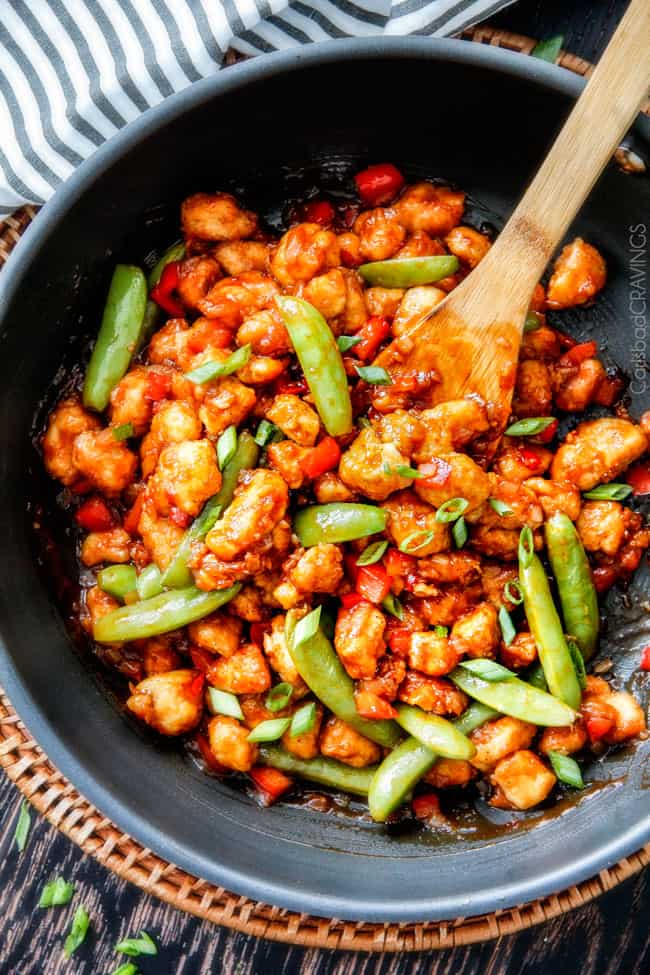
I love the fresh gingerroot in this recipe. Other vegetables (cauliflower, Chinese cabbage, snow peas) can also be added. Serve over a bed of brown rice.
- Carbohydrate 12.1060729163993 g
- Cholesterol 49.395 mg
- Fat 5.06278333332853 g
- Fiber 3.1584999464565 g
- Protein 22.8657833328289 g
- Saturated Fat 0.873617499999472 g
- Serving Size 1 1 Serving (260g)
- Sodium 310.064999731872 mg
- Sugar 8.94757296994281 g
- Trans Fat 0.607897499998658 g
- Calories 188 calories
Step-by-step
- Cut chicken into cubes.
- Heat Oil in wok or skillet.
- Add chicken with 1/2 of gingerroot; stir fry for 4 minutes.
- remove from wok.
- Stir-fry broccoli, carrots, celery and remaining gingerroot for 2 minutes.
- If necessary add a little water to prevent from sticking.
- Mix chicken stock, sherry and soy sauce; pour over mixture.
- Cover and steam for 2 minutes.
- Stir in onion and chicken.
- Mix cornstarch with water; add to vegetables and bring to boil.
The Substitution Factor
Replacing the chicken breasts with skin-on thighs alters the rendering behavior entirely. Breasts contain minimal intramuscular fat, requiring strict adherence to cooking times to prevent rubbery meat. Thigh meat tolerates higher heat fluctuations because the fat renders during the initial four-minute sear. Any vegetable swap must account for water content. Dense brassicas like cauliflower require a longer steam phase than tender leafy greens. Adjust the two-minute covered steam window by 30 seconds depending on the density of the chosen produce.Heat Management and the Wok
High surface temperature defines successful stir-frying. A cast-iron skillet or carbon-steel wok must reach high heat before the oil goes in. Cold oil in a hot pan creates a non-stick barrier. Add the cubed chicken and half the minced gingerroot immediately. Stir constantly for exactly four minutes to develop partial browning while keeping the interior moist. Remove the chicken promptly to halt the cooking process. Residual heat inside a crowded pan will dry out lean white meat within seconds.Sequencing the Vegetables
Stir-frying relies on precise timing to match vegetable density with cooking rates. Hard vegetables like carrots, broccoli spears, and celery need a rapid two-minute toss in the hot pan. Add two tablespoons of water only if the pan surface begins to scorch. Pouring the mixture of chicken stock, sherry, and soy sauce creates immediate steam. Cover the pan for two minutes to soften the produce fibers. Dissolve the cornstarch completely in cold water before pouring it into the boiling liquid. Starches gelatinize only when brought to a boil, thickening the stock into a glossy glaze.


