Sweet 'n' Spicy Sriracha-Glazed Salmon
This is one of my favorite ways to prepare salmon. The marinade in this recipe is the perfect combination of spicy, sweet, and savory - in fact, I also love to use it with steaks or chicken. The Sriracha sauce (aka rooster sauce) is a must, and you can find it in the Asian section of most supermarkets.
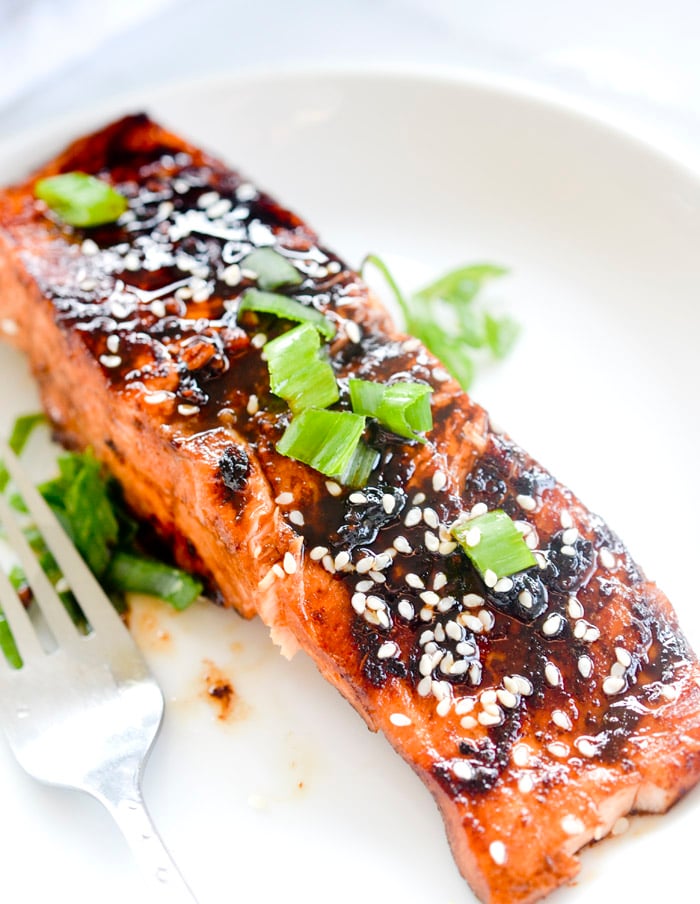
This is one of my favorite ways to prepare salmon. The marinade in this recipe is the perfect combination of spicy, sweet, and savory - in fact, I also love to use it with steaks or chicken. The Sriracha sauce (aka rooster sauce) is a must, and you can find it in the Asian section of most supermarkets.
- 1 tablespoon rice vinegar
- 2 tablespoons honey
- 1 tablespoon fresh ginger grated
- 1 tablespoon garlic minced
- 1 1/2 teaspoons sesame oil
- 1/4 cup reduced-sodium soy sauce (or tamari for gluten-free)
- 1 tablespoon sriracha sauce (or to taste)
- 1 pound wild salmon fillet cut into 4 (4-ounce) pieces
- 2 tablespoons scallions for garnish
- Carbohydrate 6.09935772277314 g
- Cholesterol 0 mg
- Fat 1.74413936663441 g
- Fiber 0.24245867858739 g
- Protein 0.968453052867771 g
- Saturated Fat 0.249234830335576 g
- Serving Size 1 1 Serving (141g)
- Sodium 376.036892089727 mg
- Sugar 5.85689904418575 g
- Trans Fat 0.085901522659217 g
- Calories 42 calories
Step-by-step
- In a 1-gallon zip-top plastic bag, combine the soy sauce, honey, vinegar, Sriracha, ginger, and garlic. Add the salmon, toss to coat evenly, and refrigerate for at least 1 hour, or up to 8 hours, turning the fish once.
- Remove the salmon from the bag, reserving the marinade. Heat a large saut? pan over medium-high heat and add the sesame oil. Rotate the pan to coat the bottom evenly and add the salmon. Cook until one side of the fish is browned, about 2 minutes. Flip the salmon and cook until the other side browns, 2 more minutes. Reduce the heat to low and pour in the reserved marinade. Cover and cook until the fish is cooked through, 4 to 5 minutes.
- Place a piece of salmon on each of 4 serving plates and sprinkle with the scallions.
Marinating fish requires strict adherence to timing, because acid in the marinade begins breaking down delicate proteins within a one-hour window. Fresh ginger and minced garlic contribute volatile aromatic compounds that dried powders cannot replicate, supplying sharp heat and pungent sulfur notes directly to the glaze. Bottled Sriracha provides consistent capsaicin heat alongside fermented notes of vinegar and garlic, acting as a stable emulsifier when combined with honey and reduced-sodium soy sauce. When transferring the fish to a large sauté pan, heat management dictates the quality of the exterior crust; cast iron or heavy stainless steel holds the thermal mass required to brown the protein in two minutes without sticking. Reserve the spent marinade carefully, as pouring it into the pan during the final low-heat stage reduces the liquids into a glossy coating while steaming the center to completion. Scaling this preparation for larger groups requires cooking the fillets in separate batches rather than crowding the pan, which would lower the oil temperature and cause the salmon to steam instead of searing. Whole wild fillets can be portioned into four-ounce blocks prior to soaking to ensure uniform penetration of the salt and sugars across every piece.



