5 Minute Artisan Bread
This is the basic Boule bread mix from the book Artisan Bread in Five Minutes a Day by Jeff Hertzberg and Zoe Francois. If you like this, get the book. I use their technique every day. We always have fresh bread on our table.
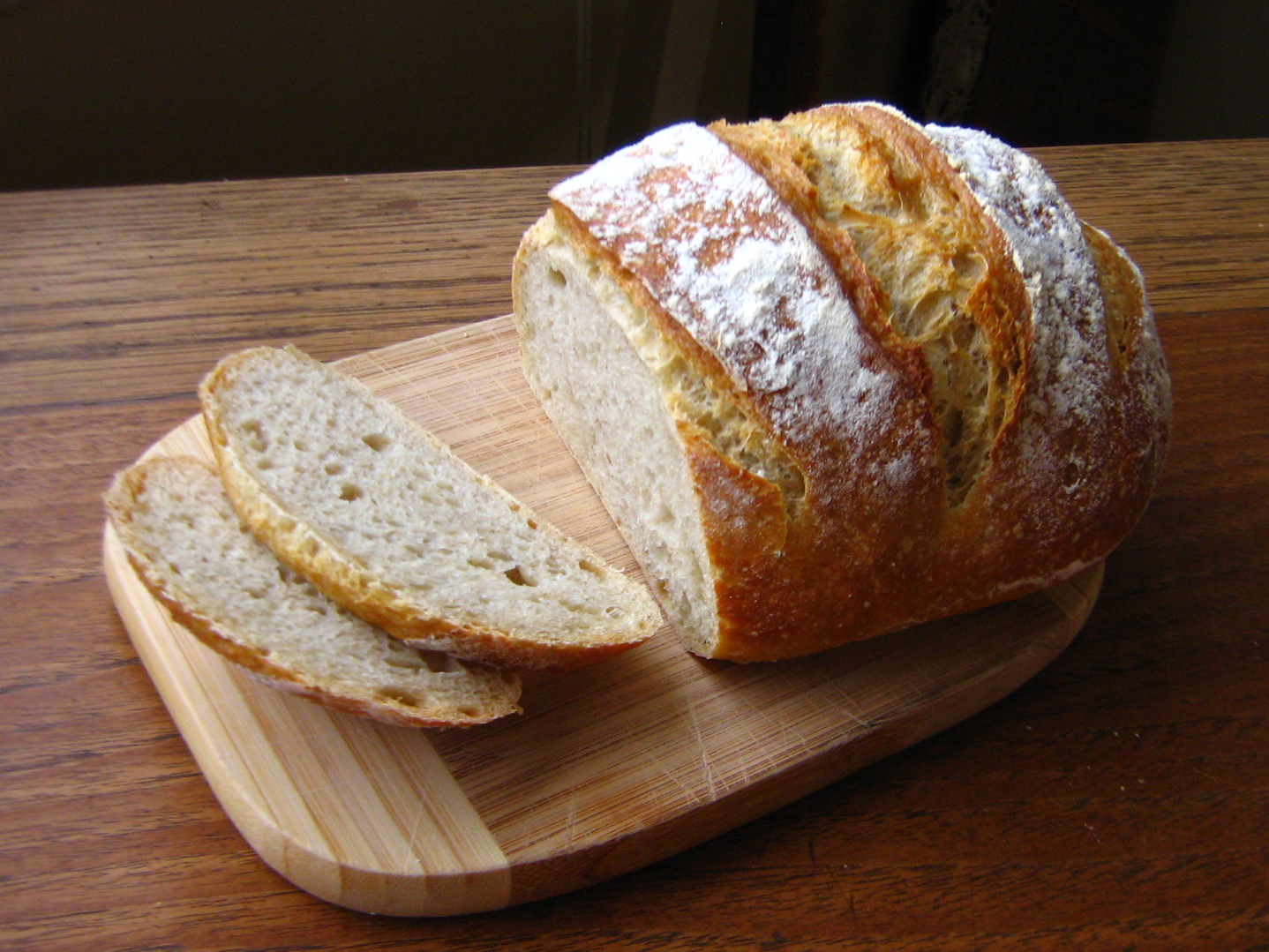
This is the basic Boule bread mix from the book Artisan Bread in Five Minutes a Day by Jeff Hertzberg and Zoe Francois. If you like this, get the book. I use their technique every day. We always have fresh bread on our table.
- Carbohydrate 37.602225 g
- Cholesterol 0 mg
- Fat 0.52605 g
- Fiber 1.53675002324581 g
- Protein 5.438025 g
- Saturated Fat 0.08181 g
- Serving Size 1 1 Serving (85g)
- Sodium 2.5656 mg
- Sugar 36.0654749767542 g
- Trans Fat 0.173484 g
- Calories 181 calories
Step-by-step
- Allow to rise. Cover with lid (not airtight or it could explode the lid off). Allow the mixture to rise at room temperature until it begins to collapse (or at least flattens on the top), approx 2 hours, depending on room temperature, and initial water temperature Longer rising times, up to 5 hours, won't harm the result.
- You can use a portion of the dough any time after this period. Fully refrigerated dough is less sticky and easier to work with than dough at room temperature.
- On Baking Day: prepare your loaf tin, tray, or whatever you're baking it in/on. Sprinkle the surface of your refrigerated dough with four. Pull up and cut of a grapefruit-size piece of dough (c 1 lb), using a serrated knife.
- Hold the mass of dough in your hands and add a little more flour as needed so it won't stick to your hands. Gently stretch the surface of the dough around to the bottom on all 4 sides, rotating the ball a quarter-turn as you go. Most of the dusting flour will fall off - that's fine, it isn't meant to be incorporated. The bottom of the loaf may appear to be a collection of bunched ends, but it will sort itself out during resting and baking.
- The correctly shaped final product will be smooth and cohesive. The entire process should take no more than 30 - 60 seconds.
- Rest the loaf and let it rise in the form, on the tray/pizza peel, for about 40 minutes Depending on the age of the dough, you may not see much rise during this period. That's fine, more rising will occur during baking.
- Twenty minutes before baking, preheat the oven to 450?F Place an empty broiler tray for holding water on any other shelf that won't interfere with the rising bread.
- Dust and Slash. Dust the top of the loaf liberally with flour, which will allow the slashing knife to pass without sticking. Slash a quarter inch deep cross, diagonal lines, or tic-tac-toe pattern on top using a serrated knife.
- After a 20 min preheat you're ready to bake, even though the oven thermometer won't be at full temperature yet. Put your loaf in the oven. Pour about 1 cup of hot water (from the tap) into the broiler tray and close the oven to trap the steam.
- Bake for about 30 minutes, or until the crust is nicely browned and firm to the touch.
- Store the rest of the dough in the fridge in your lidded (not airtight) container and use it over the next 14 days. The flavour and texture improves, becoming like sourdough. Even 24 hours of storage improves the flavour
Allowing wet dough to ferment for at least two hours at room temperature before refrigeration is the step that dictates the final crumb structure. Without this initial enzymatic activity, the starches fail to break down sufficiently, yielding a dense interior rather than an open, irregular network of air pockets. A loose lid is mandatory during this phase, as active yeast produces enough carbon dioxide to forcefully dislodge tight seals.
Standard metal baking sheets often warp under the intense heat required for crust development. Using a preheated pizza stone or cast iron combo cooker provides the thermal mass needed to spring the loaf upward during the first ten minutes of baking. Pouring one cup of hot water into a secondary broiler tray immediately upon loading the oven creates the necessary steam environment, which gelatinizes the outer starches and produces a crisp, crackling crust.
Extended cold fermentation transforms the flavor profile significantly. Storing the mass in the refrigerator for up to fourteen days allows wild microflora to develop acetic and lactic acids, shifting the neutral white bread taste toward a pronounced sourdough flavor without requiring an established starter culture.


