Penne alla Vodka
Delicioso One of the simplest and most popular Italian American dishes This luscious creamy vodka sauce is slightly rich has a little spicy tang with just a zing of vodka in the background It works equally well with rigatonni ravioli tortellini or ziti pasta as well as on some poultry dishes or bruschetta appetizers For the best sauce use the best vodka you can it really does make a difference
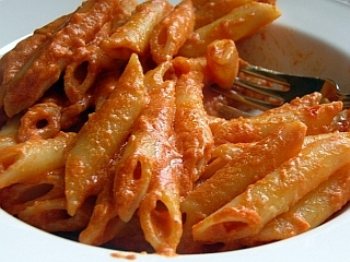
Delicioso One of the simplest and most popular Italian American dishes This luscious creamy vodka sauce is slightly rich has a little spicy tang with just a zing of vodka in the background It works equally well with rigatonni ravioli tortellini or ziti pasta as well as on some poultry dishes or bruschetta appetizers For the best sauce use the best vodka you can it really does make a difference
- 2 tablespoons olive oil
- 1 small onion minced
- sea salt
- 1 28-oz can italian plum tomatoes (i use san marzano), whole peeled
- 2 medium shallots minced
- 1/2 teaspoon crushed red pepper or to taste (more or less)
- 1 tablespoon tomato paste (i use hunt's or muir glen)
- 2 medium cloves garlic minced or pressed through garlic press
- 1/3 cup vodka (use a good quality vodka)
- 1/2 cup heavy cream at room temperature
- 1 pound penne pasta wheat
- 8 fresh basil leaves (up to 10) torn and shredded (about 2 tablespoons)
- parmigiano-reggiano cheese for serving, freshly grated
- Carbohydrate 22.3388383562775 g
- Cholesterol 21.47875 mg
- Fat 8.20547411068282 g
- Fiber 3.76656031613052 g
- Protein 4.73496256057269 g
- Saturated Fat 3.942402875 g
- Serving Size 1 1 Serving (310g)
- Sodium 261.524958333333 mg
- Sugar 18.572278040147 g
- Trans Fat 0.716540485682821 g
- Calories 214 calories
Step-by-step
- Bring 4 quarts water to rapid boil in a large Dutch oven or pot over high heat.
- Drain tomatoes reserving liquid. Puree half of tomatoes in a blender or food processor until smooth. Dice remaining tomatoes into 1/4-inch pieces. Combine both pureed and diced tomatoes in a measuring cup and add enough of reserved tomato liquid to equal 2 cups of tomatoes; set aside. Measure out vodka; set aside.
- Heat oil in large heavy-bottomed saucepan over medium heat. Add onions, shallots, pepper flakes and tomato paste. Saute, stirring frequently, until onions and shallots just begin to turn light golden, about 3 minutes. Add garlic and stirring continuously, saute until fragrant, about 1 minute. Stir in tomatoes and 1/2 teaspoon salt. Remove pan from heat and add vodka*. Return pan to heat and bring to a brisk simmer over medium-high heat. Cook, stirring frequently, until strong alcohol flavor cooks off and sauce thickens, about 8 to 10 minutes. Stir in cream and cook until hot, about 2 minutes.
- While sauce is cooking (right after adding vodka to sauce): Add 1 tablespoon salt to boiling water and drop pasta. Cook, stirring frequently, until molto al dente (about 1 minute shy of al dente - which is tender, but firm to the bite). Drain pasta well, reserving 1/4 cup cooking water. Return pasta back to Dutch oven, add sauce, and toss over medium heat until pasta absorbs some of the sauce, about 1 to 2 minutes. Add reserved cooking water, as needed, if sauce is too thick. Stir in basil and adjust seasoning with salt. Serve immediately, passing Parmigiano-Reggiano separately.
The ingredient roster reveals aromatics and dairy, but it fails to expose the molecular negotiations happening inside the saucepan. When high-proof alcohol hits the hot pan alongside crushed tomatoes and a precise amount of tomato paste, ethanol acts as a molecular bridge that binds water-soluble tomato flavors to fat-soluble compounds, unlocking a depth of taste that neither ingredient could project entirely on its own. While the pot of four quarts of water comes to a rapid boil on the high heat setting, careful management of the heat prevents the heavy cream from breaking when introduced to the acidic tomato base.
The Chemistry of Reduction
Simmering the vodka and tomato mixture for eight to ten minutes is not merely about removing the harsh burn of raw spirit; it allows the volatile organic compounds to concentrate while water evaporates from the crushed whole peeled tomatoes. Cooking the shallots and minced onions in olive oil over medium heat for three minutes softens their cellular walls just enough to release natural sugars without scorching the crushed red pepper flakes. Adding garlic during the final sixty seconds prevents acrid sulfur compounds from developing, maintaining a clean, savory backbone behind the sweet San Marzano profile.
Managing Texture and Timing
Testing pasta doneness relies entirely on visual and physical cues rather than arbitrary timers. Pulling the penne wheat pasta from the boiling water one minute shy of fully tender yields a rigid core that continues softening as it absorbs the starch-thickened sauce over medium heat. Retaining a quarter cup of starchy pasta cooking water provides free amylose molecules necessary to emulsify the heavy cream and oil into a cohesive coating that clings uniformly to each tube.


