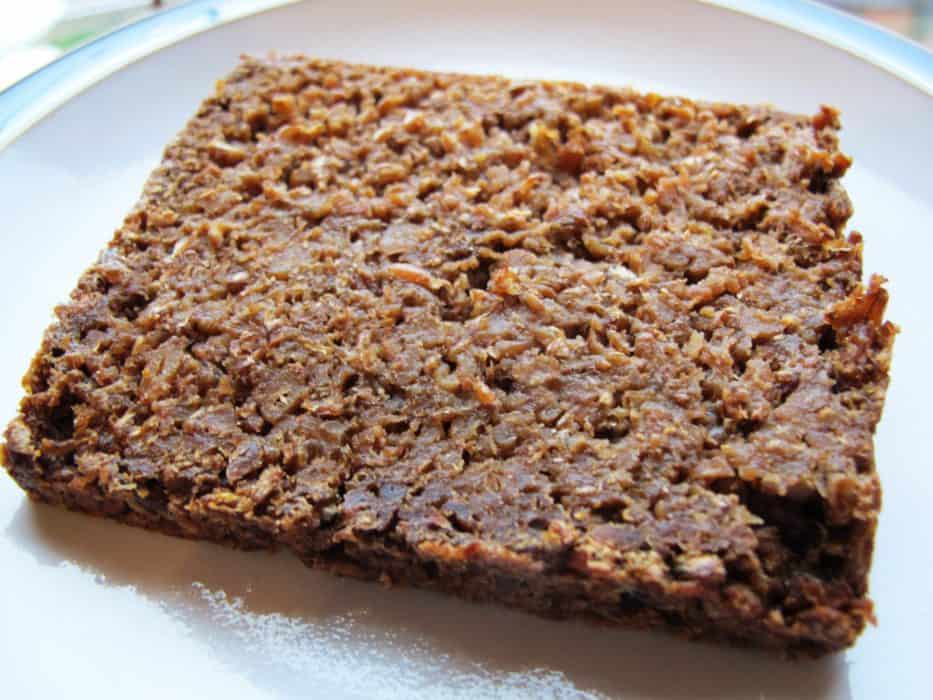
Try this German Pumpernickel Bread recipe.
- Carbohydrate 432.4102125 g
- Cholesterol 98.56 mg
- Fat 103.650555 g
- Fiber 36.58800060606 g
- Protein 56.74359 g
- Saturated Fat 35.4498025 g
- Serving Size 1 1 Serving (927g)
- Sodium 4840.41525 mg
- Sugar 395.82221189394 g
- Trans Fat 6.17517099999998 g
- Calories 2758 calories
Step-by-step
- Recipe by: James Porter - from the house <porterj@LBM.COM> In large bowl, stir together yeast, cocoa, sugar, caraway seed, salt, and 2 cups rye flour; set aside.
- In 2 quart saucepan over low heat, heat water, molasses and butter until very warm (120-130 ^F)
- Using mixer at low speed, gradually beat molasses mixture into yeast mixture until well blended. Increase speed to medium; beat 2 minutes. Add remaining 1c rye flour. Increase speed to high; beat 2 more minutes.
- Stir in enough all-purpose flour to make a soft dough. Turn out dough onto lightly floured surface. Knead until smooth and elastic about 5 minutes.
- Place into greased large bowl, turning over dough so that top is greased. Cover with towel and let rise in warm place until almost doubled, about 45 minutes to an hour.
- Punch down dough. Divide in half. cover and let rest 5 minutes.
- Shape each half into a round loaf. Place, 4" apart, on greased large baking sheet.
- Cover and let rise until almost doubled, 45 minutes to an hour. Diagonally slash each loaf, crosswise, 3 times.
- Bake in 375^ oven for 20 minutes. Cover loosely with foil; bake 15 minutes more or until loaves sound hollow when tapped.
- Immediately remove from baking sheet. Brush tops of hot loaves with shortening. Cool on racks. Makes 2 loaves.
- "German Pumpernickel Bread" from Farm Journals Homemade Breads (Galahad Books, 1985)
- Posted to MM-Recipes Digest V4 #197 by "Griff" <wgriffin@ix.netcom.com> on Jul 29, 1997
Bakers frequently err by omitting rye flour entirely when attempting pumpernickel, substituting standard white flour at a one-to-one ratio which destroys the characteristic dense crumb. Real pumpernickel relies heavily on rye, but rye flour lacks strong gluten proteins. Mixing three cups of rye flour with three cups of all-purpose flour provides enough structural integrity while maintaining the heavy, moist texture required for this style. When heating the liquid ingredients in a two-quart saucepan, maintain a strict temperature range of 120 to 130 degrees Fahrenheit. Liquids exceeding 130 degrees will kill the active dry yeast, halting fermentation entirely before the dough even begins. Incorporating unsweetened cocoa powder and dark molasses provides the dark mahogany color and subtle bitterness traditionally achieved through long commercial souring processes. Beat the initial batter on high speed for two full minutes to develop what little gluten the rye possesses. Knead the resulting soft dough on a lightly floured surface for precisely five minutes until it feels smooth and elastic. Let the shaped loaves rise in a warm environment until they nearly double in volume, requiring roughly 45 to 60 minutes. Slash the tops diagonally three times across each loaf before baking at 375 degrees Fahrenheit for 20 minutes. Covering the loaves loosely with aluminum foil for the final 15 minutes prevents the dark crust from burning before the interior finishes baking. Tapping the bottom of a finished loaf should produce a hollow sound indicating proper doneness. Brushing the hot crust with shortening immediately upon removal from the baking sheet softens the exterior as the bread cools on wire racks.


