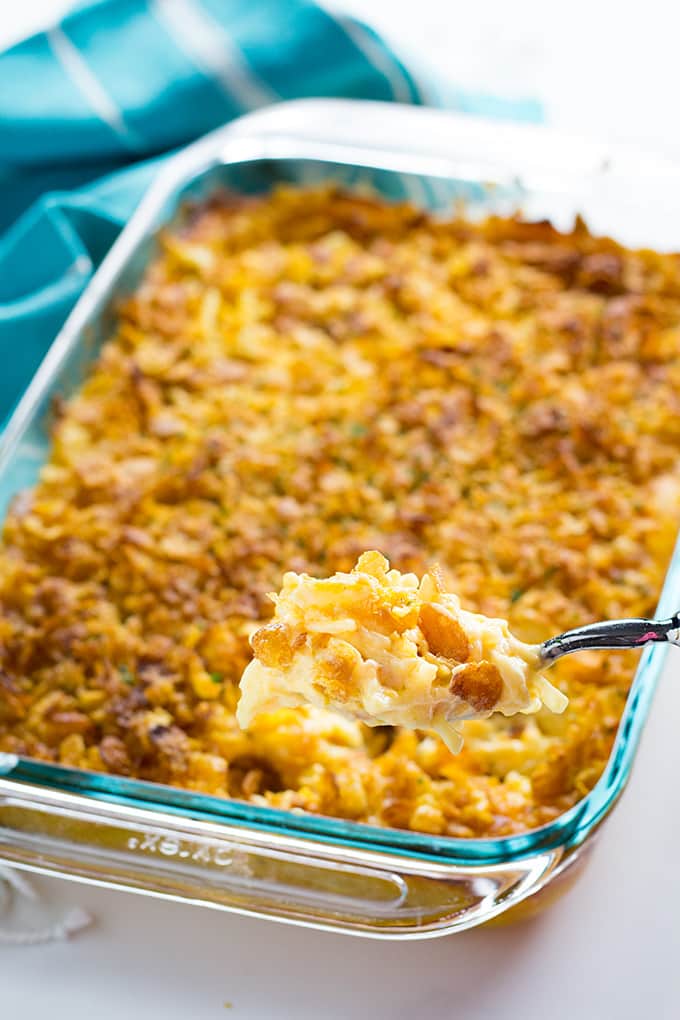
Very good and quick for family or friends gatherings.
- Carbohydrate 80.0552257428795 g
- Cholesterol 212.463000126417 mg
- Fat 87.576129763697 g
- Fiber 1.59813418370111 g
- Protein 46.4039508067326 g
- Saturated Fat 40.9925788093231 g
- Serving Size 1 1 Serving (822g)
- Sodium 1685.06599948073 mg
- Sugar 78.4570915591784 g
- Trans Fat 8.32702499177672 g
- Calories 1277 calories
Step-by-step
- Mix together all ingredients.
- Place in greased 9"x13" casserole dish.
- Sprinkle cheese on top.
- Bake at 350 degrees for 45 minutes covered.
- Uncover and bake an additional 15 minutes.
Beyond the Label
The ingredient list leaves out how frozen potatoes behave when combined with dairy and starches. Thawing the hash browns completely before mixing prevents excess moisture from breaking the emulsion of the soup and sour cream. A standard 9x13-inch glass baking dish holds this volume precisely, allowing the center to reach a safe internal temperature without scorching the edges during the covered 45-minute bake at 350 degrees.
Balancing the Plate
Heavy potato casseroles require bright, acidic counterparts to cut through the richness of dairy fats. Roasted green vegetables tossed in lemon juice or a sharp vinegar-dressed green salad provide necessary contrast. Grilled flank steak or roasted pork tenderloin also pairs effectively, as lean proteins do not compete with the dense, cheesy texture of the potatoes.
Substitutions and Adjustments
Swapping margarine for butter introduces extra water content, which can alter the final crust formation during the final 15 minutes of uncovered baking. Replacing sour cream with plain yogurt reduces overall fat content, but the higher acidity may curdle when exposed to sustained oven heat. Processed cheese melts smoothly due to emulsifying salts, whereas sharp cheddar will separate and release oil if grated from a block.


