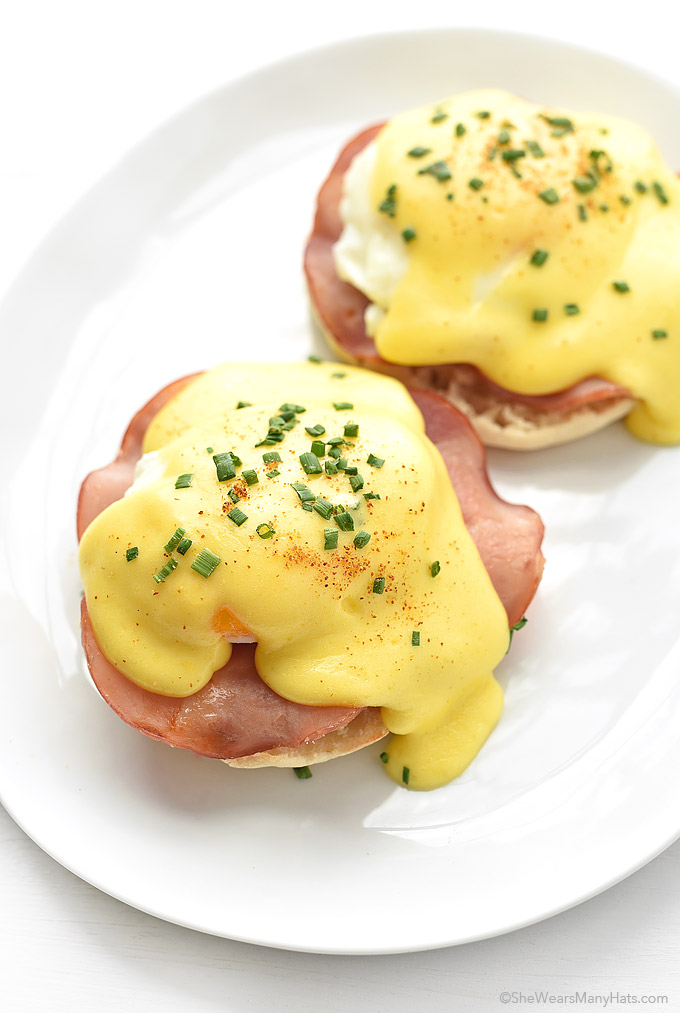
I have found this hollandaise sauce to be very tasty and easy to make.
- Carbohydrate 15.3115231617512 g
- Cholesterol 900.12625 mg
- Fat 41.552165259611 g
- Fiber 0.750254152599963 g
- Protein 13.1365979160905 g
- Saturated Fat 21.1408559526329 g
- Serving Size 1 1 Serving (132g)
- Sodium 180.630674039779 mg
- Sugar 14.5612690091512 g
- Trans Fat 2.41864303812414 g
- Calories 485 calories
Step-by-step
- With the whisk on the immersion blender, blend egg yolks and salt and pepper for about new minute.
- In a small sauce pan, heat the lemon juice and the white wine vinegar to a simmer. Pour this into the egg yolks SLOWLY whilst the blender is running.
- In the same small sauce pan, melt the butter without stirring. Upon completion remove from heat and let stand for a few moments (this allows the milk solids to settle to the bottom). Carefully pour the clear yellow liquid into the egg yolk mixture in a thin slow trickle while the blender is running. This is how you get a thick, smooth buttery sauce!
- Poach the eggs, grill the bacon, and toast the muffins.
- Top each muffin with bacon and a poached egg. Pour the hollandaise sauce over egg.
- I serve at this time, however you can put them under a hot grill for 30 seconds prior to serving.
Swapping clarified butter for whole salted butter introduces excess moisture and milk solids that will break the emulsion, resulting in a thin sauce rather than a clingy, opaque coating. Achieving proper texture relies entirely on mechanical force and thermal control. An immersion blender creates the high shear necessary to force fat droplets into suspension with the egg yolks, while heated acid begins the initial protein denaturation. Maintaining a slow, steady trickle of butter ensures the fat incorporates without overwhelming the yolk's carrying capacity.
The Mechanics of the Emulsion
Blending the egg yolks, salt, pepper, and lemon juice for approximately 60 seconds builds a preliminary foam that stabilizes the mixture before fat is introduced. Butter must reach a clear, golden state without browning, and letting it rest briefly allows heavy milk solids to drop to the bottom of the pan so they can be excluded. Pouring only the clear yellow liquid prevents unwanted water from entering the bowl. If the sauce begins to look greasy rather than glossy, the fat is being added faster than the lecithin in the yolks can bind it.
Balancing Crisp and Tender Elements
Contrasting textures define the dish, requiring crisp English muffin surfaces, yielding poached eggs, and charred edges on the Canadian bacon. Toasting the muffins until golden brown creates a barrier against the liquid components, preventing sogginess during assembly. Grilling the bacon renders out excess surface moisture to concentrate the savory flavors, which chemically balance the rich, buttery sauce through umami and salt contrast. Poached eggs should be dropped into simmering water treated with a splash of white wine vinegar, keeping the albumen tight around the yolk to yield a firm exterior and a flowing center.



