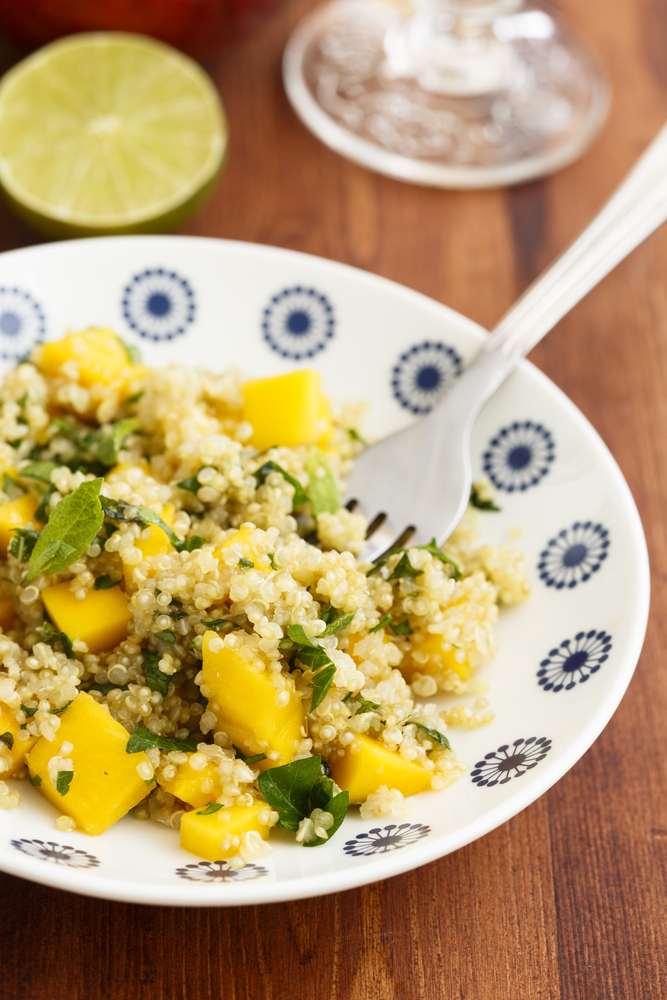
Delicious and Versatile Quinoa Salad
- Carbohydrate 34.0013226276967 g
- Cholesterol 0 mg
- Fat 3.89572267899249 g
- Fiber 3.73689793894182 g
- Protein 4.70870035406146 g
- Saturated Fat 0.517393267986013 g
- Serving Size 1 1 Serving (162g)
- Sodium 215.659891418941 mg
- Sugar 30.2644246887549 g
- Trans Fat 0.314193681899285 g
- Calories 183 calories
Step-by-step
- Place quinoa in mesh strainer and rinse well.
- cook in saucepan with broth.
- bring to boil, then cover and simmer until water is absorbed and there is a "ring" of quinoa around edge of pan (approx 10-13 min).
- Stir, let stand, covered, 15 min.
- Transfer to large bowl; cover and cool in refrigerator for an hour.
- If you intend to serve warm skip this step.
- For dressing: combine oil, vinegar, mustard, salt and pepper to taste in small bowl; use whisk until blended.
- Pour over quinoa mixture, mix to blend flavors.
- When ready to serve: add mango, green onions, cranberries and parsley to quinoa.
Rinsing raw quinoa under cold running water through a fine mesh strainer removes saponins, naturally occurring bitter triterpenoid glucosides coating the seed hull that otherwise impart an unpleasantly soapy flavor profile. When simmering the grain in a flavorful broth rather than plain water, the expanding starch granules absorb dissolved amino acids and aromatic compounds directly into the germ and endosperm, fundamentally altering the baseline savory profile of the dish. Cooking requires precisely ten to thirteen minutes of covered simmering until moisture dissipates completely, followed by an undisturbed fifteen-minute steam period off the heat to allow the spiral-shaped germ to fully unfurl without bursting. Temperature management dictates textural integrity; chilling the cooked grain for sixty minutes firms the starches and prevents the delicate cubed fruit from melting into a pulpy paste upon combination. Whisking the extra virgin olive oil, Dijon mustard, and white vinegar vigorously creates a temporary emulsion where mustard proteins act as surface-active agents holding oil droplets suspended in the aqueous vinegar phase. Because raw green onions contain volatile sulfur compounds that sharpen over time, folding them in immediately before service preserves their crisp bite without overwhelming the sweeter dried cranberries.
Adapting Liquids and Acids
Modifying foundational components alters both hydration kinetics and flavor balance. Substituting standard white vinegar with fresh lime juice shifts the pH downward, brightening the tropical notes of the mango while requiring a slight adjustment to the fat-to-acid ratio to maintain balance. Broth selection similarly dictates sodium levels; using an unsalted vegetable stock allows precise control over seasoning because store-bought chicken broths vary wildly in sodium concentration. If dried cranberries are unavailable, golden raisins provide an alternative sweetness, though their lower acidity changes how the fruit interacts with the sharp mustard vinaigrette. Maintaining exact ratios ensures the dressing coats each individual grain evenly without pooling at the base of the mixing bowl.
- If the dressing separates before pouring, re-emulsify the mixture vigorously with a fork or wire whisk for thirty seconds until opaque.
- Should the quinoa retain excessive crunch after thirteen minutes of simmering, add two tablespoons of hot water, cover the pan, and let it steam off heat for five additional minutes.
- When substituting dried cherries for cranberries, chop them to a similar size to ensure uniform distribution across every serving portion.



