Pizza with Fresh Vegetables and Mozzarella
Pizza dough adapted from Americas Test Kitchen's Pizza Margherita. Topped with fresh vegetables and mozzarella cheese.
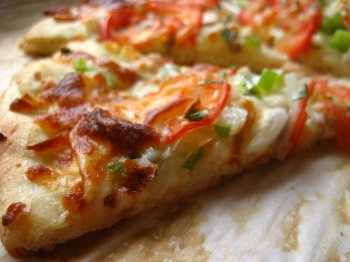
Pizza dough adapted from Americas Test Kitchen's Pizza Margherita. Topped with fresh vegetables and mozzarella cheese.
- Carbohydrate 91.6300955914404 g
- Cholesterol 0 mg
- Fat 1.11651279581772 g
- Fiber 2.67520637778129 g
- Protein 10.9135790022624 g
- Saturated Fat 0.167248510125824 g
- Serving Size 1 1 Serving (160g)
- Sodium 586.0781439894 mg
- Sugar 88.9548892136591 g
- Trans Fat 0.365422981368811 g
- Calories 430 calories
Step-by-step
- Pulse 1 3/4 cups of the AP flour, cake flour, sugar table salt and yeast in a food processor (fitted with a dough blade if possible( I used the regular blade) to combine.
- With the processor running, pour the water through the feed tube and process until a rough ball forms, about 30- 40 seconds.
- Let the dough rest for 2 minutes, then process for 30 sec. longer.
- If after 30 seconds, the dough is sticky and clings to the blade, add the remaining 1/4 flour 1 TBS at a time as needed.
- Turn the dough onto a lightly floured counter and shape it into a smooth , tight ball.
- Place the dough in a large lightly oiled bowl and cover tightly with a greased plastic wrap.
- Let it rise in a warm place until doubled in size~ 1 to 1/2 hrs.
- In the meantime, In a skillet on low saute some minced garlic in 2-3 TBS of olive oil.
- Keep the heat on low so as not to burn.
- You want a mellow garlic.
- This step was my version so you can skip it if you want.
- Adjust oven to the lower middle rack , place a baking stone on the rack and heat the oven to 500 degrees.
- Let the baking stone heat for 30 minutes( but no longer than 1 hr~so heat it about halfway through the rise time of the dough).
- Line a rimless (or inverted) baking sheet with parchment paper (this helps tremendously!).
- I used a pizza peel instead of the baking sheet.
- Turn the dough out unto a lightly floured counter, divide it into 2 equal pieces and cover with greased plastic wrap.
- Working with one piece, press and roll the dough into a 12 inch round on a lightly floured counter.
- Transfer the dough to a piece of parchment paper and reshape as needed.
- Make a indented rim around the whole pizza.
- Lightly brush the dough with the oil and garlic.
- Keep the garlic in the inner circle of the dough trying not to put any garlic on the rim of the pizza dough~ so as not to burn the garlic in the oven.
- Sprinkle some cheese, add toppings and slide the parchment and pizza onto the hot baking stone.
- Bake for 8-12 minutes total.
- Transfer pizza unto cutting board sprinkle with basil some kosher salt(this helps a great deal~ it brings out the flavors).
- Drizzle with 1 tsp olive oil.
- If you are baking both pizzas on the same day let the baking stone reheat for 5 minutes before putting the second dough.
Swapping all-purpose flour for cake flour in a pizza dough formulation alters the structural integrity of the crust by reducing the overall protein content, which yields a more tender, less chewy crumb that behaves differently under high heat. When flour meets water and yeast in a food processor, mechanical shear forces rapidly hydrate the starches and proteins while simultaneously developing gluten strands without requiring extended manual kneading. Processing the ingredients for thirty to forty seconds forms a cohesive ball, whereas incorporating warm water around 110 degrees Fahrenheit stimulates microbial activity in the instant yeast without denaturing the fungi. Resting the dough allows the gluten network to relax before rolling, which prevents the stretched disk from aggressively pulling back toward its original center.
Thermal Transfer and Stone Mechanics
Heating a baking stone at 500 degrees Fahrenheit for thirty minutes establishes a massive reservoir of thermal energy that transfers conductive heat directly to the bottom of the dough upon contact, causing water inside the structure to instantly vaporize and inflate tiny air pockets for a crisp crust. Parchment paper acts as a thermal buffer that prevents scorching while facilitating smooth transfer from a peel directly onto the scorching stone surface. Because vegetables like tomatoes and mushrooms contain high water activity, slicing them thinly and patting them completely dry prevents excess moisture from pooling on the crust and inhibiting the gelatinization of starches during the eight to twelve minute bake.
Garlic Infusion and Flavor Chemistry
Sauteing minced garlic in olive oil over low heat gently releases lipid-soluble flavor compounds into the fat without triggering the Maillard reaction or caramelization that creates bitter, acrid pyrazines when garlic burns. Distributing this infused oil strictly inside the inner circle of the dough protects the exposed outer rim from premature charring in the intense radiant environment of the oven. Finishing the baked pie with a final sprinkle of kosher salt dissolves into the surface moisture, boosting the perception of sweetness in the tomatoes through ionic enhancement while fresh basil releases volatile aromatic terpenes upon contact with the hot cheese.


