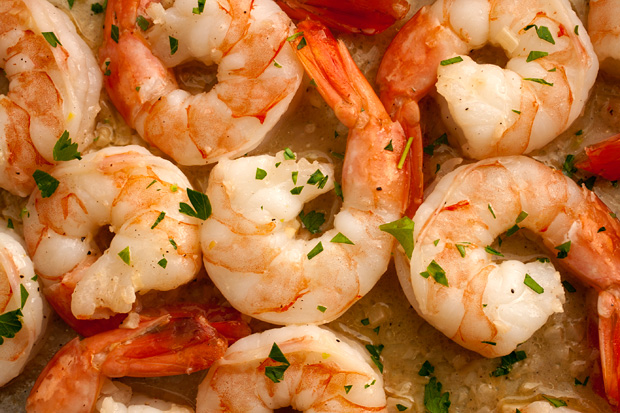
A delicious Garlic butter shrimp scampi recipe
- Carbohydrate 2.35884725742269 g
- Cholesterol 319.2851509 mg
- Fat 25.8682641708952 g
- Fiber 0.050436413894499 g
- Protein 34.9396041691423 g
- Saturated Fat 15.0715161584526 g
- Serving Size 1 1 Serving (201g)
- Sodium 414.872060147688 mg
- Sugar 2.30841084352819 g
- Trans Fat 2.42412788449711 g
- Calories 386 calories
Step-by-step
- Preparation: Finely mince 3 large (or 4 medium) cloves of garlic and set aside, the finer the mince the better. Finely chop a few sprigs of fresh parsley set aside.
- De-vein, de-shell all raw shrimp and place on a plate with a layer of paper towels underneath and pat dry the top with another paper towel to remove all excess moisture. Season shrimp with a little salt and pepper (sea salt and fresh cracked multi colored pepper corns is my favorite)
- Cooking: Add 1 quarter of a stick of butter and a splash of olive oil (about a table spoon) to a large sauté pan (you should be able to add all of the shrimp at once without having any shrimp on top another). Turn heat up high and let butter melt (its important to bring the heat up fast and high but WITHOUT reaching the olive oils smoking point) and add shrimp to pan, cook on medium high heat for 2 minutes before disturbing the shrimp to get a nice sear. Once shrimp has gone from the grayish color to mostly pink flip the shrimp and sauté the other side for 2 minutes.
- Remove shrimp and place into a dish with low sides to contain the butter garlic sauce (a small casserole dish works well). Add 3 quarters of a stick of butter and finely minced garlic to sauté pan with heat on medium (the one you cooked the shrimp in). Allow the butter to melt completely and poor over shrimp, sprinkle fresh chopped parsley and a splash of lemon juice over the shrimp and serve.
- If you are adding to pasta, Remove the tails when de-shelling, and add in a little heavy cream and fresh grated parmesian cheese during the last step (making the sauce in the pan after removing the shrimp) for a creamy garlic butter sauce, goes great with angel hair pasta or linguini.
- This recipe is also great for on top of a Ribeye.
Most home cooks make the mistake of overcrowding the sauté pan, which traps moisture and causes the shellfish to steam instead of sear. Achieving a proper exterior crust requires managing both heat and surface moisture before any fat hits the pan. Patting the raw crustaceans thoroughly dry with paper towels eliminates the liquid barrier that prevents Maillard browning. Combining olive oil with butter raises the smoke point of the dairy solids, allowing you to use high heat without burning the lipids prematurely. Spacing the items in a single layer ensures that every piece makes direct contact with the hot metal surface for precisely two minutes per side.
Controlling the Cooking Window
Crustaceans undergo a rapid protein transformation when subjected to direct thermal energy, shifting from translucent gray to opaque pink within seconds of completion. Overcooking even slightly tightens the muscle fibers, squeezing out internal moisture and resulting in a rubbery chew. Removing the shrimp immediately after this color transition preserves juiciness while the pan is utilized to build the sauce. Mincing the garlic finely ensures it releases aromatic compounds quickly into the residual fat without scorching.Tracing the Lineage
This preparation descends from traditional Italian-American adaptations of oil-and-garlic-based condiments applied to local seafood catches. Traditional interpretations rely heavily on minimal ingredients where proper execution of heat determines success. Incorporating acid like lemon juice cuts through the richness of dairy fats to balance the palate. Serving the final dish immediately prevents residual heat from continuing the cooking process on the plate.


