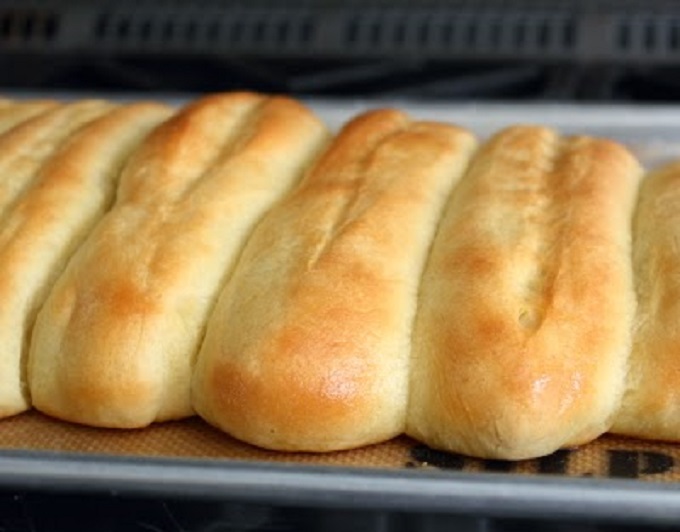
Try this Split Top Hot Dog Buns recipe, or contribute your own.
- Carbohydrate 0.0580682291680356 g
- Cholesterol 37.8761718799054 mg
- Fat 4.93689505393391 g
- Fiber 0.00276041666666667 g
- Protein 0.832613281269393 g
- Saturated Fat 2.92672770950533 g
- Serving Size 1 1 Serving (72g)
- Sodium 1347.48208600037 mg
- Sugar 0.0553078125013689 g
- Trans Fat 0.40628942721288 g
- Calories 47 calories
Step-by-step
- Add a 1/2 cup of the flour to the yeast and water and let sit for 10 mins in a stand mixer bowl.
- Add egg, melted butter, sugar and salt to bowl and whisk together. Add rest of flour and and knead on low for 5-6 minutes with dough hook attachment.
- Transfer ball to lightly floured surface and roll into a smooth ball. Put ball into cleaned mixer bowl with 1-2 teaspoons of olive oil to coat the dough. Cover with foil and place in cool oven and let rise for 2 hours.
- Remove dough from bowl and on a lightly floured surface, press the air out of the dough while shaping it into a rectangle. Cut dough into 8 equal pieces.
- Shape pieces into roughly hot dog bun shape, 5-6 inches long. Place onto silicone lined baking sheet 1/4 inch apart. With a sharp knife cut down the center of each roll about 1/8 inch deep.
- Brush buns with melted butter on all sides. Place in cool oven and let rise for 45 minutes.
- Bake for 20-25 minutes at 375 degrees.
- Brush more melted butter on top and let cool completely.
Standard side-sliced hot dog rolls often tear when loaded with heavy fillings, whereas top-sliced versions provide a sturdy, upright trough that holds ingredients securely. Baking these at home requires attention to specific variables that commercial bakeries control mechanically.
Water temperature dictates how fast the yeast activates. Keep your liquid at precisely 105 degrees Fahrenheit; anything hotter kills the microorganisms, while cold water stalls the fermentation process entirely. Mixing a half cup of all-purpose flour into the yeast and warm water creates a sponge that kickstarts starch digestion before the fats are introduced. If you substitute whole wheat flour for a portion of the all-purpose, reduce the total volume by roughly ten percent because bran absorbs liquid differently and will result in a dense crumb.
Low-speed kneading with a dough hook for five to six minutes develops the gluten matrix without overheating the motor or tearing the developing strands. When shaping the individual pieces into five-to-six-inch cylinders, press out large gas pockets so the final crumb remains uniform rather than developing random giant holes. Scoring the unbaked dough down the center approximately one-eighth of an inch deep creates the signature vertical split as the bread expands during its forty-five-minute second rise.
Placing the rolls one-quarter of an inch apart on a silicone-lined baking sheet forces them to rise upward into each other rather than spreading outward into flat ovals. Bake them at 375 degrees Fahrenheit for twenty to twenty-five minutes until the crust turns golden brown and internal moisture evaporates fully. Brushing melted butter across the exterior immediately after they emerge from the oven softens the crust, preventing the top split from hardening into a jagged edge.
Hydration and Temperature Control
Water temperature dictates how fast the yeast activates. Keep your liquid at precisely 105 degrees Fahrenheit; anything hotter kills the microorganisms, while cold water stalls the fermentation process entirely. Mixing a half cup of all-purpose flour into the yeast and warm water creates a sponge that kickstarts starch digestion before the fats are introduced. If you substitute whole wheat flour for a portion of the all-purpose, reduce the total volume by roughly ten percent because bran absorbs liquid differently and will result in a dense crumb.
Kneading and Shaping Mechanics
Low-speed kneading with a dough hook for five to six minutes develops the gluten matrix without overheating the motor or tearing the developing strands. When shaping the individual pieces into five-to-six-inch cylinders, press out large gas pockets so the final crumb remains uniform rather than developing random giant holes. Scoring the unbaked dough down the center approximately one-eighth of an inch deep creates the signature vertical split as the bread expands during its forty-five-minute second rise.
Baking and Post-Bake Handling
Placing the rolls one-quarter of an inch apart on a silicone-lined baking sheet forces them to rise upward into each other rather than spreading outward into flat ovals. Bake them at 375 degrees Fahrenheit for twenty to twenty-five minutes until the crust turns golden brown and internal moisture evaporates fully. Brushing melted butter across the exterior immediately after they emerge from the oven softens the crust, preventing the top split from hardening into a jagged edge.



