Fresh Coconut Cream Pie
The perfect coconut cream pie for any occasion with a homemade crust, rich filling, and airy whipped cream topping.
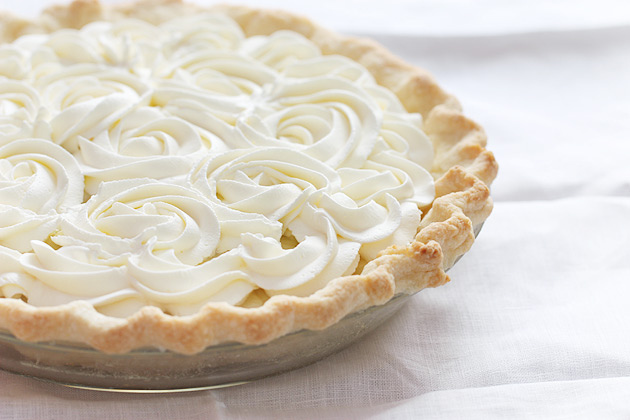
The perfect coconut cream pie for any occasion with a homemade crust, rich filling, and airy whipped cream topping.
- 1 teaspoon vanilla extract
- 3 cups milk
- 1/2 teaspoon salt
- one crust pie crust:
- 1 cup all purpose flour
- 2 tablespoons sugar
- 1 stick cold butter cut in pieces
- 2-3 tablespoons ice cold water all ice removed
- pie filling:
- 2/3 cup granulated sugar freshly grated
- 5 egg yolks
- 4 tablespoons corn starch optional
- 2/3 cup coconut
- 1 tablespoon vanilla extract
- 1/2 teaspoon coconut extract (optional)
- 1 tablespoon butter
- whipped cream:
- 3/4 cup heavy cream
- 2 tablespoons powdered sugar
- Carbohydrate 35.7710376252074 g
- Cholesterol 200.456395875389 mg
- Fat 29.4241586263426 g
- Fiber 0.420476705520006 g
- Protein 6.69826178526626 g
- Saturated Fat 18.4660878013466 g
- Serving Size 1 1 Serving (172g)
- Sodium 167.003651598204 mg
- Sugar 35.3505609196874 g
- Trans Fat 1.8404218012839 g
- Calories 430 calories
Step-by-step
- Preheat the oven to 400 degrees. In the bowl of a food processor, combine flour, sugar, and salt. Add in butter, and pulse until the mixture resembles coarse meal. Distribute the water over the mixture and pulse until the water is well-distributed and the mixture holds together like dry clay. Dump mixture onto a floured board, knead a time or two, form into a disk, and wrap in plastic wrap. Refrigerate for at least 20 minutes.
- Pound dough with a rolling pin a few times to soften the butter. On a well-floured board, roll into an 11 inch circle. Place the dough in a 9 inch pie plate. Roll up the edges and crimp with your fingers or a fork. Prick the bottom of the crust with a fork a few times. Refrigerate 20 minutes. Place a large circle of parchment paper in the center of the chilled crust, and fill with a pound of dried beans (you can reuse them for this purpose again and again). Bake for 15 minutes with the beans in. Remove from the oven, take out the beans and parchment paper, and bake again for about 10 minutes, or until the center starts to turn golden brown.
- In a medium saucepan set over medium heat, bring the milk almost to a boil. Meanwhile, whisk sugar and egg yolks in a large glass bowl until pale yellow, smooth, and falling in ribbons. Whisk in corn starch until smooth.
- Whisk in hot milk, a half a cup at a time until mixture is warm to the touch. Pour entire mixture back into the saucepan and whisk constantly until pudding starts to get very thick and bubbly.
- Pull off the heat and add in coconut, vanilla, coconut extract, if using, and butter. Pour into prepared pie shell. Refrigerate for at least 2 hours.
- Beat all ingredients together until stiff peaks form. Do not over beat.
- Place whipped cream in a large pastry bag fitted with a star tip (Wilton 1M), and decorate.
Can grated fresh coconut truly transform a custard pie, or does dried flake still hold the crown? When markets stock heavy brown husks alongside standard produce, cracking one open yields moisture and natural oils that sweetened packaged shreds lack entirely. Utilizing fresh fruit requires adjusting expectations around texture, since whole meat brings a denser bite compared to desiccated flakes. Incorporating this aromatic element transforms a standard custard into something deeply fragrant and distinct.
Mastering the Blind Crust
Achieving a flaky pastry base requires strict temperature control and proper weight distribution. Cold butter cut into pieces should be pulsed only until the mixture resembles coarse meal, ensuring pockets of fat remain intact for steam expansion during baking. Chilling the dough twice—once as a disk for twenty minutes and again inside the nine-inch pie plate—prevents shrinkage in a 400 degree oven. Lining the crimped shell with parchment paper and filling it with a full pound of dried beans creates the downward pressure needed to keep the sides upright during the initial fifteen-minute blind bake. Removing the weights and baking for an additional ten minutes develops the necessary golden color without burning the edges.Building the Stovetop Custard
Stirring milk, sugar, and egg yolks demands constant attention to avoid scorching the dairy at the bottom of the pan. Whisking the hot milk into the egg and sugar mixture a half cup at a time tempers the yolks, preventing premature curdling from thermal shock. Determining doneness happens entirely by visual cues rather than a digital probe. Watch for the pudding to get very thick and bubbly on the stovetop before pulling the saucepan off the heat. Stirring in butter, vanilla, and coconut at this final stage emulsifies the fats into the starch matrix smoothly.Whipping and Assembly
Heavy cream combined with powdered sugar requires careful monitoring during high-speed agitation to prevent separation into butter and buttermilk. Stop beating immediately when stiff peaks hold their shape firmly on the whisk attachments. Piping the airy topping through a Wilton 1M star tip adds structural height over the chilled filling. Allow the assembled dessert to set thoroughly in the refrigerator for at least two hours before slicing into wedges.


