Shabbat Breakfast Bread (Kubaneh)
This unique Yemenite bread, baked overnight in a covered dish, is perfect for Sabbath breakfast or brunch. It's baked at a low temperature, covered to steam, resulting in a delicious bread. It was a hit in my Jewish breads cooking class! Some families serve it with sugar, others with Yemenite Tomato Salsa and Hot Pepper-Garlic Chutney.
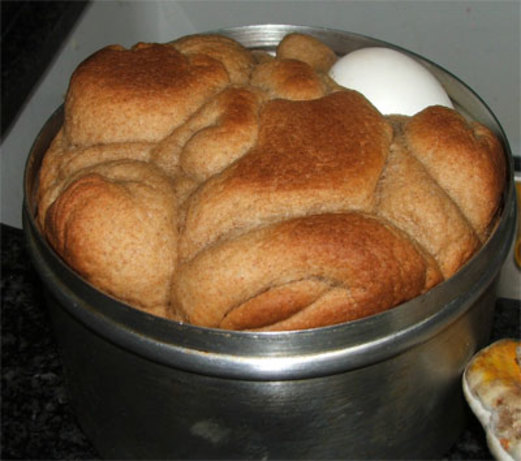
This unique Yemenite bread, baked overnight in a covered dish, is perfect for Sabbath breakfast or brunch. It's baked at a low temperature, covered to steam, resulting in a delicious bread. It was a hit in my Jewish breads cooking class! Some families serve it with sugar, others with Yemenite Tomato Salsa and Hot Pepper-Garlic Chutney.
- 1 �envelope active dry yeast
- 1/3 �cup lukewarm�water
- 6 �tablespoons sugar plus
- 1 �teaspoon sugar
- 1 1/2 �teaspoons salt
- 5 �tablespoons margarine�or butter cut into pieces
- 3/4 �cup boiling water
- 3 �cups all-purpose flour
- 1/2 �cup very soft�margarine�or butter for spreading on dough
- Carbohydrate 0.33425 g
- Cholesterol 0 mg
- Fat 0.04025 g
- Fiber 0.18375 g
- Protein 0.335125 g
- Saturated Fat 0.00520625 g
- Serving Size 1 1 Serving (2g)
- Sodium 436.465 mg
- Sugar 0.1505 g
- Trans Fat 0.01253875 g
- Calories 3 calories
Step-by-step
- Sprinkle yeast over lukewarm water and add 1 teaspoon sugar.
- Leave for 10 minutes until yeast is foamy.
- In a mixing bowl, combine remaining sugar, salt, 5 tablespoons margarine, and boiling water.
- Stir until sugar and margarine is completely dissolved.
- Stir in yeast mixture.
- Add flour and mix with a wooden spoon until dough becomes difficult to stir.
- Knead in remaining flour.
- Knead dough vigorously on a lightly floured work surface, adding flour by tablespoons if necessary, until dough is very smooth but still soft, about 10 minutes.
- Put dough in a clean, oiled bowl, cover with a damp cloth, and let rise in a warm place for 1 hour or until nearly doubled in volume.
- Punch down dough, knead it briefly in bowl, cover, and let rise again in a warm place for about 1 hour; or refrigerate for 3 to 4 hours.
- Generously rub a deep 2-quart baking dish with margarine or butter.
- Divide dough into 8 pieces.
- With a lightly oiled rolling pin, roll out one piece on a lightly oiled surface to a rectangle about 1/8 inch thick.
- Spread with about 2 teaspoons of butter or margarine.
- Roll up like a jelly roll.
- Flatten resulting roll by tapping it with your knuckles and spread it with about 1 teaspoon butter, then roll up a spiral and place it in baking dish so that spiral design faces up.
- Continue with remaining pieces of dough, placing them one next to the other and touching each other in dish.
- If any margarine or butter remains, put it in small pieces on top.
- Cover with greased paper or foil placed on surface of dough and with a tight lid.
- Preheat oven to 225 degrees.
- Bake 3 hours or until golden brown.
- Turn out onto a plate, then reverse onto another plate and put back into baking dish, so it is now upside down.
- Cover and bake another hour; or reduce oven temperature to 200 degrees and bake overnight.
- (Bread can be baked ahead and reheated in its covered baking dish for about 45 minutes in a 225 degree oven.) Serve warm.
The ingredient list fails to mention how aggressively this dough demands proper fat selection. Kubaneh relies on heavy lamination through generous amounts of butter or margarine to create its distinct pull-apart crumb. Swapping dairy butter for standard tub margarine introduces excess water content. That moisture disrupts the steam environment inside the covered pot. Doughs loaded with high-water spreads will steam into a dense, gummy mass rather than rising into distinct, tender layers. Stick to block butter or high-fat European-style margarine containing at least 80 percent fat solids.
The Science of Low-Temperature Baking
Yemenite tradition dictates an overnight bake at a very low heat. Operating an oven at 200 degrees Fahrenheit for eight hours requires precise equipment calibration. Standard residential ovens fluctuate wildly in temperature. Place an independent oven thermometer inside the cavity to verify the actual ambient heat. Too much heat will scorch the bottom spirals before the interior starches fully gelatinize. Insufficient heat yields a pale, pasty interior with raw pockets of yeast dough.
Lamination and Structural Integrity
Rolling each of the eight dough portions to an exact one-eighth-inch thickness dictates the final texture. Thicker sheets prevent the butter from soaking evenly into the crumb. Lubricating the work surface with neutral oil rather than extra flour keeps the dough pliable. Stack the rolled spirals tightly inside a heavy-gauge two-quart cast iron or ceramic baking dish. A tight vessel traps internal steam effectively, forcing the dough to expand upward while absorbing the melting fat.


