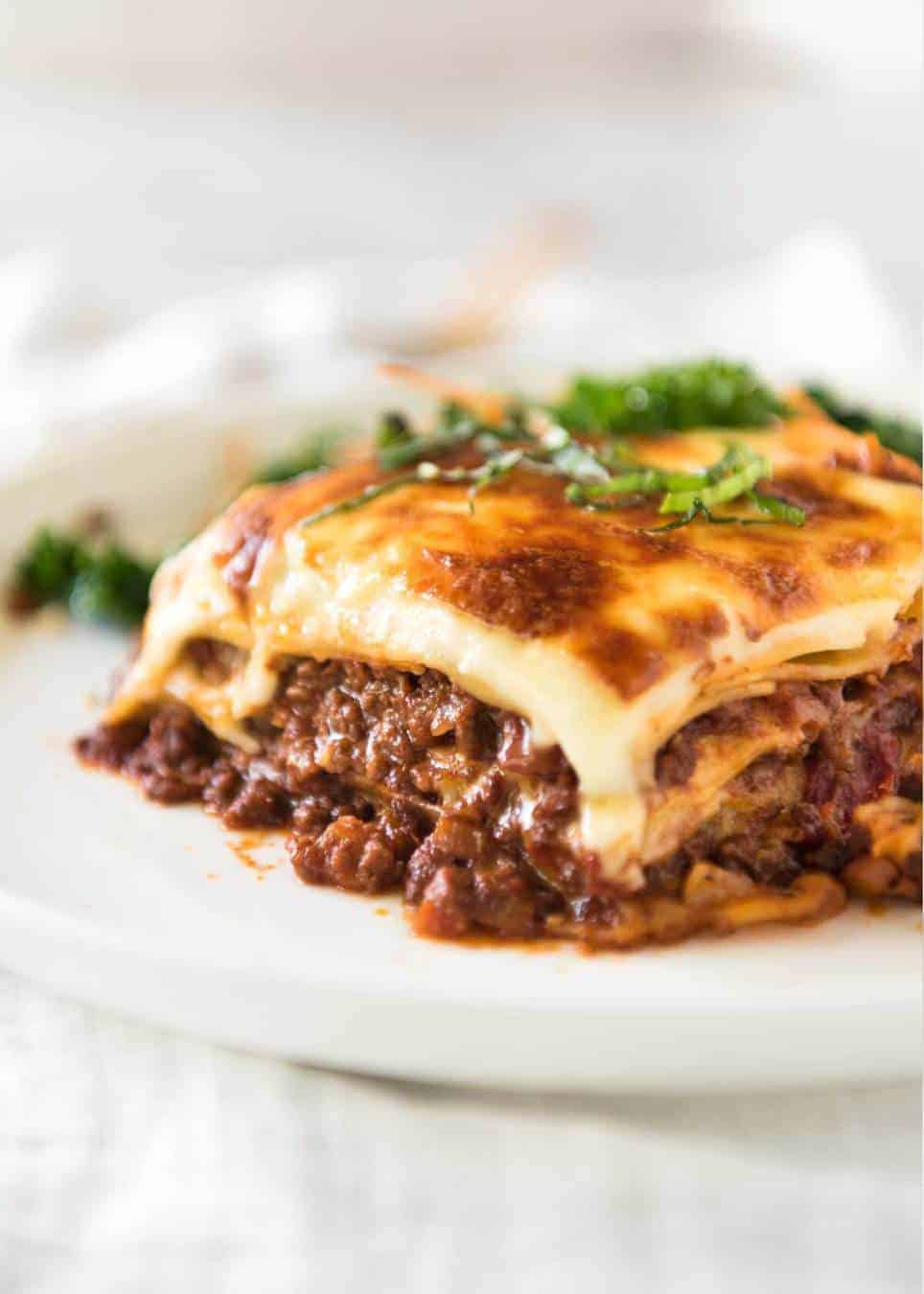
Basic lasagna. Ricotta & Meat mixture adapted from a Bobby Flay recipe.
- salt & pepper to taste
- 2 lg eggs
- 1 tbsp fresh basil chopped
- 3 tbsp olive oil
- 3 lbs ground beef
- 4 sprigs fresh thyme
- 1/4 cup fresh italian parsley chopped
- 4 tbsp olive oil
- tomato sauce prep the day before
- 3 garlic cloves coarsely chopped
- 1 celery stalk chopped into small pieces
- 5 14.5 oz cans tomatoes, diced no salt added
- 3 tbsp fresh basil
- 3 tbsp fresh italian parsley
- meat mixture
- 3 lbs italian sausage remove from casing
- 3 sprigs fresh rosemary
- 1 tbsp fresh italian parsley chopped
- ricotta mixture
- 3 cups ricotta cheese strained in a cheesecloth lined strainer for at least 4 hours
- 3 tbsp fresh basil chopped
- 1/2 cup parmigiano-reggiano freshly grated
- 2-3 boxes lasagna pasta, cooked cook one box at a time.
- 4 cups mozzarella fresh is best or sargento
- Carbohydrate 32.6221481553121 g
- Cholesterol 271.787625 mg
- Fat 47.2483897061404 g
- Fiber 2.21798873233721 g
- Protein 59.3345965674659 g
- Saturated Fat 17.96268688125 g
- Serving Size 1 1 Serving (483g)
- Sodium 1079.7603625 mg
- Sugar 30.4041594229749 g
- Trans Fat 6.51314894364035 g
- Calories 803 calories
Step-by-step
- Add olive oil to a large pot on medium heat.
- Saute garlic until it just turns brown.
- Add celery and saute for a minute or two.
- Add basil and parsley and mix.
- Place tomatoes in a blender and puree.
- Add tomato puree to pot and stir.
- Add salt and pepper to taste.
- In a large bowl, mix the ground beef and Italian sausage.
- Blend in the herbs.
- Add olive oil to a large pan.
- Saute more garlic (about 3-4 tbsp).
- Cook the meat and partially drain.
- Then add 1 cup of the tomato sauce.
- Set aside.
- Stir together the ricotta, eggs, parsley, basil, cheese and salt and pepper in a bowl.
- Cover and refrigerate for at least 1 hour to allow flavors to meld.
- Preheat the oven to 375 degrees F.
- In a 9x13 glass pan spread a thin layer of tomato sauce.
- Add one layer of pasta going the long direction.
- Add a second layer of pasta going in the opposite direction.
- Add a thin layer of tomato sauce.
- Spread 1/2 of the ricotta mix on top.
- Spread 1/3 of the meat mixture.
- Sprinkle 1 cup of mozzarella on top.
- Add 2 more layers of pasta, like before.
- Repeat for second layer.
- Place remaining meat on top.
- Pour 1/3 remaining sauce on top.
- Add the rest of the cheese on top.
- Cover in foil and place in oven for 20 minutes.
- Lower the temp to 350 and cook for another 25-35 minutes.
- The filling should be bubbly.
- Remove from oven and let it sit for about 10 minutes.
- Cut into squares.
- Serve with tomato sauce and freshly grated Parmigiano-Reggiano.
Straining the ricotta for at least four hours before mixing removes excess whey that would otherwise make the baked layers watery. Plan this drainage window well ahead of assembly so the dairy achieves a dense, spreadable consistency that holds its shape under heat. Weighing down the cheesecloth with a small plate speeds moisture extraction without forcing solids through the mesh.
Preparing the tomato sauce the day before allows the pureed canned tomatoes and aromatics to thicken naturally while concentrating the savory profile. Letting this base cool completely before assembly prevents premature cooking of the raw eggs incorporated into the ricotta layer. Large batch sizes demand heavy-bottomed pots that distribute heat evenly and prevent scorching at the base.
Allowing the baked pan to rest for ten minutes off the heat lets the melted mozzarella and proteins set properly before slicing into individual portions. This stabilization period prevents the square portions from collapsing when transferred to plates. Leftovers maintain optimal quality when stored in airtight containers within the refrigerator for up to four days.
Reheating single squares in a 350 degree oven revives the crisp edges and melts the cheese without drying out the ground beef and Italian sausage filling. Covering the portion loosely with foil for the first fifteen minutes traps steam to warm the center before uncovering to re-crisp the top layer. Microwave reheating remains an option for speed, though dry heat preserves the textural contrast between the pasta sheets and the meat filling much better.


