Salmorejo - Spanish Chilled Tomato Soup
It was in Madrid in March where I first met salmorejo, gazpachos richer, deeper cousin. The cool, creamy tomato soup transcended seasonality. It was topped with egg and jamon iberico, which wept fatty tears over its surface. Salmorejo demands that you act as a Spaniard and mop up every drop with bread. Then, like an American, you order another.
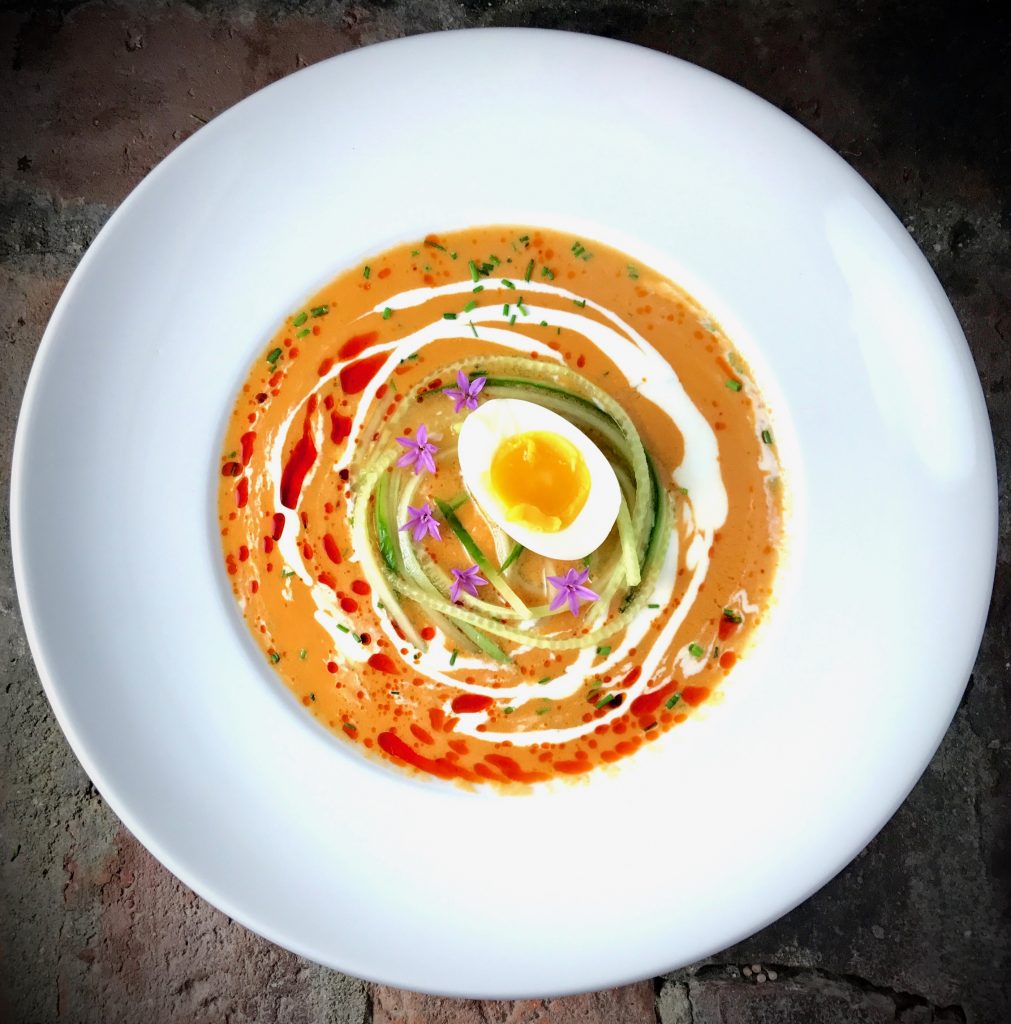
It was in Madrid in March where I first met salmorejo, gazpachos richer, deeper cousin. The cool, creamy tomato soup transcended seasonality. It was topped with egg and jamon iberico, which wept fatty tears over its surface. Salmorejo demands that you act as a Spaniard and mop up every drop with bread. Then, like an American, you order another.
- 1 clove garlic crushed
- freshly ground black pepper to taste
- 3 tbsp. kosher salt plus more to taste
- 8 plum tomatoes cored, halved, and seeded
- 1 baguette cut into large pieces
- 1/2 small yellow onion
- 1 cup extra-virgin olive oil plus more for drizzling
- 2 tbsp. sherry vinegar
- 3 hard-boiled eggs chopped
- 1 1/2 cups iberian ham or prosciutto, finely chopped
- Carbohydrate 41.77655125 g
- Cholesterol 79.5 mg
- Fat 30.4144825776032 g
- Fiber 3.10281262117624 g
- Protein 11.05039375 g
- Saturated Fat 4.69575876071545 g
- Serving Size 1 1 Serving (245g)
- Sodium 3062.39175000155 mg
- Sugar 38.6737386288238 g
- Trans Fat 1.27929625210149 g
- Calories 478 calories
Step-by-step
- Place salt, tomatoes, garlic, bread, and onion in a bowl, cover with boiling water, and let sit for 1 hour.
- Drain vegetables, reserving 1 cup soaking liquid; place in blender.
- Squeeze water from bread; place in blender with reserved soaking liquid, oil, and vinegar.
- Purée until smooth; season with salt and pepper, and chill.
- Pour into serving bowls; top with eggs, ham, and a drizzle of oil.
The Blending Mechanism and Texture Control
Steeping the bread, tomatoes, garlic, onion, and salt in boiling water for one hour hydrates the starches while drawing out excess raw astringency from the alliums. Squeezing the water completely out of the bread before blending is critical because introducing uncontrolled moisture prevents the extra-virgin olive oil from forming a stable, glossy emulsion. When high-speed blade friction forces the oil into the soaked crumb and tomato solids, tiny fat droplets disperse uniformly to create a velvety mouthfeel that low-powered blenders simply cannot achieve. If the motor on your machine struggles to reach 20,000 RPM, strain the purée through a fine-mesh sieve to eliminate microscopic fibrous grit.
Equipment Selection and Particle Size
Standard household food processors rely on S-blades that chop rather than shear, resulting in a gritty, granular soup instead of the characteristic silky suspension demanded by this Andalusian classic. A powerful standing blender equipped with a deep vortex jar generates the mechanical force required to thoroughly shatter the tomato skins and integrate the fat. Emulsions rely on precise particle reduction down to the micron level, meaning that running the blender for a full ninety seconds ensures the olive oil remains locked within the bread and tomato matrix rather than separating out into an oily slick during chilling. Storing the finished soup in an airtight glass container for at least four hours allows the starches to fully retrogradely set, locking in the dense texture before garnishing with chopped hard-boiled eggs and cured ham.



