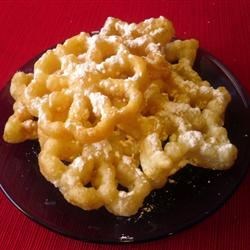
Trying this Rosettes recipe will not disappoint. So give it a try.
- Carbohydrate 17.9038107225279 g
- Cholesterol 1.12666666734295 mg
- Fat 1.02190069466424 g
- Fiber 0.201747225782606 g
- Protein 1.29936816688443 g
- Saturated Fat 0.252385500899737 g
- Serving Size 1 1 Serving (36g)
- Sodium 12.0491777804829 mg
- Sugar 17.7020634967453 g
- Trans Fat 0.0653784924291744 g
- Calories 86 calories
Step-by-step
- Combine eggs, sugar and salt; beat well. Add remaining ingredients and beat until smooth.
- Heat a rosette iron in deep, hot oil (375 degrees) for 2 minutes.
- Drain excess oil from iron. Dip in batter to 1/4 inch from the top of the iron, then dip iron immediately into hot oil (375 degrees).
- Fry rosette until golden, about 30 seconds. Lift out; tip upside down to drain. With fork, push rosette off iron onto a rack placed over paper towels.
- Reheat iron 1 minute; make next rosette.
- Sprinkle rosettes with confectioners' sugar.
Deep frying delicate pastry requires strict temperature control, specifically maintaining the oil at 375 degrees Fahrenheit so the batter sets instantly upon contact without absorbing excess grease. Achieving that signature lacy structure relies entirely on a cast metal iron that must be preheated directly in the hot oil for two full minutes before its initial dip into the batter. If the iron is insufficiently heated, the batter will slide right off the metal into the fryer instead of adhering to form the traditional shape.
- Monitor the oil temperature constantly with a deep-fry thermometer, because dropping below 375 degrees will result in soggy, oil-logged pastries while exceeding 400 degrees will burn the exterior before the interior cooks.
- Control the depth of the immersion carefully by dipping the hot iron only up to a quarter inch from the top edge, ensuring the batter never flows over the crown of the form or the cooked pastry will become impossible to release.
- Maintain consistency by reheating the iron in the hot oil for one minute between each individual pastry generation.
Serve these fragile, airy confections alongside rich, dark beverages like espresso or spiced hot chocolate, which cut through the light sweetness of the powdered sugar topping. While traditional wheat flour provides the necessary gluten structure for adherence to the iron, alternative starches can be tested cautiously, though results may vary widely due to the lack of structural protein.


