Garlic and Sesame Crackers
I ended up using a half cup of pecan meal in this recipe because nut meal adds to the taste and texture of gluten-free crackers. If pecans are a problem for you, almond meal will work. Or use a quarter cup of seeds, if you prefer note that adding seeds into the dough may make the crackers less crisp.
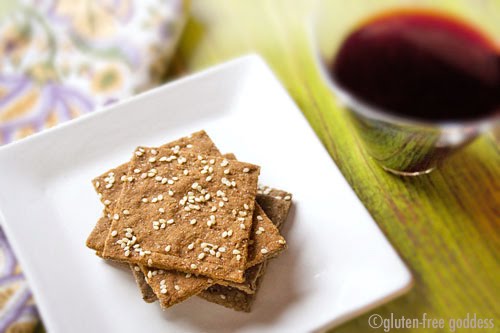
I ended up using a half cup of pecan meal in this recipe because nut meal adds to the taste and texture of gluten-free crackers. If pecans are a problem for you, almond meal will work. Or use a quarter cup of seeds, if you prefer note that adding seeds into the dough may make the crackers less crisp.
- 1 teaspoon baking soda
- 1 teaspoon garlic powder
- 1 teaspoon sea salt
- 1 teaspoon dried minced onion
- whisk together the dry ingredients:
- 1/2 cup sorghum flour
- 1/2 cup buckwheat flour
- 1/2 cup millet flour
- 1/2 cup pecan or almond meal
- 1/4 cup quinoa flour or brown rice flour
- 1 tablespoon potato starch
- 2 teaspoons cocoa powder
- 1 teaspoon dried thyme or dried crushed rosemary
- 1 teaspoon
- xanthan gum
- stir in:
- 1/4 cup good olive oil
- ener-g egg replacer for 1 egg whisked with warm water
- 1/3 to 1/2 cup warm water to start
- 1 tablespoon honey raw agave or molasses
- Carbohydrate 5.4205101917269 g
- Cholesterol 0 mg
- Fat 1.74938014766244 g
- Fiber 0.609124532745623 g
- Protein 0.788675247006498 g
- Saturated Fat 0.263160211764428 g
- Serving Size 1 1 cracker (9g)
- Sodium 86.6086863015072 mg
- Sugar 4.81138565898127 g
- Trans Fat 0.0765057407406385 g
- Calories 40 calories
Step-by-step
- Stir the ingredients until a stiff dough forms- you'll need to press the dough out into a thin layer, so if it appears too dry, or it falls apart easily, add one tablespoon of warm water and mix; repeat until the dough is malleable but not too wet.
- Divide the dough in half.
- Preheat the oven to 375 degrees F. Line two baking sheets with parchment or a reusable Exopat.
- Using oiled hands flatten and spread half the dough on the prepared baking sheet. Make as thin a layer as possible. Use the edge of a rubber spatula to straighten outside edges, if you like.
- Score the flattened dough into cracker sized pieces. I used a pizza cutter to do this.
- To bake you'll need: Sea salt Sesame seeds (or flax seeds, or hemp seeds)
- Sprinkle the scored dough with salt and sesame seeds.
- Bake in the center of a preheated oven for 15 to 20 minutes till firm and slightly crisp (they will crisp up more as they cool). I use an Exopat, so keep that in mind; they may cook faster without one. Keep an eye on them.
- Remove and allow the crackers to cool on a rack.
- We bag and freeze the cooled crackers. If you find they soften from humidity, reheat them on a baking sheet for a few minutes before serving.
- Makes 36 crackers.
Swapping pecan meal for almond meal in gluten-free cracker dough alters more than just flavor; nut fats dictate structural integrity, meaning higher-oil meals require careful water management so the dough remains malleable without turning sticky. Bakers frequently ruin cracker dough by rolling it unevenly, which causes thin edges to burn while thick center pieces remain chewy. Achieving a uniform thickness requires pressing the dough directly onto parchment paper with oiled hands, then smoothing the surface with a rubber spatula before scoring. A pizza cutter provides clean lines for distinct pieces, allowing steam to escape properly during the bake. Watch the oven closely around the fifteen-minute mark, pulling the sheets when the crackers feel firm and show a slight color change. Because these baked goods lack commercial preservatives, they absorb ambient kitchen humidity rapidly and lose their snap on the counter. Store cooled batches in airtight freezer bags immediately, then revive softened crackers by placing them on a baking sheet in a warm oven for three minutes before serving.



