Tin Roof Cheesecake
If you haven't heard before, 'tin roof' refers to the combination of chocolate and peanuts. It's a match made in heaven. This chocolate cheesecake has a chocolate wafer and ground peanut crust and is topped with an artful display of chocolate-covered peanuts. Feel free to use store-bought chocolate-covered peanuts, but I also gave a quick recipe for homemade.
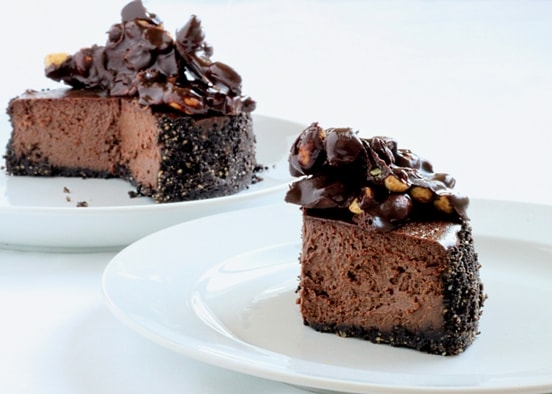
If you haven't heard before, 'tin roof' refers to the combination of chocolate and peanuts. It's a match made in heaven. This chocolate cheesecake has a chocolate wafer and ground peanut crust and is topped with an artful display of chocolate-covered peanuts. Feel free to use store-bought chocolate-covered peanuts, but I also gave a quick recipe for homemade.
- 1 large egg
- 1/2 teaspoon sugar
- 1 tablespoon butter
- pinch salt
- 2 teaspoon cocoa powder
- for the crust:
- 3 tablespoon sugar
- 1 3/4 ounce chocolate wafers (~7 cookies)
- 2 tablespoon unsalted roasted peanuts halved
- 1 1/2 tablespoon unsalted butter melted
- for the cheesecake:
- 5 ounce cream cheese softened
- 1 ounce bittersweet chocolate melted
- 1/3 teaspoon vanilla
- for the chocolate covered peanuts:
- 2 ounce bittersweet chocolate
- 1 tablespoon honey (or corn syrup)
- 1/4 cup unsalted roasted peanuts halved
- Carbohydrate 83.3511337577738 g
- Cholesterol 222.356367685791 mg
- Fat 78.6510810529969 g
- Fiber 7.06480492724797 g
- Protein 21.5000622195377 g
- Saturated Fat 35.2771751850363 g
- Serving Size 1 1 Serving (252g)
- Sodium 502.452398940534 mg
- Sugar 76.2863288305259 g
- Trans Fat 6.72368462031276 g
- Calories 1072 calories
Step-by-step
- Preheat the oven to 350° and grease a small 5†spring form pan.
- In a food processor, make the crust by grinding together the chocolate wafers, peanuts, sugar, salt and melted butter. Pour the mixture into the spring form pan, and pack it down and up the sides of the pan. Pack very well using a shot glass or small glass.
- Bake the crust on a baking sheet for 8 or 9 minutes. When done, remove from oven and turn the oven down to 300°.
- Meanwhile, beat together all cheesecake ingredients. Beat until very well combined, but don’t over do it—you’ll put too much air in the batter and cause cracks in your final product.
- Pour the mixture into the crust and bake for 36-38 minutes, until the center is slightly jiggly but not wet when you touch it.
- Leave the cheesecake in the oven, but turn the oven off and prop the door open with a wooden spoon. Let sit for 30 minutes.
- After 30 minutes, move the cheesecake to a wire rack to cool another 30 minutes.
- Finally, run a knife around the edge of the pan, and then cover with plastic wrap before moving it to the refrigerator. All of these steps ensure that your cheesecake will not crack or deflate.
- Let the cheesecake chill for a minimum of 4 hours.
- Meanwhile, make the chocolate covered peanuts: have ready a sheet pan lined with wax paper or a silicone mat.
- Combine all ingredients except peanuts in a double boiler and melt over low heat (you can also use your microwave on 20-second pulses). Once chocolate is melted and shiny, stir in the peanuts. Immediately pour this mixture onto the awaiting sheet pan and let cool until set in the fridge (~10 minutes).
- When ready to serve the cheesecake, unmold it carefully from the spring form pan, move it to a plate and decorate with large chunks of the chocolate covered peanuts.
The Chemistry of Crust and Cracks
Swapping the standard graham cracker base for crushed chocolate wafers and roasted peanuts alters the fat distribution and structural integrity of the crust, demanding a heavy-handed pack using a flat-bottomed glass to prevent crumbling during slicing. Cream cheese batters require minimal aeration to avoid structural failure; incorporating too much air during the mixing phase creates trapped pockets of gas that inevitably expand in the oven and cause the surface to split open. Minimizing mechanical mixing protects the emulsion of dairy fats and melted bittersweet chocolate, resulting in a dense, velvety mouthfeel that contrasts sharply with the crunchy topping.Reading the Center
Judging doneness without a thermometer relies entirely on kinetic observation rather than thermal probing. Bakers must watch for a very specific oscillation where the perimeter remains firm and set while the dead center retains a gentle, gelatinous jiggle—resembling set gelatin rather than liquid batter. Pulling the springform pan out too early yields a soupy interior that refuses to slice cleanly, whereas leaving it in until the middle becomes completely rigid overbakes the dairy proteins and introduces a chalky texture. Gradual cooling inside a powered-down oven with the door propped open by a wooden spoon prevents the rapid thermal shock that tears cooling custard apart.The Sugar-Fat Balance
Making homemade chocolate-covered peanuts requires precise handling of melted bittersweet chocolate combined with honey or corn syrup, which acts as an invert sugar to prevent crystallization and graininess. Melting this mixture slowly over low heat in a double boiler—or using gentle 20-second microwave pulses to avoid scorching the cocoa solids—ensures a glossy coating that snaps cleanly when bitten. Spreading the coated legumes onto a silicone mat and chilling them for ten minutes yields crisp garnishes that hold their structural shape when mounted atop the chilled dairy base.


