Mediterranean Phyllo Pizza
I found roasted red and orange peppers at Trader Joe's. Along with yellow cherry tomatoes this looked as good as it tastes!
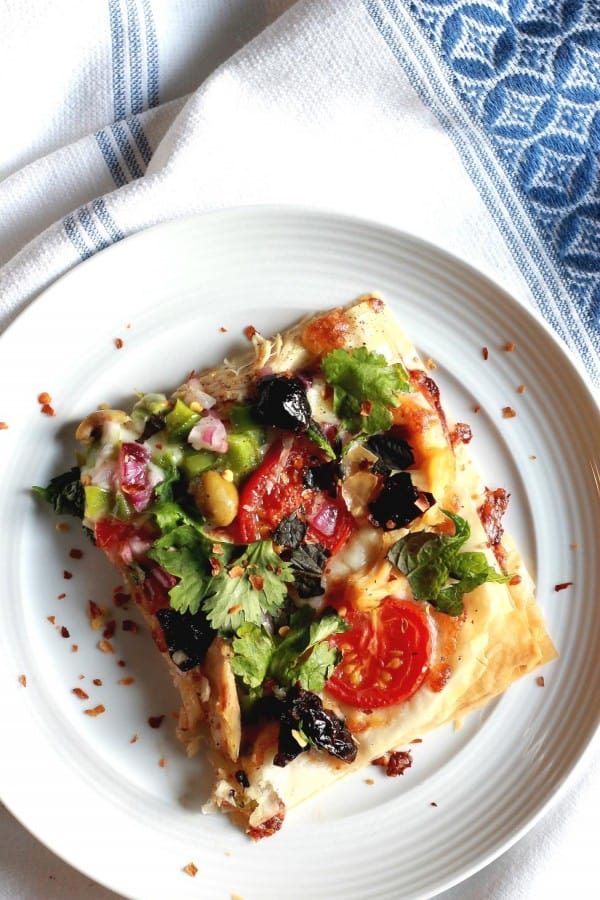
I found roasted red and orange peppers at Trader Joe's. Along with yellow cherry tomatoes this looked as good as it tastes!
- salt and pepper to taste
- 1 teaspoon oregano
- 1/2 cup parmesan grated
- 4 scallions sliced thinly
- 3 teaspoons extra virgin olive oil
- -- stir together --
- 3 tbs unsalted butter melted
- -- combine in a bowl --
- 3/4 cup mozzarella shredded
- 3/4 cup feta cheese finely crumbled
- -- prepare --
- 20 sheets phyllo dough thawed
- 2 cups cherry tomatoes halved (yello, orange or red)
- 1/4 cup roasted peppers chopped (yellow, orange, or red)
- Carbohydrate 6.204772906947 g
- Cholesterol 14.3574583333333 mg
- Fat 5.33154491085568 g
- Fiber 0.405238132867951 g
- Protein 4.04047361085533 g
- Saturated Fat 2.91320307200587 g
- Serving Size 1 1 Serving (41g)
- Sodium 182.076452271314 mg
- Sugar 5.79953477407905 g
- Trans Fat 0.316533318934088 g
- Calories 89 calories
Step-by-step
- Preheat oven to 400?
- Position first sheet of phylo on the center of oiled baking sheet (9X13).
- Brush phyllo very lightly with butter-oil mix. Layer and brush two sheets, then sprinkle with 2T cheese mix. Repeat with 3 more layers, brushing each with butter-oil mix and sprinkling the third layer with cheese. Continue until you''ve used all the sheets.
- Brush the top sheet with the butter-oil mix and sprinkle with half of the remaining cheese. Add the scallions, roasted peppers and tomatoes and season with salt; sprinkle the remaining cheese over the top. Bake until cheese is melted and the phyllo is golden and crisp on the edges. 20-25 iminutes.
Phyllo dough demands precision because paper-thin sheets dry out instantly upon exposure to air. Keep the unused stack covered with a damp kitchen towel while assembling the layers. Brushing every single sheet with fat creates the steam barriers required for flaky separation. Skipping layers yields a dense, cardboard-like crust instead of a shatteringly crisp base. Butter provides rich flavor, but blending it with extra-virgin olive oil lowers the burning point slightly while keeping the liquid fat easy to brush across delicate pastry. Moisture management dictates the success of vegetable toppings on delicate pastry. Halved cherry tomatoes release significant water during baking at 400 degrees Fahrenheit. Salt them in a colander for fifteen minutes before assembly to draw out excess liquid, preventing soggy patches on the crust. Roasted peppers add concentrated sweetness without adding free water, making them an ideal swap for fresh capsicum. Feta and mozzarella bring contrasting qualities. Mozzarella melts into a stretchy binder, while aged feta contributes sharp salinity that cuts through the rich butter. Scallions provide a mild, clean onion bite that survives high heat better than raw white onions. Leftovers lose their crisp texture rapidly due to ambient humidity absorbing into the baked pastry layers. Reheat chilled slices on a wire rack inside a 350-degree oven for five minutes to restore structural rigidity. Microwave heating should be avoided entirely because steam ruins the flaky lamination.



