Greek Aromatic Lamb
Oh what a beautiful dish, almost identical to the one Maureen and I used to have at the Bakery Restaurant on the Greek island of Spetses. We tried it at Wilton Lodge for a dinner party which was a triumph, so much so that in the winter of 1992 at Norwood West it was a great favourite.
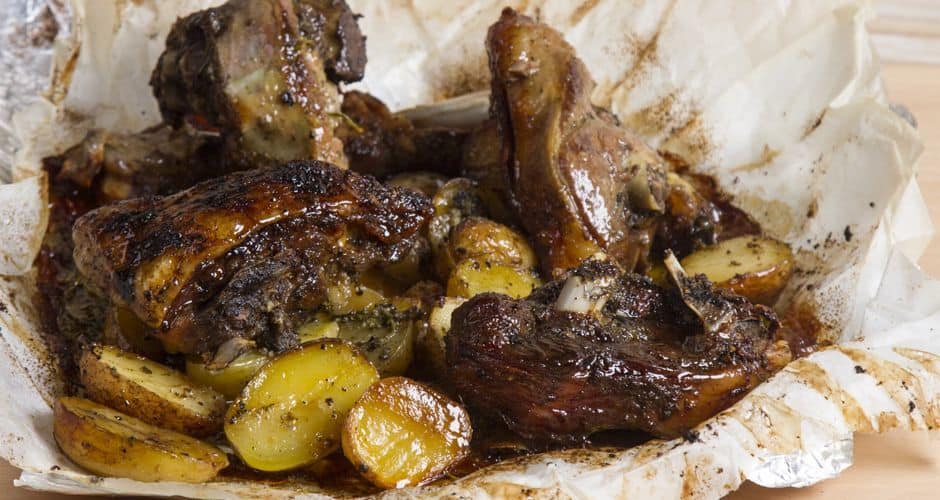
Oh what a beautiful dish, almost identical to the one Maureen and I used to have at the Bakery Restaurant on the Greek island of Spetses. We tried it at Wilton Lodge for a dinner party which was a triumph, so much so that in the winter of 1992 at Norwood West it was a great favourite.
- Carbohydrate 32.682251178465 g
- Cholesterol 216.83786866625 mg
- Fat 40.7666220466025 g
- Fiber 4.86032347301615 g
- Protein 62.8386053928375 g
- Saturated Fat 16.114446881502 g
- Serving Size 1 1 Serving (422g)
- Sodium 197.715032014 mg
- Sugar 27.8219277054489 g
- Trans Fat 3.3353544804045 g
- Calories 755 calories
Step-by-step
- Put the leg of lamb into a large roasting pan. Bruise the leaves of the sprigs of rosemary, thyme and oregano and sprinkle them over the meat, add plenty of pepper and 1 tablespoon of honey.
- Rub the mixture into the meat with your hands then rub half a lemon over the joint, squeezing the juice on to the meat as you do so. Do not add any salt. Leave to marinate for 4 to 24 hours.
- Peel and quarter the potatoes, then arrange them in a single layer round the lamb.
- Squeeze lemon juice over the potatoes, use at least half a lemon, or up to one and a half lemons for a strong lemony flavour.
- Carefully pour ? pint of water into a corner of the roasting pan, then sprinkle over the potatoes and lamb about 2 tablespoons chopped fresh rosemary, at least 1 teaspoon each fresh chopped thyme and oregano, and some salt and pepper.
- Drizzle on 1 to 1 ? teaspoons of honey and 1 tablespoon of olive oil, then dot with 1 oz of butter.
- Bake at 425 F (220 C) gas mark 6 for a further 1 to 1 to 1 ? hours
- The ingredients will become golden and will caramelize to a rich brown in places.
- Lift the meat and turn the potatoes occasionally, and if necessary, add a little boiling water to the pan to prevent drying out.
Allowing the lamb to marinate for the full twenty-four hours changes the exterior surface chemistry, enabling the honey and citrus juice to interact with surface proteins before heat is ever applied. Skipping this rest period results in a steamed exterior rather than a deep, savory crust because excess moisture remains trapped on the outer layers of the meat. Massaging the aromatics directly into the muscle fibers breaks down essential oil cell walls in the rosemary, thyme, and oregano, releasing volatile compounds that penetrate deeper into the protein matrix during the resting window.
High roasting temperatures set at 425 degrees Fahrenheit are mandatory for rendering the intramuscular fat and achieving the necessary Maillard browning without overcooking the interior of a four-pound leg. Potatoes arranged around the base of the roasting pan absorb this rendered lamb fat alongside the circulating citrus juices, creating a dual texture of crisp exterior edges and creamy interiors. Turning these potatoes every thirty minutes ensures even heat conduction from the pan surface, preventing localized burning where sugars from the honey caramelize.
Substituting dried herbs for fresh requires a strict mathematical reduction of two to one because dehydrated leaves concentrate volatile oils and impart a bitter, dusty profile when subjected to prolonged high heat. Granulated sugar cannot replace honey in this application because honey contains invert sugars that brown and caramelize at significantly lower temperatures, contributing directly to the sticky lacquer on the meat. Butter combined with olive oil provides both the high smoke point needed for roasting and the dairy solids required for deep golden color development.
Maintaining adequate moisture in the roasting pan requires adding boiling water rather than cold liquid to prevent the pan temperature from dropping and halting the rendering process. Tenting the roast loosely with foil during the final twenty minutes traps steam if the exterior darkens too quickly before the center reaches the desired internal doneness. Resting the carved meat for fifteen minutes off the heat allows internal juices to redistribute evenly through the muscle fibers rather than pooling uselessly on the carving board.



