Black Bean Soup (Coach House)
Best Black Bean soup ever from the now closed Coach House Restaurant in Greenwich Village New York
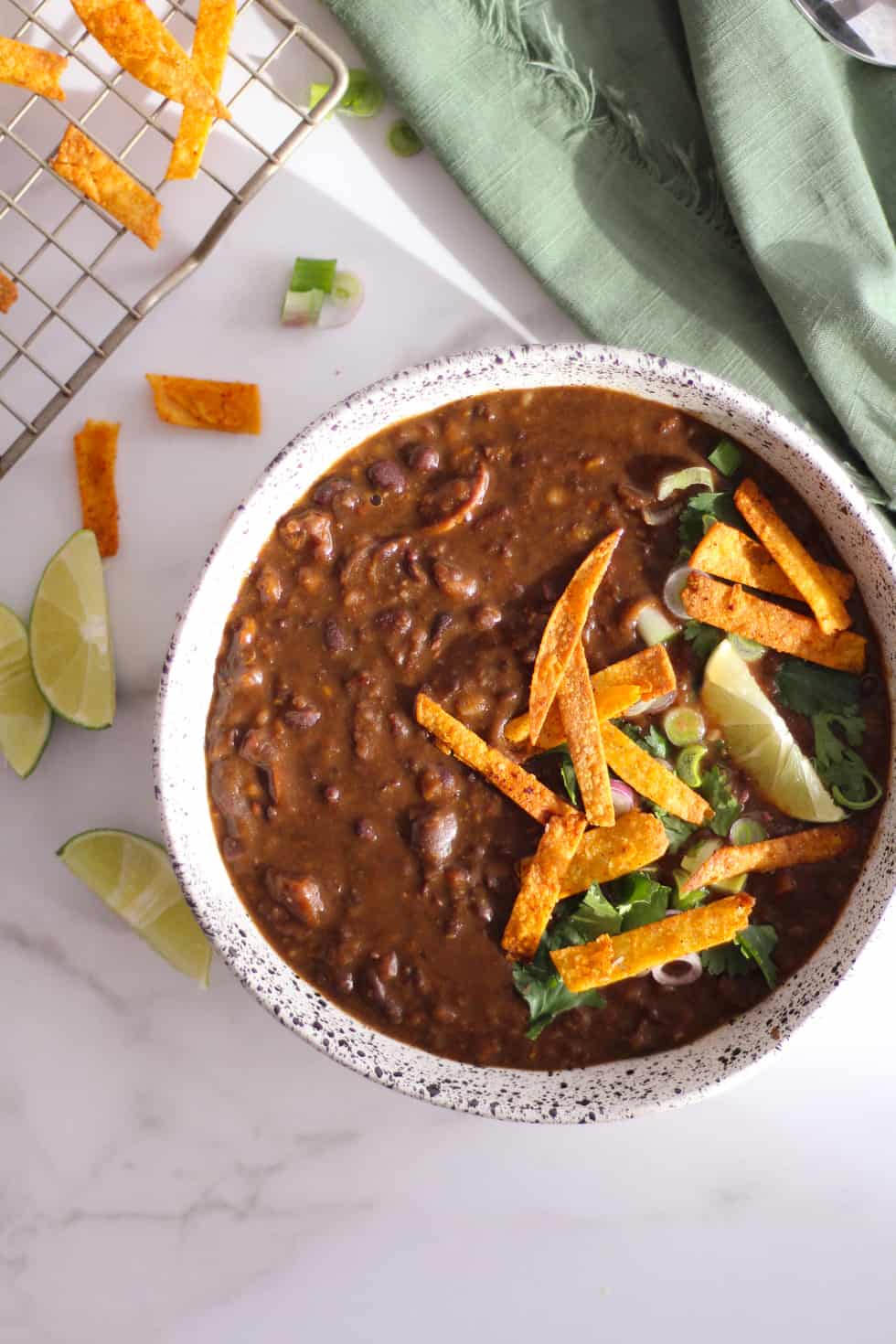
Best Black Bean soup ever from the now closed Coach House Restaurant in Greenwich Village New York
- salt to taste
- 1/4 cup olive oil
- 1/4 teaspoon cayenne or more to taste
- 1 pound dried black beans
- 1/4 pound raw cured ham cut into i/2 inch cubes
- 4 cups onion chopped (finely)
- 1/3 cup garlic minced (finely)
- 14 cup beef broth (low fat, low sodium)
- pepper freshly ground to taste
- 2 tablespoon wine vinegar
- 1/4 cup sherry dry
- ham finely chopped for garnish
- lime thin slices for garnish
- onion chopped, for garnish
- 1 cup rice cooked
- Carbohydrate 43.5735945833333 g
- Cholesterol 6.53333333333333 mg
- Fat 3.26231708333333 g
- Fiber 7.33017494265239 g
- Protein 15.8106470833333 g
- Saturated Fat 0.912476 g
- Serving Size 1 1 Serving (414g)
- Sodium 1170.91958333333 mg
- Sugar 36.243419640681 g
- Trans Fat 0.288554416666666 g
- Calories 270 calories
Step-by-step
- Rinse beans well and pick over them to remove any foreign particles. Place beans in mixing bowl, add cold water to cover to a depth of four inches above the beans. Let stand overnight.
- Heat oil in a soup kettle. Add the salt pork, cubbed ham, four cups shopped onions and garlic. Cook stirring, about 5 minutes until onions are translucent and salt pork rendered of its fat.
- Drain beans well and add them to the kettle. Add broth and bring to the boil. Add salt, black pepper, and cayenne pepper.. Partly cover and cook stirring ocassionally, about 4 hours.
- Put half the soup with the beans through a food mill or sieve or use a blender.. Return to the kettle and stir, to blend with the remaining soup and beans. Add vinegar and dry sherry. Serve pipping hot with chopped onion, lime slices, chopped ham and rice.
Dried black beans require precise water ratios that standard ingredient measurements often obscure. While the recipe calls for soaking a single pound of beans in four inches of water overnight, multiplying this quantity for a larger crowd demands caution. Doubling the beans does not strictly require doubling the soaking vessel dimensions, but failing to provide adequate room prevents uniform hydration. Beans absorb roughly twice their dry volume in water during a twelve-hour soak, meaning cramped quarters yield unevenly softened centers that resist breaking down during the four-hour simmer.
Adjusting yields downward requires careful monitoring of the liquid reduction rate during long cooking times. When scaling the recipe in half, reduce the initial volume of beef broth proportionally, yet keep a close eye on evaporation around the three-hour mark. Smaller batches concentrate salinity much faster than large pots, risking an over-seasoned final product before the starches have fully thickened the broth. Taste the simmering liquid frequently once the beans turn tender, adding pinches of salt only after the ham has released its inherent sodium into the pot.
Achieving the characteristic velvety consistency relies entirely on mechanical separation rather than chemical thickeners. Passing precisely half of the cooked bean mixture through a food mill or blender creates a dual-texture profile where whole legumes float suspended in a thick, opaque purée. Ensure the equipment processes the hot mixture thoroughly to rupture the bean skins, releasing internal starches that bind the remaining broth without flour or starch additions.
Serving this soup alongside steamed white rice provides a classic textural contrast that absorbs the spiced, vinegar-brightened liquid. Dry sherry and wine vinegar added at the very end of cooking introduce acidity that cuts through the rich pork fat, but add them off direct heat to preserve their volatile aromatics.



