Roast Carrot & Avocado Salad with Orange & Lemon Dressing
If you're going to use cooked carrots in a salad you've got to make it with some attitude! This fantastic Moroccan-style salad combines roast carrots with avocados – and because they have the same texture in your mouth, I thought I'd add the chargrilled flavour and crunch of toasted ciabatta to round things off. With spices, seeds, yoghurt and a delicious citrus dressing, you've got a winner.
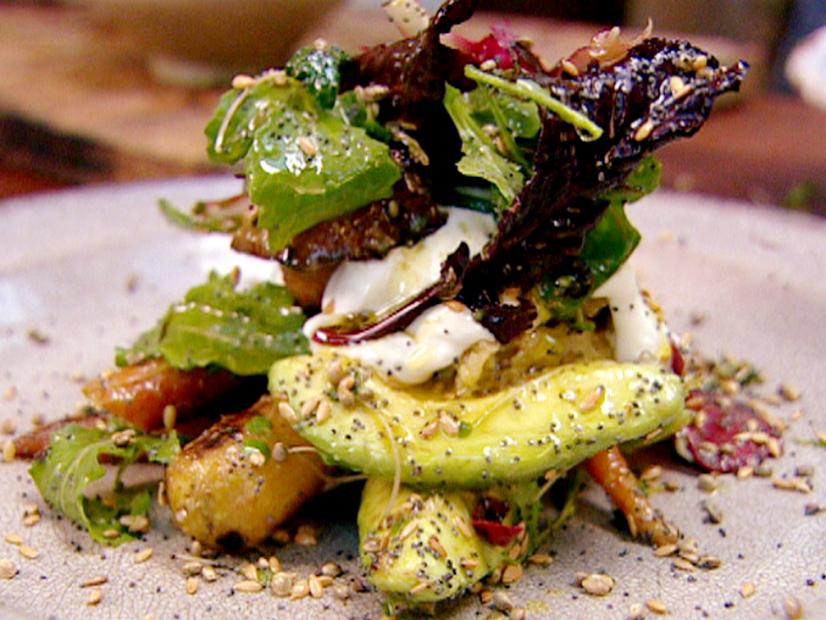
If you're going to use cooked carrots in a salad you've got to make it with some attitude! This fantastic Moroccan-style salad combines roast carrots with avocados – and because they have the same texture in your mouth, I thought I'd add the chargrilled flavour and crunch of toasted ciabatta to round things off. With spices, seeds, yoghurt and a delicious citrus dressing, you've got a winner.
- extra virgin olive oil
- 2 cloves garlic peeled
- 3 avocados
- 500 grams carrots, with leafy tops
- 2 level teaspoons cumin seeds
- dried chiles 1-2
- sea salt, pepper
- 4 sprigs fresh thyme leaves picked
- red or white wine vinegar
- 1 orange halved
- 4 slices ciabatta or good bread
- 2 handfuls mixed salad leaves: rocket, radicchio washed and spun dry
- 2 punnets cress
- 150 ml fat free natural yoghurt
- 4 tablespoons mixed seeds toasted
- Carbohydrate 18.0970563653691 g
- Cholesterol 0 mg
- Fat 25.5837112165162 g
- Fiber 11.1840515480013 g
- Protein 3.49732128799395 g
- Saturated Fat 3.68818363875776 g
- Serving Size 1 1 Serving (201g)
- Sodium 11.7601225884794 mg
- Sugar 6.91300481736773 g
- Trans Fat 1.52516400589863 g
- Calories 294 calories
Step-by-step
- Preheat the oven to 180°C/350°F/gas 4. Parboil your carrots in boiling, salted water for 10 minutes, until they are very nearly cooked, then drain and put them into a roasting tray. You should flavour them while they're steaming hot, so while the carrots are cooking get a pestle and mortar and smash up the cumin seeds, chillies, salt and pepper. Add the garlic and thyme leaves and smash up again until you have a kind of paste. The idea here is to build up the flavours. Add enough extra virgin olive oil to generously cover the paste, and a good swig of vinegar. This will be like a marinade, a rub and a dressing all in one! Stir together, then pour over the carrots in the tray, coating them well. Add the orange and lemon halves, cut-side down. These will roast along with the carrots, and their juice can be used as the basis of the dressing. Place in the preheated oven for 25 to 30 minutes, or until golden.
- While the carrots are roasting, halve and peel your avocados, discarding the stones, then cut them into wedges lengthways and place in a big bowl. Remove the carrots from the oven and add them to the avocados. Carefully, using some tongs, squeeze the roasted orange and lemon juice into a bowl and add the same amount of extra virgin olive oil and a little swig of red wine vinegar. Season, and pour this dressing over the carrots and avocados. Mix together, have a taste and correct the seasoning. Call your gang round the table while you toast or griddle your ciabatta slices.
- Tear the toasted bread into little pieces and add to the dressed carrot and avocado. Mix together, toss in the salad leaves and cress and transfer to a big platter or divide between individual plates. Spoon over a nice dollop of yoghurt, sprinkle over your toasted seeds and drizzle over some extra virgin olive oil.
Trading ciabatta for sourdough alters the crunch factor significantly, introducing a sharper lactic acidity that counters the natural sweetness of root vegetables. Roasting root vegetables without burning the aromatics requires precise thermal control. Parboiling the roots in boiling salted water for 10 minutes initiates internal gelatinization of starches before they enter the 180 degrees Celsius oven. This thermal head start ensures the center softens uniformly while the exterior develops a deep, caramelized crust during the subsequent 25 to 30 minutes of roasting.
Crushing whole cumin seeds and dried chilies in a mortar and pestle releases essential oils far more effectively than pre-ground powders. Pounding the garlic and fresh thyme directly into the spice mixture creates an emulsion base when extra virgin olive oil and vinegar are introduced. This paste functions as both a thermal insulator and a flavor carrier during high-heat roasting. Squeezing the roasted citrus halves directly into the pan juices yields a concentrated acid base for the final vinaigrette, bypassing raw citrus harshness entirely.
Scaling this preparation for larger groups requires attention to pan surface area. Crowding the roasting tray traps moisture and causes steaming rather than browning; use two separate baking sheets if necessary to maintain proper spacing between the root pieces.



