Louisiana Red Beans and Rice (pork or no pork)
New Orleans style beans and rice, traditionally served on Monday evenings. I dont eat pork, so this recipe is written from a perspective of adding the smoky flavor without ham or pork. However, if you want to use pork, add a ham hock to simmer with the beans, and sub the turkey sausage for a smoked pork sausage.
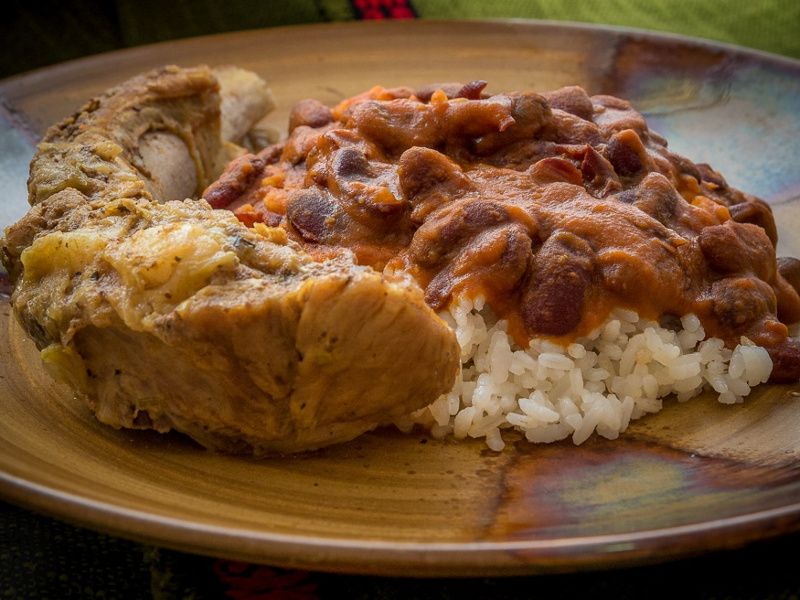
New Orleans style beans and rice, traditionally served on Monday evenings. I dont eat pork, so this recipe is written from a perspective of adding the smoky flavor without ham or pork. However, if you want to use pork, add a ham hock to simmer with the beans, and sub the turkey sausage for a smoked pork sausage.
- 1/2 teaspoon salt
- 1 tablespoon olive oil
- 2 green onions green part only, chopped, plus more for garnish
- 1 1/2 cups yellow onions chopped
- 3/4 cup green bell pepper chopped
- 3/4 cup celery chopped
- 1/2 teaspoon cayenne pepper
- 1/2 teaspoon black pepper fresh ground
- 2 tablespoons fresh parsley chopped
- 2 teaspoons fresh thyme
- Carbohydrate 3.605973 g
- Cholesterol 0 mg
- Fat 1.449013 g
- Fiber 0.976460016041994 g
- Protein 0.553897 g
- Saturated Fat 0.2157644 g
- Serving Size 1 1 Serving (49g)
- Sodium 8.50745 mg
- Sugar 2.62951298395801 g
- Trans Fat 0.0569136500000002 g
- Calories 28 calories
Step-by-step
- Heat the oil in a large pot or pan. Add the bacon and cook over medium heat for 10 minutes, stirring occasionally, until the bacon is lightly browned. Remove the bacon with a slotted spoon to a large plate, retain as much as of the oil in the pan as possible
- Add the sausage and cook, stirring until the sausauge extracts its juices and spices.
- Add the onions, bell peppers, celery, salt, cayenne, black pepper, thyme, parsley and bay leaves and cook until the vegtables are soft, about four minutes.
- Add the garlic and cook for 1 minute.
- Add the beans, the green onions, a few dashes of the hot sauce and liquid smoke, and cover with enough stock or water to cover the contents in the pot.
- Add the bacon back to the pot, stir well, and bring to a boil.
- Reduce the heat to medium-low and simmer, uncovered, stirring occasionally, until the beans are tender and starting to thicken, about 2 hours. (Should the beans become too thick and dry, add more water, about 1/4 cup at a time.).
- Remove from the heat and with the back of a heavy spoon, mash about 1/4 of the beans against the side of the pot. This is critical for louisiana style beans and rice. I like to remove the beans and after seperating the veggies, mash them up and add back to the pot. Continue to cook until the beans are tender and creamy, 15 to 20 minutes.
- Remove from the heat and remove the bay leaves. Serve over rice and garnish with green onions.
Thick, creamy bean starches coat long-grain rice while the background smoke of the broth permeates every kernel. Red beans and rice possesses a unique culinary chemistry that improves significantly with time. This dish historically anchored Monday schedules in New Orleans households because laundry tubs required constant attention, leaving cooks free to tend a pot that benefited from hours of unattended simmering. Modern preparation follows this exact logic, though freezing introduces new variables to manage. Legumes absorb surrounding moisture continuously, meaning starches can break down into an unappealing mush if containers sit too long in ice. Freeze the cooked beans within three months for optimal texture retention, storing them in airtight containers without the rice. Rice starches undergo retrogradation during freezing, turning chalky and brittle when thawed directly from a frozen state. Reheat the bean base on the stovetop over medium-low heat, adding water in quarter-cup increments if the consistency tightens beyond a velvety sauce. Cook a fresh batch of rice separately while the beans return to a simmer. Mashing roughly one quarter of the cooked beans against the pot wall releases internal starches into the cooking liquid, creating the traditional gravy without adding heavy cream or flour. Smoked turkey sausage or traditional pork variations should be sliced evenly to distribute fat evenly through the simmering liquid during the two-hour reduction phase.


