Heston's Chips
These chips are one of my proudest legacies You see them on menus up and down the country now but the original recipe came out of endless experimenting at home long before I even opened the Fat Duck. The first secret is cooking the chips until they are almost falling apart as the cracks are what makes them so crispy. The second secret is allowing the chips to steam dry then sit in the freezer for an hour to get rid of as much moisture as possible. The final secret is to cook the chips in very hot oil for a crispy, glass-like crust.
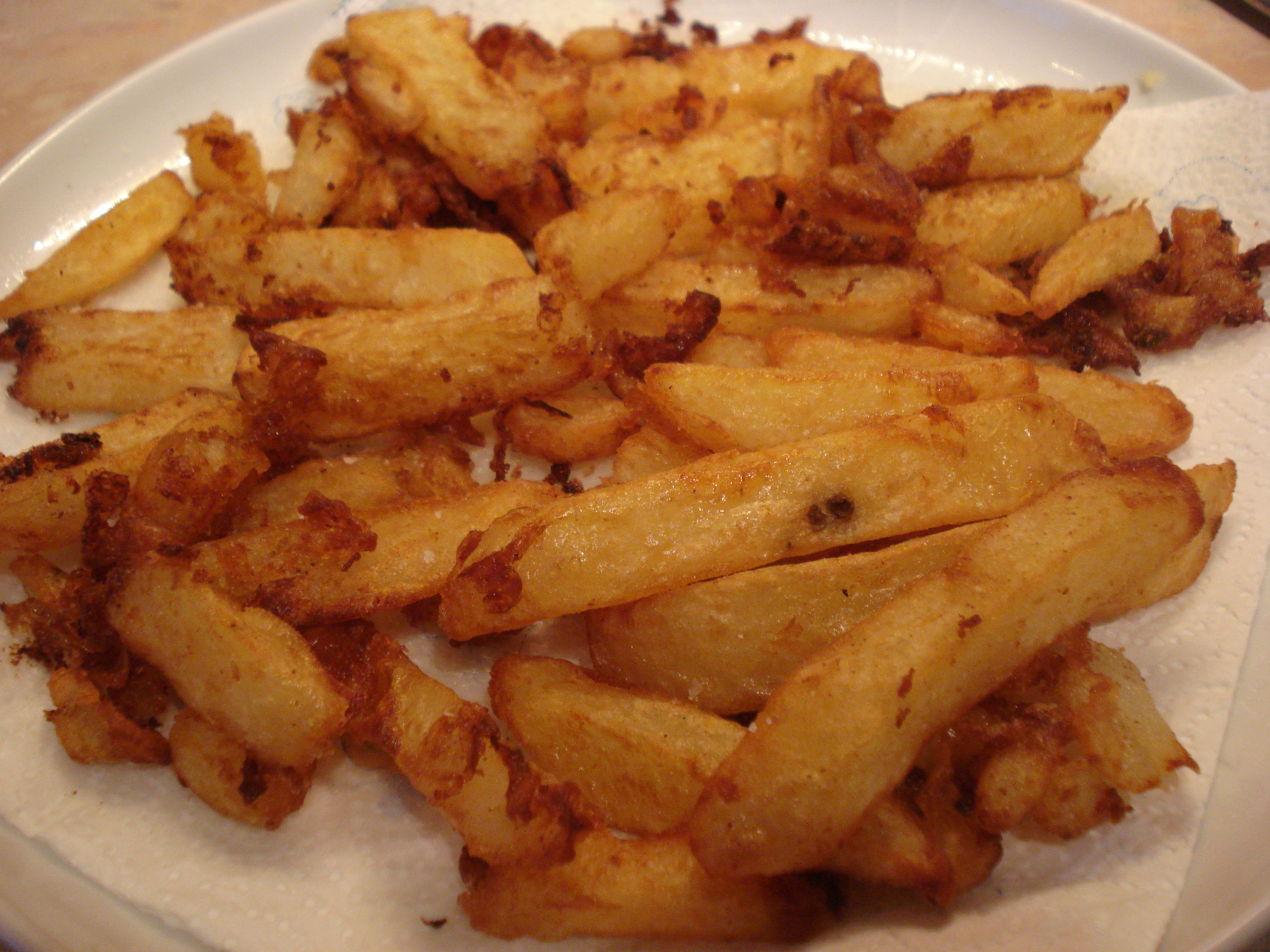
These chips are one of my proudest legacies You see them on menus up and down the country now but the original recipe came out of endless experimenting at home long before I even opened the Fat Duck. The first secret is cooking the chips until they are almost falling apart as the cracks are what makes them so crispy. The second secret is allowing the chips to steam dry then sit in the freezer for an hour to get rid of as much moisture as possible. The final secret is to cook the chips in very hot oil for a crispy, glass-like crust.
- Carbohydrate 29.1166666666667 g
- Cholesterol 0 mg
- Fat 36.4833333333333 g
- Fiber 3.66666674613953 g
- Protein 3.36666666666667 g
- Saturated Fat 3.53133333333333 g
- Serving Size 1 1 Serving (212g)
- Sodium 3498.22 mg
- Sugar 25.4499999205271 g
- Trans Fat 1.63033333333333 g
- Calories 450 calories
Step-by-step
- Put the cut chips into a bowl under running water for 5 minutes to wash the starch off.
- Place 2 litres of cold tap water in a large saucepan and add the potatoes. Place the pan over a medium heat and simmer until the chips are almost falling apart (approximately 20–30 minutes, depending on the potato).
- Carefully remove the cooked chips and place them on a cooling rack to dry out. Then place the rack in the freezer for at least 1 hour to remove more moisture.
- Heat a deep-fat fryer or a deep pan no more than half filled with oil (to a depth of around 10cm) to 130ºC. Fry the chips in small batches until a light crust forms (approximately 5 minutes), remove from the oil and drain on kitchen paper.
- Put the potatoes on a cooling rack and place in the freezer for at least 1 hour. (At this stage, if you don’t want to cook and serve immediately, the chips can be kept in the fridge for 3 days.)
- Heat the oil in the deep-fat fryer or deep pan to 180ºC and fry the chips until golden (approximately 7 minutes). Drain and sprinkle with salt.
Standard fast-food french fries rely on a single, rapid submersion in boiling fat, which often yields a limp interior and a surface that softens within minutes. Achieving a rigid, glass-like exterior without sacrificing a fluffy interior requires manipulating starch structures and eliminating internal moisture through a multi-stage thermal process. Maris Piper potatoes work exceptionally well here because their high starch content and mealy texture react predictably when subjected to prolonged boiling and freezing.
Initial surface starch must be removed under running water for five minutes to prevent the exterior from gumming up prematurely during the simmer. Simmering the cut potatoes in cold water brought gradually to heat causes the cell walls to break down until the chips are nearly fracturing under their own weight. This extreme softening creates microscopic fissures across the exterior surface, which later trap oil and turn into crisp, protruding shards during frying. Once boiled, the potatoes must be steamed dry on a wire rack and transferred to a freezer for at least one hour to sublimate remaining surface moisture. Deep-frying requires two distinct temperature phases: an initial bath at 130 degrees Celsius to set the structure without browning, followed by a secondary freeze, and a final plunge at 180 degrees Celsius until golden and rigid.
Groundnut or grapeseed oil should be utilized due to their high smoke points and neutral flavor profiles, ensuring the potato starch remains the dominant sensory component. If storage is necessary between the processing stages, par-cooked potatoes will hold safely in the refrigerator for up to three days before undergoing their final high-temperature crisping.



