Whoopie Pies
This is a traditional Pennsylvania Dutch favorite that you can find at every bake sale or farmers market in the state. There are two distinct camps when it comes to the filling ingredients: One camp uses a Crisco/confectioners sugar filling, and the other advocates a marshmallow fluff filling. The traditional Pennsylvania Dutch whoopie pie uses the Crisco filling. However, I have also included the directions for the marshmallow fluff variation.
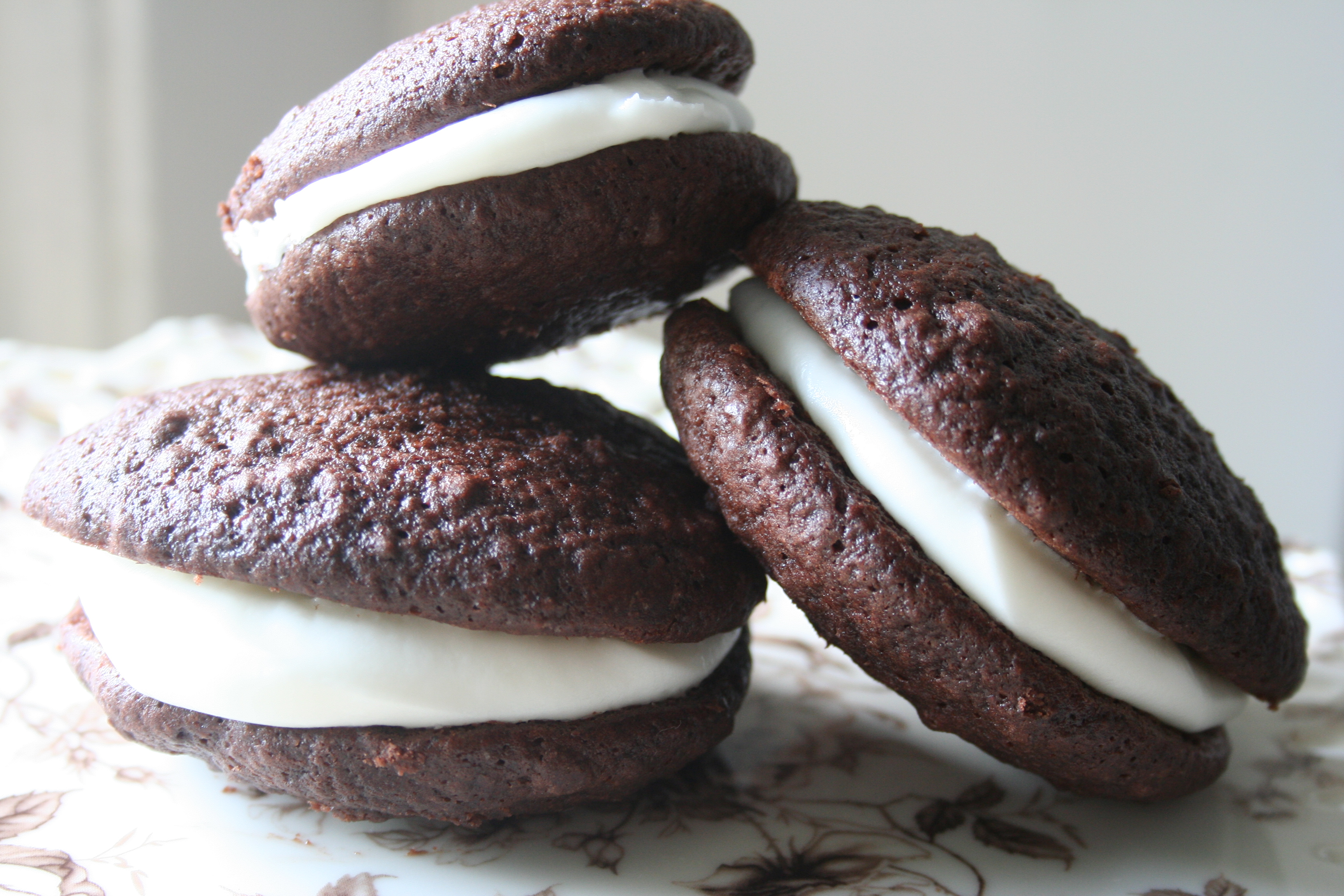
This is a traditional Pennsylvania Dutch favorite that you can find at every bake sale or farmers market in the state. There are two distinct camps when it comes to the filling ingredients: One camp uses a Crisco/confectioners sugar filling, and the other advocates a marshmallow fluff filling. The traditional Pennsylvania Dutch whoopie pie uses the Crisco filling. However, I have also included the directions for the marshmallow fluff variation.
- 2 teaspoons baking soda
- 1 teaspoon salt
- 4 tablespoons milk
- 2 cups sugar
- 2 teaspoons vanilla extract
- 2 large eggs
- 1 cup shortening
- 4 cups confectioners sugar
- 1 cup cocoa
- 1 cup sour milk
- 1 cup hot water
- 4 cups all purpose flour
- 1 cup unsalted butter at room temperature
- 4 tablespoons all purpose flour
- -- whoopie pie filling --
- 1/2 cups crisco
- 1/2 tablespoons vanilla
- 2 egg whites beaten
- -- marshmallow fluff filling --
- 2 cups confectioners sugar sifted
- 1 7-1/2 oz. jar marshmallow fluff
- Carbohydrate 3029.96628719567 g
- Cholesterol 4853.14771604848 mg
- Fat 533.649528792187 g
- Fiber 18.9566663603588 g
- Protein 232.223036202052 g
- Saturated Fat 247.276341973883 g
- Serving Size 1 1 recipe (5151g)
- Sodium 5068.45237809138 mg
- Sugar 3011.00962083531 g
- Trans Fat 42.6241559323635 g
- Calories 17618 calories
Step-by-step
- Cream shortening and sugar; add eggs and beat well.
- Add sour milk and vanilla.
- Sift flour, salt, and cocoa; mix well into egg mixture.
- Finally, combine soda with hot water and add to the mix.
- Drop onto greased cookie sheet and bake at 400? for 8 minutes.
- Combine and beat all the filling ingredients together, adding the beaten egg whites last.
- In the bowl of an electric mixer fitted with the paddle attachment, cream together butter and sugar until pale and fluffy, about 3 minutes.
- Add Fluff and vanilla and continue mixing until well combined.
- Put the filling between 2 cookies to form a "sandwich".
Baking soda requires an acid to initiate the release of carbon dioxide gas. This recipe utilizes sour milk, which provides the necessary lactic acid to react with the alkaline baking soda. Without sufficient acid, the cookies will taste metallic and fail to achieve proper lift. Mixing hot water into the batter at the final stage increases kinetic energy, dissolving the sugar crystals rapidly and speeding up the hydration of the flour proteins. Drop the batter onto greased cookie sheets and bake at 400 degrees Fahrenheit for precisely eight minutes to set the exterior crumb before the interior dries out.
Filling Mechanics: Shortening Versus Marshmallow Fluff
The filling defines the textural profile of the sandwich. Filling number one utilizes hydrogenated vegetable shortening and beaten egg whites. Shortening consists entirely of fat without water content, which yields a firm, stable emulsion that resists melting at room temperature. Beaten egg whites introduce air cells into the fat matrix, creating a dense yet airy foam. Conversely, marshmallow fluff contains corn syrup, sugar, and egg whites, introducing significant moisture. When combined with butter, the water content increases, yielding a softer, stickier spread that requires immediate assembly to prevent the cookies from absorbing excess liquid.
- If the cookies spread too thin on the baking sheet, ensure the sour milk is properly acidic and measure the flour by mass rather than volume.
- Stiff peaks in the egg whites are critical; under-whipping introduces excess water that will break the shortening emulsion.
- Store completed sandwiches in an airtight container to manage moisture migration between the crumb and the filling layers.



