Salt and Pepper Spare Ribs
One of our favourite takeaway dishes, but this recipe is the one I learnt from Ken Hom and the one that we always used for the Chinese themed dinner parties for Lord and Lady Hanson.
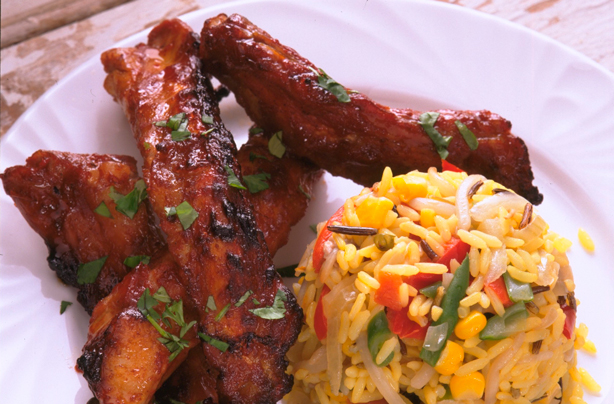
One of our favourite takeaway dishes, but this recipe is the one I learnt from Ken Hom and the one that we always used for the Chinese themed dinner parties for Lord and Lady Hanson.
- 1 tablespoon water
- 1/2 teaspoon cracked black pepper
- 1 pound pork spare ribs or baby back ribs
- 1 teaspoon sea salt use the coarsest you can find
- 1/2 teaspoon szechwan peppercorns see note
- 1 pinch five spice powder
- 1 tablespoon corn flour a heaped tablespoon
- 1 liter -- 1 litre vegetable oil for frying --
- 1 red chili finely sliced
- 1 spring onions finely sliced
- Carbohydrate 2.79490972213005 g
- Cholesterol 61.236 mg
- Fat 17.9610327777731 g
- Fiber 0.247430553133681 g
- Protein 12.6195491666511 g
- Saturated Fat 6.61882944444305 g
- Serving Size 1 1 Serving (90g)
- Sodium 348.729809027715 mg
- Sugar 2.54747916899637 g
- Trans Fat 1.71765611111091 g
- Calories 226 calories
Step-by-step
- To make the salt and pepper gently heat the Szechwan peppercorns in a dry pan for 1 minute, cool and grind in a pestle and mortar or a pepper grinder, mix the salt, black pepper and Szechwan peppercorns together set to one side.
- Place the spareribs, water, corn flour and five spice powder into a large bowl mix well, cover with cling film and marinade for at least 3 hours in the refrigerator.
- Now we cook the spareribs, heat the vegetable oil in a wok or deep frying pan (a good test is to drop a cube of bread into the hot oil and it should brown in 30 seconds) add the spare ribs and cook for 1 minute, remove the ribs, drain well and set aside.
- Now heat the oil again until it is almost smoking return the spareribs to the hot oil and cook until they start to turn brown drain on kitchen paper.
- Remove all the oil from the wok and quickly stir-fry the sliced chilli and spring onion add the cooked spareribs to the wok sprinkle the salt and pepper mixture over the ribs, quickly mix all the components together and remove immediately from the heat.
- Serve with a finger bowl of warm water and a lemon slice.
Why are deep-fried pork spare ribs sometimes disappointingly soggy instead of aggressively crisp on the exterior? Achieving that distinct texture relies entirely on the dual-stage cooking process, which forces moisture out of the meat during an initial short bath in oil before a searing hot second plunge locks in the crunch. Managing heat retention in a heavy wok or deep cast-iron Dutch oven prevents the oil temperature from plummeting when cold meat enters the pan, ensuring the corn flour coating seals instantly rather than absorbing grease. While potato starch or rice flour can substitute for corn flour at a one-to-one ratio, corn flour yields a uniquely shattering crust that holds up remarkably well against the final high-heat toss.
Dry-toasting the Szechwan peppercorns for precisely one minute in an ungreased skillet releases essential volatile oils that mellow harsh medicinal notes and amplify floral fruitiness. Grinding these toasted husks immediately before combining them with coarse sea salt and cracked black pepper creates a dynamic seasoning blend that penetrates the porous, freshly fried pork surfaces more effectively than standard table salt ever could. This meticulous spice preparation transforms a basic condiment into a pungent, aromatic punch that defines the dish.
Substituting pre-ground supermarket spices for whole Szechwan peppercorns drastically flattens the flavor profile, stripping away the signature citrusy numbness that defines authentic preparations. Freshly cracked peppercorns deliver immediate aromatic compounds that evaporate rapidly during industrial processing, meaning whole spices crushed just prior to mixing produce a vastly superior, vibrant finish. Utilizing fresh red chilies and crisp spring onions at the very end introduces vital piquancy and bright color without releasing excess moisture that would otherwise soften the newly formed crust.
Allowing the ribs to marinate in the refrigerator for at least three hours gives the water, corn flour, and five spice powder adequate time to break down surface proteins and form a tenacious adhesive layer. This extended chilling window ensures the seasoning slurry stays firmly anchored to the pork bones during the aggressive turbulence of the double-frying stage. Draining the fried pieces thoroughly on absorbent kitchen paper between frying rounds prevents residual surface grease from pooling, preserving the structural integrity of the crunchy exterior until the final aromatic toss.


