Grammie's Whoopie Pies
In my hometown, my grandmother is famous for her whoopie pies. I grew up eating these and cant think of a better dessert.
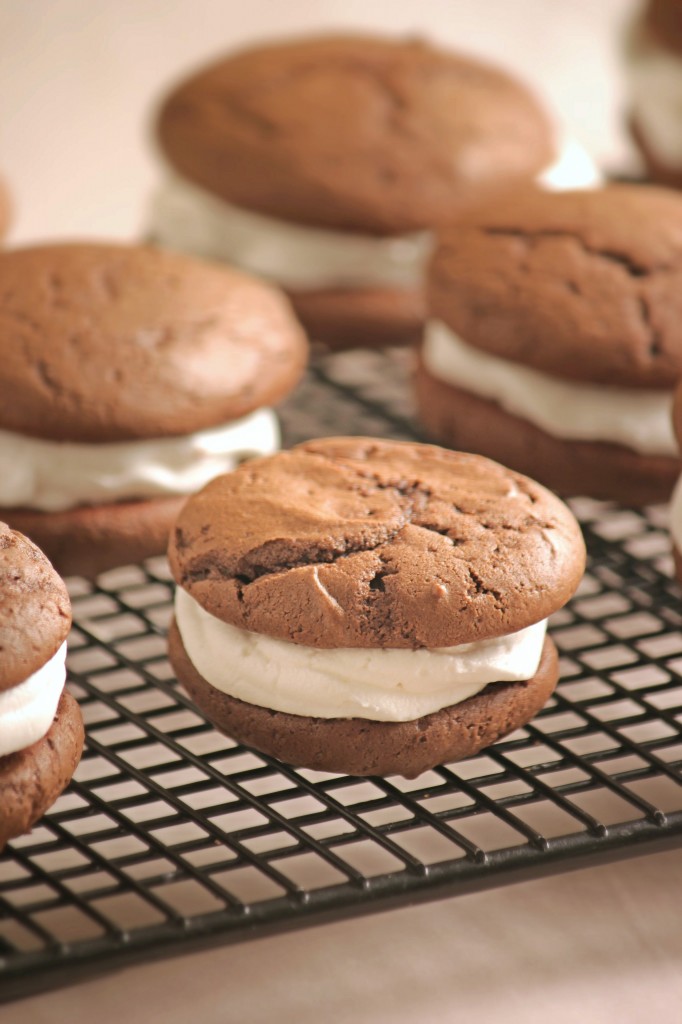
In my hometown, my grandmother is famous for her whoopie pies. I grew up eating these and cant think of a better dessert.
- Carbohydrate 54.4730496152804 g
- Cholesterol 36.5633333346859 mg
- Fat 1.50716055588862 g
- Fiber 0.770284735361439 g
- Protein 4.44480263943301 g
- Saturated Fat 0.616622430768077 g
- Serving Size 1 1 Serving (133g)
- Sodium 5743.23005447267 mg
- Sugar 53.702764879919 g
- Trans Fat 0.140169222235748 g
- Calories 247 calories
Step-by-step
- Mix all the batter ingredients together and beat until smooth.
- If baking whoopie pies, place soup-spoon sized dollops on a baking sheet. Bake at 350 degrees for 12 minutes or until a toothpick comes out clean.
- If baking a whoopie pie cake, split the batter between two 9-inch pans (square or round). Bake at 350 degrees for 25 minutes or until a toothpick comes out clean.
- While the whoopie pies are cooling, mix all the frosting ingredients together and beat until smooth.
- Frost pies/cake when cool.
A proper whoopie pie presents two domed chocolate cakes holding a thick, sweet white filling that yields slightly under gentle pressure without cracking the crumb. Achieving this texture relies entirely on how the batter holds its shape on the baking sheet before entering the oven. When portioning the mixture, uniform volume ensures that matching tops and bottoms bake at identical rates, preventing awkward assembly later. Spreading soup-spoon sized dollops two inches apart allows the heat to circulate freely around each piece, setting the exterior crust while the interior retains its soft, cake-like moisture. Overmixing the flour will develop excess gluten and yield tough rounds instead of tender cakes, so incorporate the dry ingredients only until smooth.
The Role of Fat in the Filling
Traditional fillings rely on shortening rather than butter for structural stability at room temperature. Shortening traps air effectively during the creaming process and melts at a higher temperature than dairy fat, keeping the filling from sliding out when held. Bakers looking to avoid hydrogenated oils can substitute margarine at a one-to-one ratio, though the resulting spread will require refrigeration to maintain its shape.
- Ensure baked cakes cool completely to 70 degrees Fahrenheit before applying frosting to prevent the filling from melting.
- Store assembled pies in an airtight container at room temperature for up to three days.
- If the frosting appears too stiff during mixing, incorporate warm milk one teaspoon at a time until smooth.



