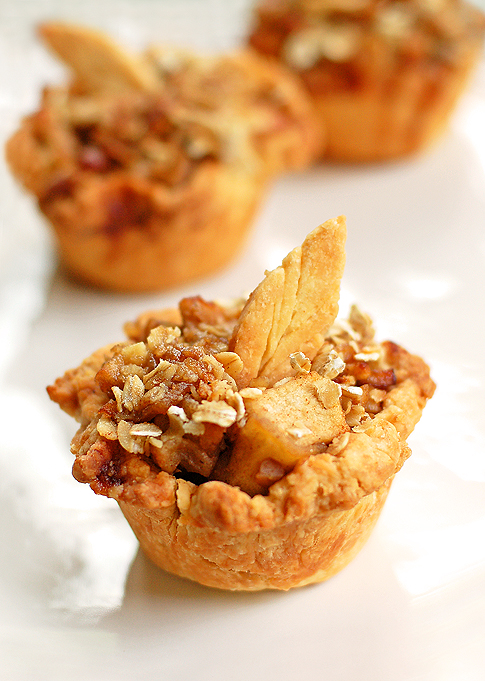
Makes 24 mini pies, easily halved to 12.
- Carbohydrate 42.0160191755706 g
- Cholesterol 15.2515625065405 mg
- Fat 6.10105171540135 g
- Fiber 5.3659390544354 g
- Protein 0.61869442127771 g
- Saturated Fat 3.70295162192825 g
- Serving Size 1 1 Serving (217g)
- Sodium 42.9381828877219 mg
- Sugar 36.6500801211352 g
- Trans Fat 0.573983486269482 g
- Calories 210 calories
Step-by-step
- Mix apples with flour, sugar, cinnamon, and nutmeg
- Stir well to get nice and coated
- Unroll your first pie crust and cut several circles out. Continue this until you have enough crusts.
- I found that a wide mouth mason jar ring worked perfectly.
- Line each cup of your muffin tin with a tiny pie crust.
- I found that pinching the edge of the dough around the top edge of the tin and making a hammock of sorts worked really well. You can then gently fill the crusts with your apple mixture and push the crusts down the rest of the way.
- You should be able to fill until slightly mounded.
- Then take your equally divided butter... and put a dab on each pie.
- Cover as desired with left over dough. Brush with melted butter and bake at 400 for 18 to 22 minutes. I started checking in on mine at 10 minutes and checked every two until they were perfect.
Historical Context
Handheld apple pastries trace their lineage back to medieval English turnovers and hand pies designed for field laborers. Modern adaptations utilize standard muffin tins to achieve uniform portion control without sacrificing the structural integrity of a traditional double-crust pie. Precision matters when scaling down; cutting dough with a wide-mouth mason jar ring yields circles that fit standard cup dimensions seamlessly.Technique and Structure
Thermal distribution in miniature vessels differs significantly from standard nine-inch pie plates. Baking at 400 degrees Fahrenheit encourages rapid steam release from the fruit while setting the fat in the pastry before it melts away entirely. Suspending the dough in a hammock shape inside the tin prevents bottom-crust sogginess by allowing excess juices to pool temporarily before evaporation occurs during the twenty-minute bake.Substitutions
Starchy thickeners like arrowroot or cornstarch can replace all-purpose flour if a translucent fruit gloss is preferred over a matte finish, though quantities must be halved to avoid gelatinous textures. Butter fats contribute essential moisture to lamination, whereas shortening yields a more stable flakiness under high heat conditions.


