Pasta Salad for a Crowd
Unique pasta salad recipe. My friends and family say it's the best they've ever put into their mouths!
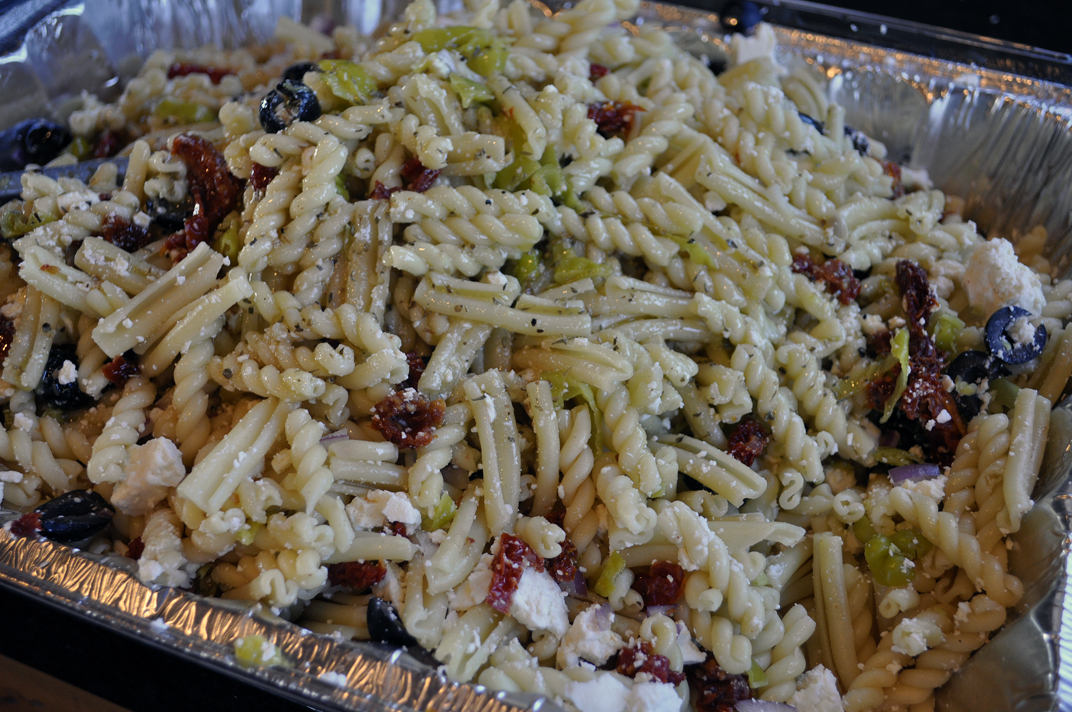
Unique pasta salad recipe. My friends and family say it's the best they've ever put into their mouths!
- Carbohydrate 22.0652854166667 g
- Cholesterol 50.5808333333333 mg
- Fat 7.33086458333333 g
- Fiber 0.354666671951612 g
- Protein 9.93572083333333 g
- Saturated Fat 2.75283041666667 g
- Serving Size 1 1 Serving (80g)
- Sodium 443.58125 mg
- Sugar 21.7106187447151 g
- Trans Fat 0.735594166666666 g
- Calories 195 calories
Step-by-step
- Cook Rotini according to package directions; rinse to cool and drain well.
- Place in large bowl and add black olive slices, cheddar cheese and meat; stir to combine.
- Add enough ranch dressing with bacon to moisten; stir.
- Shake in enough zesty Italian dressing to give it a little punch of flavor.
- Chill for at least two hours.
- Taste this just before serving as you may want to add a little more dressing.
Standard ingredient lists omit how starches behave during extended chilling, specifically how dry pasta continues absorbing moisture from surrounding liquids long after initial mixing. Preparing this dish requires accounting for this gradual liquid loss by reserving a portion of both dressings to stir in just before service. Scaling quantities upward demands a vessel holding at least six quarts to allow thorough tossing without crushing delicate rotini spirals or breaking up the julienned meat.
Economic efficiency in large-batch cooking relies on utilizing versatile cuts like rotini, which possess tight helical grooves designed to capture viscous emulsions. Swapping the specified ham or turkey for leftover roasted chicken requires no volumetric adjustment, keeping ingredient costs firmly under control while using existing refrigerator inventory. Shredding block cheddar manually yields superior melting and coating properties compared to pre-bagged alternatives coated in cellulose powder, ensuring a smoother mouthfeel throughout the mixture.
Excess moisture remains the primary enemy of structural integrity in cold noodle dishes, dissolving distinct textures into a homogenized paste. Rinsing the cooked rotini thoroughly under cold running water halts internal residual heat cooking immediately while removing exterior starch film that would otherwise clump the pieces together. Draining the pasta in a colander for a full five minutes ensures surface water never dilutes the ranch and Italian dressing blend.
Resting the assembled bowl in a refrigerator operating below 40 degrees Fahrenheit for a mandatory two-hour window allows fat molecules in the cheese and dressings to firm up and bind the components. Storing leftovers safely requires airtight containers consumed within a three-day window, preventing the vegetables from releasing excess water and degrading the overall quality. Adjusting salt levels at the final tasting stage compensates for the dulling effect cold temperatures have on human taste receptors.


