Cinnamon Raisin Bread
Warm, sweet, and filled with raisins, this bread is perfect for breakfast or a snack.
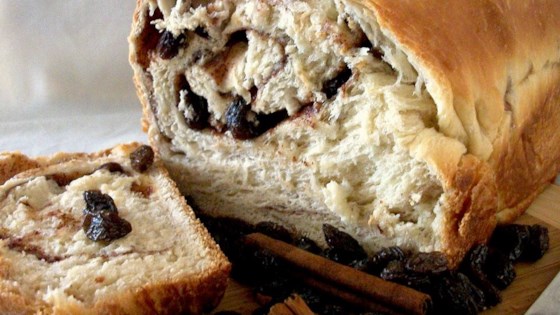
Warm, sweet, and filled with raisins, this bread is perfect for breakfast or a snack.
- 2 tablespoons milk
- 1 teaspoon salt
- 3 eggs
- 3/4 cup white sugar
- 1/2 cup white sugar
- 1 1/2 cups milk
- 1 cup raisins
- 8 cups all-purpose flour
- 2 tablespoons butter melted
- 1 cup warm water (110 degrees f/45 degrees c)
- 2 (.25 ounce) packages active dry yeast
- 1/2 cup margarine softened
- 2 tablespoons ground cinnamon
- Carbohydrate 30.2845811917798 g
- Cholesterol 3.1862847237943 mg
- Fat 6.39913821851354 g
- Fiber 1.15017408445875 g
- Protein 3.60880771226292 g
- Saturated Fat 1.65490564853922 g
- Serving Size 1 1 Serving (67g)
- Sodium 431.643106936831 mg
- Sugar 29.1344071073211 g
- Trans Fat 0.341822689996496 g
- Calories 192 calories
Step-by-step
- Warm the milk in a small saucepan until it bubbles, then remove from heat. Let cool until lukewarm.
- Dissolve yeast in warm water, and set aside until yeast is frothy. Mix in eggs, sugar, butter or margarine, salt, and raisins. Stir in cooled milk. Add the flour gradually to make a stiff dough.
- Knead dough on a lightly floured surface for a few minutes. Place in a large, greased, mixing bowl, and turn to grease the surface of the dough. Cover with a damp cloth. Allow to rise until doubled.
- Roll out on a lightly floured surface into a large rectangle 1/2 inch thick. Moisten dough with 2 tablespoons milk. Mix together 3/4 cup sugar and 2 tablespoons cinnamon, and sprinkle mixture on top of the moistened dough. Roll up tightly; the roll should be about 3 inches in diameter. Cut into thirds, and tuck under ends. Place loaves into well greased 9 x 5 inch pans. Lightly grease tops of loaves. Let rise again for 1 hour.
- Bake at 350 degrees F (175 degrees C) for 45 minutes, or until loaves are lightly browned and sound hollow when knocked. Remove loaves from pans, and brush with melted butter or margarine. Let cool before slicing.
Baking enriched doughs on a budget demands maximum utility from pantry staples without sacrificing chemical integrity. Sugar acts as a hygroscopic agent, binding water molecules and slowing gluten development, which creates a softer crumb texture inside the loaf. Active dry yeast requires precise temperature control between 105 and 110 degrees Fahrenheit to hydrate properly without thermal shock. Plumping raisins in warm water beforehand prevents them from absorbing moisture directly from the surrounding dough during the initial rise.
Gradual flour incorporation ensures the eight cups of all-purpose flour hydrate evenly alongside the fats from butter and margarine. Kneading aligns the gluten strands, building the elastic matrix necessary to trap carbon dioxide gas produced by the fermenting yeast. Milk contains lactose and proteins that promote browning through the Maillard reaction during baking. Moistening the rolled dough with two tablespoons of milk before applying the sugar and cinnamon mixture creates an adhesive layer that prevents the spiral filling from separating into empty cavities.
Assessing doneness requires auditory feedback rather than guesswork. Tapping the bottom of the baked loaf should produce a distinct hollow sound when the internal structure has fully set. Brushing the crust with melted butter immediately after removal softens the exterior shell while retaining internal moisture. Slicing too early causes the starches to compress and gummy textures to form, so resting the loaves until completely cool is mandatory.



