San Antonio Squash Casserole
I have tried this dish at Threadgill's in Austin and it's yummy. This is supposed to be their recipe
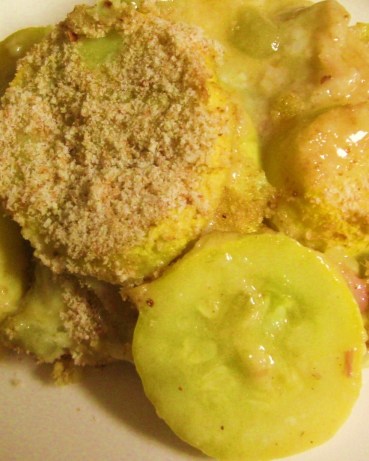
I have tried this dish at Threadgill's in Austin and it's yummy. This is supposed to be their recipe
- Carbohydrate 38.3523563507715 g
- Cholesterol 145.068563135 mg
- Fat 51.8460453829126 g
- Fiber 6.23613482351482 g
- Protein 33.0674891961089 g
- Saturated Fat 30.8386420511184 g
- Serving Size 1 1 Serving (582g)
- Sodium 1893.2484479822 mg
- Sugar 32.1162215272566 g
- Trans Fat 3.11521358934194 g
- Calories 736 calories
Step-by-step
- Preheat oven to 350 degrees F.
- Melt half of the butter in a large skillet over medium heat.
- Add onion and saute until soft.
- In a separate skillet, saute the squash in the remaining butter until soft.
- Alternatively, you can cook the squash in the microwave.
- Drain excess liquid from squash.
- Butter a casserole dish and then combine the onion, squash, cheese, green chiles, and soup in the casserole dish.
- Bake until heated through and cheese is well melted.
- Remove from oven, stir, and sprinkle bread crumbs on top.
- Return to the oven and bake 5 more minutes, or until bread crumb mixture is golden.
Balancing Moisture and Melting Fats
Cooking yellow squash requires careful management of internal water content, which can easily dilute a rich sauce if left unchecked. Slicing the squash and cooking it until soft releases excess cellular liquid, and draining this thoroughly prevents the canned cream of celery soup from breaking down into a watery pool. When cubed American cheese meets the hot vegetables in a 350 degrees F oven, its sodium citrate emulsifiers bond tightly with the dairy fats to create a remarkably smooth, velvety sauce without graininess. Because this formulation relies heavily on processed cheese for its emulsion stability, attempting a direct one-to-one swap with aged cheddar requires adding a splash of milk and some cornstarch to achieve the same homogenous melt.
Texture and Scaling Considerations
Adding the bread crumbs during the final five minutes of baking protects them from burning while ensuring a crisp contrast to the tender vegetable base. Doubling this yield for larger gatherings is straightforward, though wider pans work better than deep ones to maintain an even heat distribution across the center. Spreading the mixture thin allows the green chiles and onions to integrate uniformly without steaming the topping into sogginess.



