Pork Chop Rolls
This is a version of rouladen, a rolled German meat dish. You can stuff it with a bread stuffing, or as I do here, with bacon, pickle and mustard.
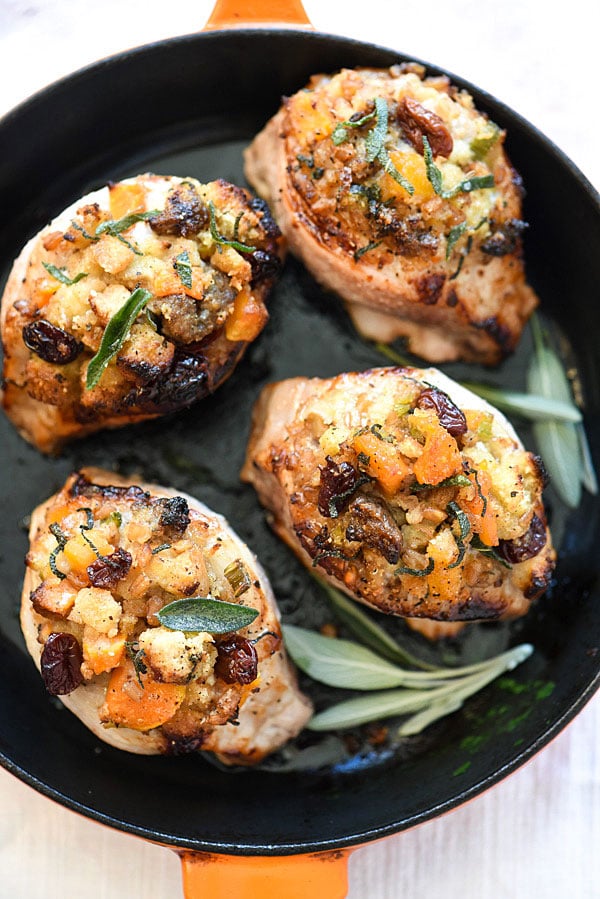
This is a version of rouladen, a rolled German meat dish. You can stuff it with a bread stuffing, or as I do here, with bacon, pickle and mustard.
- Carbohydrate 7.25538897161162 g
- Cholesterol 134.205093191275 mg
- Fat 58.6882852672757 g
- Fiber 1.84887499433877 g
- Protein 31.0419761159656 g
- Saturated Fat 18.6838500873263 g
- Serving Size 1 1 Serving (368g)
- Sodium 1318.32681085543 mg
- Sugar 5.40651397727285 g
- Trans Fat 4.94251058734586 g
- Calories 682 calories
Step-by-step
- Pound the meat to 1/8" thick. Season with salt and pepper.
- Spread 1 tablespoon of mustard, or more if desired, thickly on one side of each piece of meat. Place two slices of bacon and two pickle slices on top of the mustard. Divide the onion evenly onto each piece. Starting from the narrowest end, roll tightly (jelly roll style) and secure with string or toothpicks.
- Heat oil in a heavy saucepan. Brown the meat rolls well on all sides. Add about 1 cup of water to the saucepan, bring to a boil, reduce the heat, cover and simmer for 1 1/2 hours. Add more water, 1/4 cup at a time, if needed.
- Remove the meat from the pan. Add the beef broth to the liquid the meat was cooked in. Keep boiling until liquid is reduced by one third of its original size. Whisk in tomato paste and cream; boil to thicken slightly, about 5 minutes. Season with salt and pepper. Return the meat to the pan and warm through.
Deep mahogany surfaces give way to a tender interior where rendered pork fat meets the sharp, lactic bite of dill pickles and pungent mustard. Resting thin pork tenderloin cutlets to an eighth of an inch requires steady force with a heavy mallet to rupture connective tissue without tearing the muscle fibers. Securing those cylinders tightly with kitchen twine ensures the filling components remain sealed inside the meat matrix during extended cooking. Simmering the browned rolls for ninety minutes breaks down tough collagen into gelatin, changing the texture of the pork from firm to yielding. Reducing the braising liquid alongside beef broth concentrates residual gelatin, which subsequently acts as a natural thickening agent when heavy cream and tomato paste are whisked into the pan. Protein structures contract when heated, meaning that second-day refrigeration actually improves this dish rather than hurting it. Cooling the rolls allows the muscle fibers to relax fully while reabsorbing the rich tomato and cream reduction. Storing the cooked meat submerged in its sauce in an airtight container for up to forty-eight hours permits the acetic acid from the pickles and the mustard compounds to fully permeate the pork interior, deepening the savory profile. Reheating these cylinders gently on the stovetop at a low simmer prevents the dairy solids in the heavy cream from breaking or separating.


