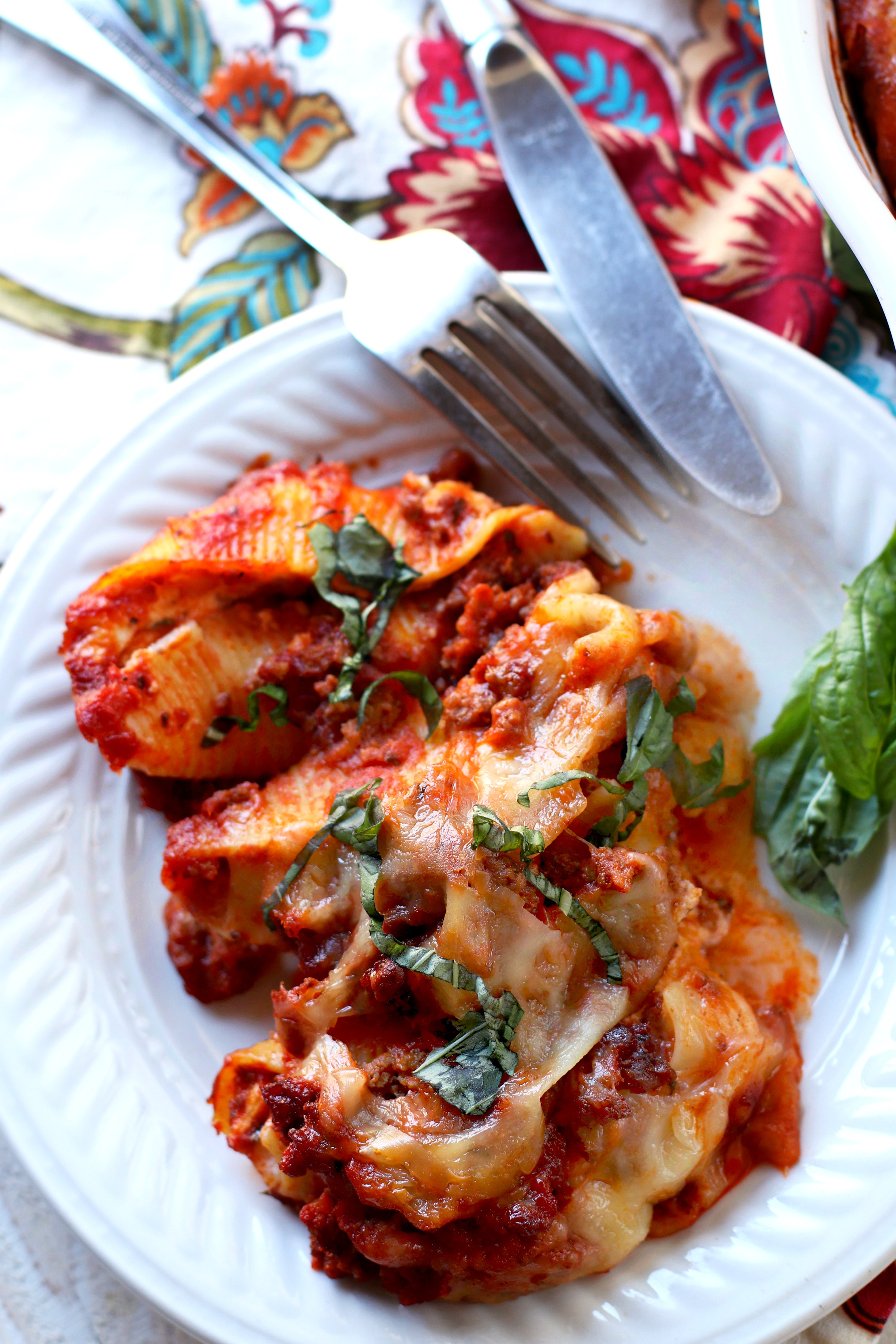
I make homemade tomato sauce, but you can also use a store-bought variety
- Carbohydrate 78.6572064910448 g
- Cholesterol 139.524565299585 mg
- Fat 16.4404714523613 g
- Fiber 1.63504166666667 g
- Protein 34.5245220005247 g
- Saturated Fat 8.72435248175704 g
- Serving Size 1 1 Serving (333g)
- Sodium 1027.84347873684 mg
- Sugar 77.0221648243781 g
- Trans Fat 1.73978292094591 g
- Calories 601 calories
Step-by-step
- In a large bowl combine mozzarella, 1/4 cup Parmigiano-Reggiano, ricotta, salt and pepper to taste. Mix thoroughly.
- Cook pasta according to directions, al dente, not overcooked. Drain.
- Preheat oven to 350.
- Spread 1/4 cup sauce over the bottom of a 9x13 inch baking pan.
- Fill shells with ricotta mixture, place them into baking dish. Spoon remaining sauce over the shells, then remaining 3/4 cup Parmigiano-Reggiano over the sauce. Bake until a nice brown crust has formed on top, about 20 minutes. Serve immediately.
Undercooking the jumbo pasta shells just enough before stuffing guarantees they hold their shape under a heavy dairy filling without tearing or turning to mush during the final bake. Boiling jumbo pasta requires careful attention to the timer, specifically pulling the shells at least two minutes before the package directions indicate for al dente, because residual heat and moisture from the ricotta and tomato sauce will continue softening the starch inside the 9x13 inch baking pan. Whisking fresh ricotta, cubed mozzarella, and Parmigiano-Reggiano together before filling creates a cohesive dairy matrix that stays anchored inside each cavity rather than leaking out into the bottom of the dish during the twenty-minute bake at 350 degrees Fahrenheit. Spreading a thin layer of tomato sauce across the base of the pan acts as a protective moisture barrier, preventing the pasta bottoms from scorching while the top develops a browned, bubbling crust from the remaining hard cheese. Swapping homemade tomato sauce for a store-bought jar works entirely fine, though commercial varieties often contain added sugar and sodium that will noticeably alter the salinity and flavor balance of the final dish. Allowing the filled shells to rest briefly after baking lets the melted mozzarella and ricotta set up, making individual portions easier to transfer to plates cleanly.



