Roast Turkey
Tips from Alton Brown's fantastic show. Brining the bird is the key to moist meat. Made this again this year, only brined in just water instead of stock to save some dough. Again, the bird turned out perfectly. Growing up, I hated white meat because it was always dry and grinding on your teeth, now I love white meat.
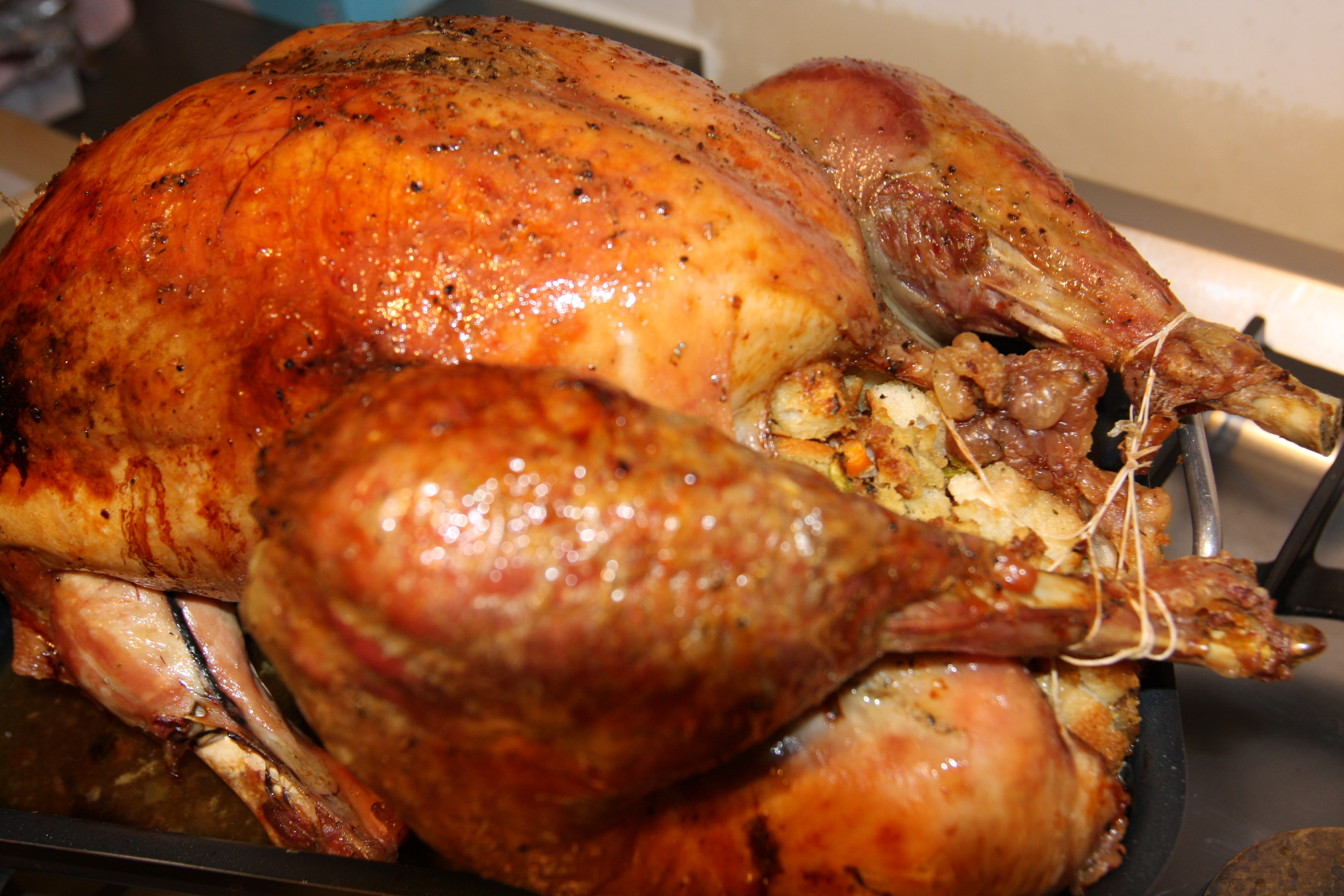
Tips from Alton Brown's fantastic show. Brining the bird is the key to moist meat. Made this again this year, only brined in just water instead of stock to save some dough. Again, the bird turned out perfectly. Growing up, I hated white meat because it was always dry and grinding on your teeth, now I love white meat.
- Carbohydrate 12.6073092988114 g
- Cholesterol 393.113387333333 mg
- Fat 26.7759377181577 g
- Fiber 0.971789891852862 g
- Protein 131.868219921644 g
- Saturated Fat 6.55384258745535 g
- Serving Size 1 1 Serving (1309g)
- Sodium 5283.38356820113 mg
- Sugar 11.6355194069585 g
- Trans Fat 3.27777948564077 g
- Calories 851 calories
Step-by-step
- Combine all brine ingredients, except ice water, in a stock pot and bring to a boil.
- Stir to dissolve solids, then remove from heat, cool to room temperature refrigerate until thoroughly chilled.
- Early on the day of cooking, (or late the night before) combine the brine and ice water in a clean 5 gallon bucket.
- Place thawed turkey breast side down in brine, cover, and refrigerate or set in cool area (like a basement) for 6 hours.
- Turn turkey over once, half way through brining.
- A few minutes before roasting, heat oven to 500 degrees.
- Combine the apple, onion, cinnamon stick and cup of water in a microwave safe dish and microwave on high for 5 minutes.
- Remove bird from brine and rinse inside and out with cold water.
- Discard brine.
- Place bird on roasting rack inside wide, low pan and pat dry with paper towels.
- Add steeped aromatics to cavity along with rosemary and sage.
- Tuck back wings and coat whole bird liberally with canola (or other neutral) oil.
- Roast on lowest level of the oven at 500F for 30 minutes.
- Remove from oven and cover breast with double layer of aluminum foil, insert probe thermometer into thickest part of the breast and return to oven, reducing temperature to 350 degrees F.
- Set thermometer alarm (if available) to 161 degrees F.
- A 14-16 pound bird should require a total of 2-2 1/2 hours of roasting.
- Let turkey rest, loosely covered for 15 minutes before carving.
Swapping the traditional stock base in a salt-and-sugar brine for plain water alters the depth of flavor slightly, but the fundamental chemistry of moisture retention remains entirely unaffected. Dissolving kosher salt and brown sugar in boiling water breaks down the solutes before they submerge into a cold ice-water bath, creating an osmotic environment that forces hydration deep into the muscle tissue of a sixteen-pound bird over six hours. Thoroughly chilling that liquid before the poultry enters the vessel prevents any bacterial risks during the resting window in a cool basement or refrigerator. When preparing poultry in compact cooking spaces, managing thermal dynamics requires precise equipment choices, particularly when blasting bird skin at extreme temperatures.
The Physics of High-Heat Searing
Heating the oven to 500 degrees Fahrenheit for the first thirty minutes renders subcutaneous fat rapidly while setting the exterior protein structure into a crisp, golden shell. Microwaving internal aromatics such as red onion, fresh sage leaves, apple pieces, and a cinnamon stick for five minutes releases their essential oils instantly, steaming them internally before they ever enter the cavity. Canola oil acts as a superior conductor compared to butter during this initial high-heat phase because water-laden dairy solids burn long before the target crust forms on the skin. Shielding the breast meat with a double layer of aluminum foil after the initial half-hour prevents the delicate white meat from overcooking while the denser dark meat catches up.
Monitoring Internal Temperature
Inserting a digital probe thermometer accurately into the thickest part of the breast guarantees absolute safety without sacrificing juiciness. Lowering the oven temperature to 350 degrees F once the foil shield is in place allows the heat to penetrate evenly to a target reading of 161 degrees F before extraction. Letting the roasted centerpiece rest loosely covered for fifteen minutes redistributes the internal juices completely, preventing moisture loss across the carving board. Understanding how heat transfers through dense protein structures transforms standard holiday roasting into a predictable, repeatable science.



