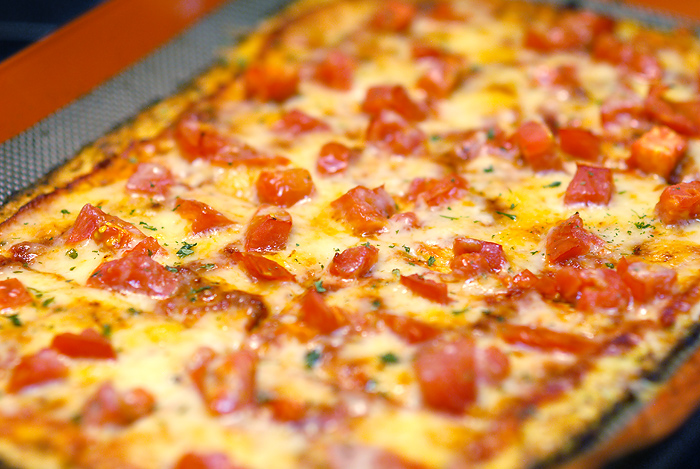
Grain Free Cheese Pizza with Cauliflower Crust
- Carbohydrate 2.03035549988448 g
- Cholesterol 409.12695000735 mg
- Fat 13.468346003327 g
- Fiber 0.504499997921451 g
- Protein 15.600887002915 g
- Saturated Fat 5.70969335231802 g
- Serving Size 1 1 Serving (115g)
- Sodium 202.780500058736 mg
- Sugar 1.52585550196302 g
- Trans Fat 1.81062355018448 g
- Calories 191 calories
Step-by-step
- Preheat oven to 400 degrees F.
- Shred 1 large cauliflower (remove leaves/stem) in a food processor using either the grater blade or s-blade. Can also manually grate with a grater. Steam the shredded cauliflower for about 4-5 minutes.
- Place the steamed cauliflower onto a clean thin dish towel and wrap it up. Then SQUEEEEEZE all the excess moisture out! You will be surprised at how much water will come out. Make sure you have about 4 cups of cauliflower when you are done.
- Add the strained cauliflower in a bowl along with the rest of the ingredients. Place the dough onto parchment paper (I use a Silpat) on your pizza pan and shape it. Keep the dough about 1/3 inch thick. I actually just spread the dough on a stoneware bar pan. This makes a thin crust, which we love.
- Place the crust in the oven and bake for about 30-40 minutes. Crust should be firm and golden brown.
- Top the baked crust with your favorite pizza toppings. We typically use sauce, cheese, tomatoes, and mushrooms. You can use any veggies or meat. Be creative!
- Return the pizza to the oven and bake for another 10-13 minutes – or until the cheese is melted and bubbly.
- Slice and serve!
A properly baked cauliflower pizza crust presents a deeply golden, rigid perimeter and a dry, firm interior capable of supporting hand-held slices without collapsing. Achieving this structural integrity depends entirely on aggressive moisture management. Raw cruciferous vegetables contain high water content that converts to steam during baking, preventing the starches and proteins from setting into a solid matrix. Without thorough liquid extraction, the base remains soggy and structurally weak.
Storage and Reheating Mechanics
Prepared cauliflower crusts freeze exceptionally well when handled correctly. Cool the baked crust completely on a wire rack to prevent condensation from softening the bottom before placing it in the freezer. Wrap the bare, un-topped crust tightly in plastic wrap, followed by a layer of aluminum foil, and store it for up to one month. Reheating frozen crusts requires no prior thawing; place the frozen base directly onto a hot pizza stone or baking sheet in a 425 degree Fahrenheit oven for five to seven minutes to restore crispness before adding toppings.
- Crust turning out gummy? Moisture was left behind in the towel-wringing phase; increase the squeezing pressure or extend the steaming time to soften cell walls further.
- Edges burning before the center sets? Press the dough thinner toward the perimeter or shield the outer rim with a strip of aluminum foil during the first fifteen minutes of baking.
- Base sticking to the pan? Substitute standard metal pans with high-grade parchment paper or a silicone baking mat, as bare metal promotes adherence.



