Anita's Almond Thumbprint Cookies with Fudge Topping
I came up with this recipe after my husband fell in love with the thumbprint cookies from HEB.
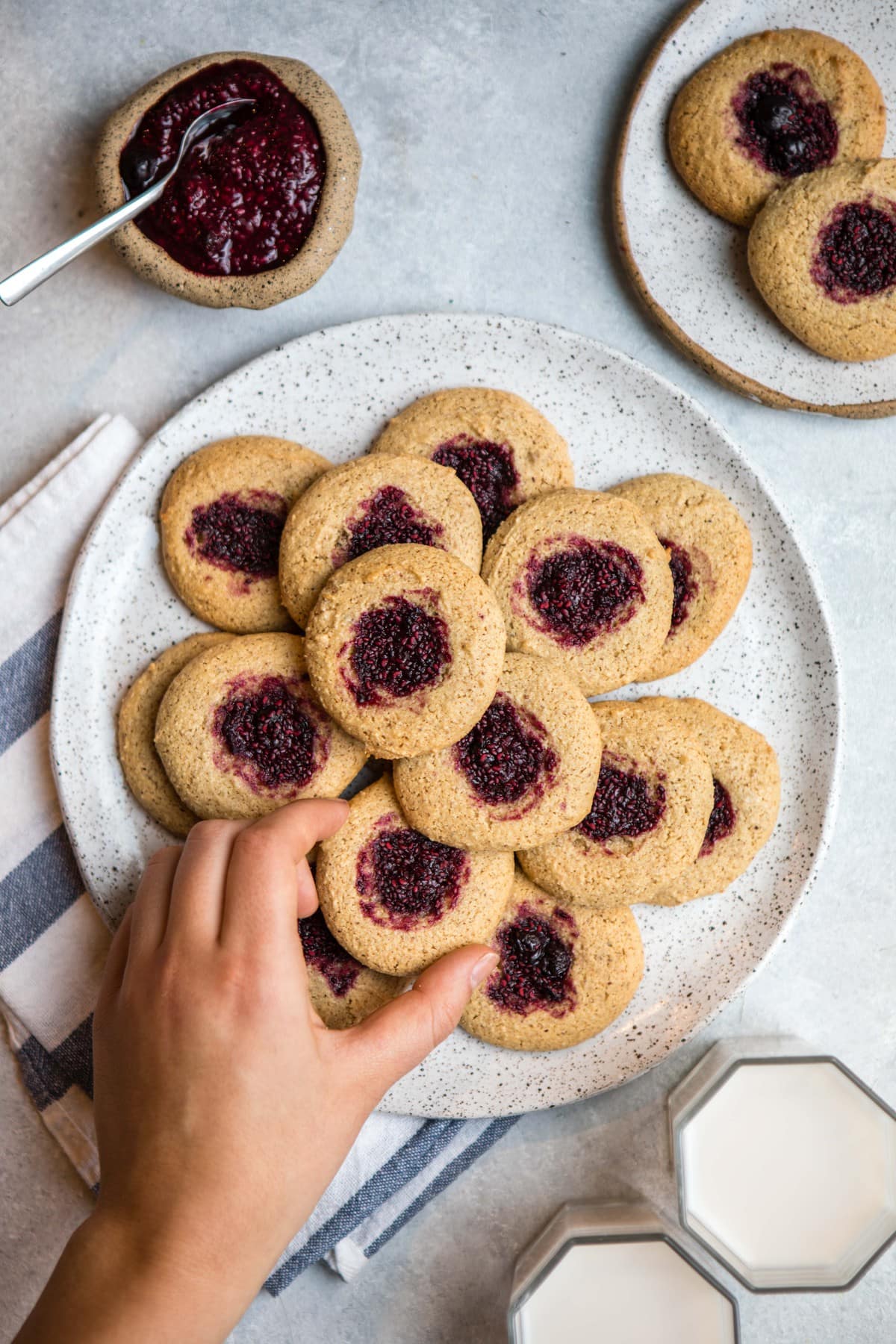
I came up with this recipe after my husband fell in love with the thumbprint cookies from HEB.
- Carbohydrate 12.5653209807692 g
- Cholesterol 12.212 mg
- Fat 5.52174196153846 g
- Fiber 0.392599038124084 g
- Protein 1.04065771153846 g
- Saturated Fat 2.99206515 g
- Serving Size 1 1 Serving (21g)
- Sodium 112.41175 mg
- Sugar 12.1727219426451 g
- Trans Fat 0.389981661538461 g
- Calories 102 calories
Step-by-step
- Heat oven to 350 degrees. For cookies, sift flour, sugar and salt into bowl. Cut in 1 cup butter with pastry blender until mixture resembles coarse crumbs. Blend in almonds and vanilla. Work mixture with fingers until a ball of dough is formed. Then shape into 1-inch balls.
- Place balls on greased cookie sheets; make a depression in center of each cookie. Bake about 8 minutes; remove from oven. Dent again and bake about 8 minutes longer; cool.
- Fill depressions in cookies with 3-Minute Microwave Fudge
- Combine sugar and cocoa in microwave-safe bowl.
- Place stick of margarine on top of sugar/cocoa mixture.
- Pour milk over all.
- DO NOT STIR.
- Microwave at high for 3 minutes
- Stir well and add vanilla and nuts.
- Place a spoonful on top of each thumbprint cookie.
Flour and butter ratios tell only half the story when constructing a stable cookie dough that must hold an indentation through two rounds of baking. Grated unblanched almonds supply natural oils and structural grit that resist total liquefaction in the oven, keeping the cookie from flattening into a disk at 350 degrees Fahrenheit. Cutting the butter into the flour with a pastry blender rather than melting it ensures pockets of solid fat remain intact, which vaporize during baking to create tender, flaky micro-structures within each one-inch ball.
Maintaining the depression requires precise timing during the thermal cycle. Pulling the sheets out at the eight-minute mark allows the partially set dough to be re-dented before the starches fully gelatinize and lock the shape into place. If skipped, the expanding butter will push the center back outward, leaving a shallow surface unable to hold the fudge topping.
Freezing unbaked dough balls provides an efficient method for make-ahead planning. Flash freeze the shaped portions on a sheet pan for one hour before transferring them to an airtight bag, where they keep safely for up to three months without flavor degradation. Bake straight from the frozen state by adding two additional minutes to the initial eight-minute bake phase, ensuring the center remains receptive to the second indentation.
The microwave fudge topping relies on an intentional lack of stirring before heating, which allows the margarine to melt and blanket the powdered sugar and cocoa evenly without forming hard sugar crystals. Stirring the mixture immediately after its three-minute heating cycle incorporates the residual heat to dissolve remaining clumps smoothly. Fold in the vanilla and chopped nuts at this final stage to preserve volatile aromatic compounds that would otherwise burn off under prolonged microwave exposure.



