Hunter's Chicken (Pollo alla Cacciatora)
This is a simple recipe that's easy enough for a mid-week dinner and delicious enough for guests. It is a popular Italian dish that can vary from cook to cook. This recipe was given to me by a friend and I have adapted it over the years. I like to serve it with either linguine or egg noodles, a nice salad, and a loaf of crusty bread.
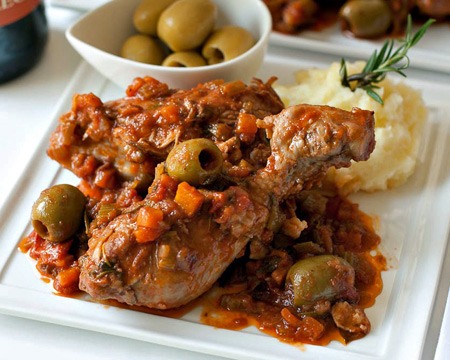
This is a simple recipe that's easy enough for a mid-week dinner and delicious enough for guests. It is a popular Italian dish that can vary from cook to cook. This recipe was given to me by a friend and I have adapted it over the years. I like to serve it with either linguine or egg noodles, a nice salad, and a loaf of crusty bread.
- 1 bay leaf
- 3 cloves garlic minced
- 2 stalks celery finely chopped
- 1/2 cup dry white wine
- 1 cup low-sodium chicken broth
- salt and freshly ground pepper
- 1 large carrot finely chopped
- 6 pieces chicken breasts and/or thighs and drumsticks
- flour for dredging, plus 1 tablespoon
- 6 tablespoons olive oil divided
- 1 large onion peeled and chopped
- 8 ounces mushrooms chopped
- 1 teaspoon fresh thyme minced
- 1 teaspoon fresh rosemary minced
- 3 large plum tomatoes diced
- freshly grated parmesan cheese (optional)
- Carbohydrate 11.5628433333333 g
- Cholesterol 170.0975 mg
- Fat 47.9475013333333 g
- Fiber 1.81725002241135 g
- Protein 45.2784225 g
- Saturated Fat 11.692039 g
- Serving Size 1 1 Serving (430g)
- Sodium 276.315916666667 mg
- Sugar 9.74559331092199 g
- Trans Fat 3.37052416666668 g
- Calories 680 calories
Step-by-step
- Dry the chicken pieces, season them with salt and pepper, and dredge them in the flour.
- Heat 4 tablespoons of oil in large skillet over medium heat. Add the chicken pieces and cook, turning once, until they are browned on both sides, about 15 minutes. Remove the chicken from the pan and set aside.
- Remove excess fat from the pan and add the remaining 2 tablespoons of oil. Stir in the oinion, celery, carrot, mushrooms and garlic and cook, stirring, until the vegetables are soft, about 8-10 minutes.
- Add the herbs and tomatoes and heat for 1 minute. Add the wine and bring to a boil for about 2 - 3 minutes.
- Sprinkle 1 tablespoon of flour over the vegetables and stir to combine thoroughly. Cook for another 2 - 3 minutes and add the broth and continue to heat and stir for about 3 minutes, as sauce thickens.
- Turn down the heat to low and return the chicken to the pan, spooning some of the vegetable mixture over all the pieces. Let it simmer, partially covered, for another 30 minutes or so, turning the chicken once, until the chicken is cooked through.
- Serve the chicken with some of the sauce spooned over the top and freshly grated parmesan cheese.
The ingredient list outlines components, but it remains silent on structural transformation. Transforming raw pieces of poultry and raw vegetables into a cohesive braise requires managing moisture and surface starches at every single stage of cooking.
Controlling Texture in the Skillet
Dry the exterior of the poultry completely with paper towels before seasoning. Surface moisture prevents the Maillard reaction, yielding gray meat instead of a crisp, golden crust. Dredge the pieces lightly in flour to add a protective barrier and provide initial thickening power for the sauce.
Heat four tablespoons of olive oil in a wide skillet over medium heat until the fat shimmers. Brown the poultry for approximately 15 minutes, turning once when the protein releases easily from the metal surface. Remove the meat entirely before sweating the aromatics.
Cook the finely chopped onion, celery, carrot, mushrooms, and garlic in the remaining two tablespoons of oil for 8 to 10 minutes. The vegetables must soften completely and release their internal water. Stirring flour directly into these softened vegetables creates a blond roux that binds with the chicken broth and white wine, preventing the sauce from breaking into an oily slick during the final simmer.
- Swapping dry white wine for dry vermouth yields identical acidity, but using red wine will darken the sauce significantly and introduce heavier tannins.
- Replacing chicken broth with water requires doubling the added salt to compensate for missing foundational sodium.
- Cutting the vegetables into uneven chunks prevents them from softening simultaneously, creating hard pieces in a smooth sauce.


