Boeuf Bourguignon
I like to prepare this recipe in the winter, when we crave warm comfort food. We often double this recipe and freeze leftovers they are wonderful for lazy nights. This is ideal for entertaining as I can prepare it a few days before. For wine pairing of course, we serve it with Burgundy wine!
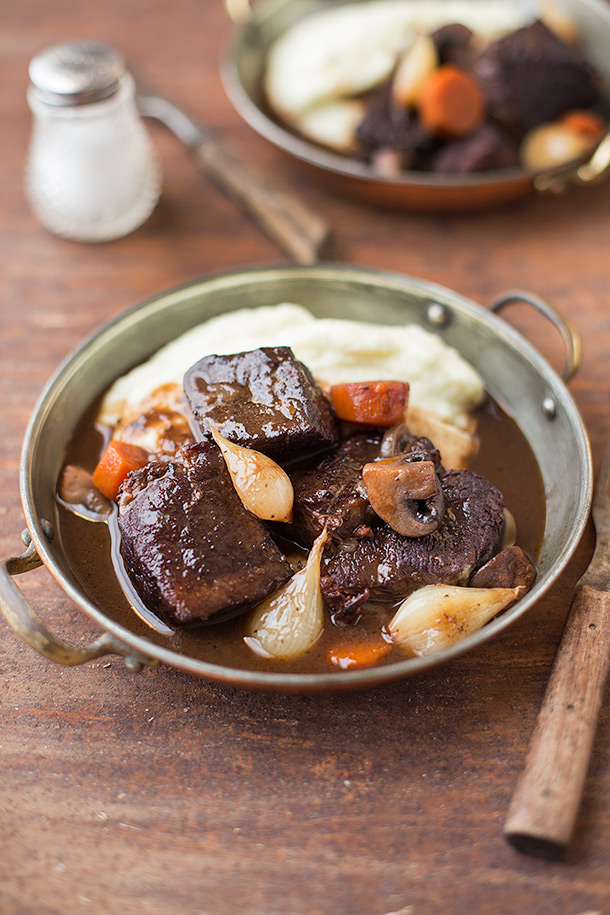
I like to prepare this recipe in the winter, when we crave warm comfort food. We often double this recipe and freeze leftovers they are wonderful for lazy nights. This is ideal for entertaining as I can prepare it a few days before. For wine pairing of course, we serve it with Burgundy wine!
- 2 kg of beef (cut in one inch cube)
- 1 carrot (slices)
- 1 large onion (slices)
- 2 garlic clove (small pieces)
- a dozen of mushroom (baby bella type - in quarter)
- 1 liter of red wine
- 1 bouquet garni (3-4 bay leaves bunch of thyme, rosemary, parsley,...)
- 4-6 slices of bacon (cut in pieces)
- 1 cup of fresh parsley
- 1/2 cup of flour
- 1 cup of butter
- Carbohydrate 15.9433566801444 g
- Cholesterol 162.826666804312 mg
- Fat 61.6314733854335 g
- Fiber 0.562500010409617 g
- Protein 2.79581666903011 g
- Saturated Fat 38.934990366247 g
- Serving Size 1 1 Serving (430g)
- Sodium 436.640667035781 mg
- Sugar 15.3808566697348 g
- Trans Fat 4.36784700369235 g
- Calories 619 calories
Step-by-step
- In a salad bowl, coat the beef cubes with flour. Add salt and pepper.
- In a cast iron pan, melt 1/4 cup of butter and brown the beef cubes.
- In a large pot (dutch oven), melt the remaining of the butter, and add beef cubes, carrot, onion, mushroom, some salt and pepper, stir well.
- Immediately after, add the wine until all is covered, the bouquet garni. Stir well for a minute or two.
- Leave the mixture covered for about two hours at medium-low heat and stir occasionnally (the stew should simmer, not boil).
- Reduce the heat to low and uncover for about one hour, then add garlic. Continue occasionnally stirring and add wine if the level of wine reaches 2/3 of the mixture.
- Continue to cook until meat is tender. Add fresh parsley (saving some for presentation).
- Serve hot with boiled potatoes and sprinkle fresh parsley for presentation (on both dishes).
- Make ahead: This dish can be made two-three days prior to serving. I usually keep it in the fridge and simmer it a few more hours everyday, adding wine. The more wine you add, the longer the dish needs to be reduced...therefore, the wine flavor will be stronger and the meat will be more tender.
How does a long braise transform tough cuts of meat into something meltingly tender while concentrating the surrounding sauce? Collagen breakdown requires sustained heat between 195°F and 205°F over several hours, turning tough connective tissue into gelatin that naturally thickens the cooking liquid. Embracing this chemistry means recognizing that braises actually improve after resting. Letting the pot cool completely allows starch molecules and rendered fats to stabilize, yielding a silkier mouthfeel upon reheating.
- Coat beef cubes thoroughly in flour to promote a deep brown crust during searing and to help thicken the sauce later.
- Maintain a gentle simmer rather than a rolling boil during the two-hour covered phase to prevent the meat fibers from seizing and toughening.
- Uncover the dutch oven during the final hour of cooking to encourage excess moisture evaporation and concentrate the red wine aromatics.
- Store the finished stew in the refrigerator for up to three days before serving, bringing it back to a gentle simmer slowly on the stovetop.
- Pair the rich, wine-heavy sauce with boiled potatoes, which absorb excess liquid and provide a neutral starch base against the savory beef.
Proper resting allows the wine and herb flavors to fully penetrate the beef cells. Reheating the dish gently over subsequent days deepens the savory profile without drying out the protein.


