The Terpsi of Beef Wellington
Beef Wellington is known to be earthy, difficult to make and a proper "fancy" meal. Well, it isnt that hard! Today I attempted to make it. My name is Terpsichore, and by definition in dictionary means Pleasure Dance. Terpsi in ancient Greek means pleasure Hence the name of the Beef Wellington I make is called The Terpsi of Beef Wellington. This is my twist that "wakes" up the "ancient recipe!" No mushrooms, no bacon, no heavy flavors. Just a kick of pungency to "wake it up!"
Beef Wellington is known to be earthy, difficult to make and a proper "fancy" meal. Well, it isnt that hard! Today I attempted to make it. My name is Terpsichore, and by definition in dictionary means Pleasure Dance. Terpsi in ancient Greek means pleasure Hence the name of the Beef Wellington I make is called The Terpsi of Beef Wellington. This is my twist that "wakes" up the "ancient recipe!" No mushrooms, no bacon, no heavy flavors. Just a kick of pungency to "wake it up!"
- 1 egg
- 1 lemon
- 1 bunch of asparagus
- 3 lbs strips)
- (you can use a cheaper cut- sirloin top ask butch
- 3 heads of garlic
- some olive oil (to taste)
- salt pepper (to taste)
- english mustard
- butter or ghee for the egg wash
- 1 bunch of mint
- four pastry doughs for pies you can use the store bought.
- meat thermometer
- Carbohydrate 2.17463666666667 g
- Cholesterol 31.02 mg
- Fat 0.941113333333333 g
- Fiber 0.926849964618683 g
- Protein 1.27570333333333 g
- Saturated Fat 0.24231 g
- Serving Size 1 1 Serving (253g)
- Sodium 10.8341666666667 mg
- Sugar 1.24778670204798 g
- Trans Fat 0.162666666666667 g
- Calories 17 calories
Step-by-step
- Firstly boil the asparagus until super soft or use a tin of asparagus (for those on a budget I made it both ways and it worked well)
- Grate the onion and add salt pepper and the bunch of mint finely chopped in a bowl.
- Once the asparagus has "over-boiled" and is floppy and cooled Chop it into mush.
- Mix all of the ingredients. Add some lemon zest, chopped garlic (to taste), I used 3 small heads, some olive oil, taste until nice twang achieved.
- Rest for 30 min at room temp.
- Trim the tenderloin into 2 nice "long blocks"
- keep the fillet's trimmings.
- Thinly slice the trimmings as best you can and meanwhile you sear the beef.
- Don't cook it sear it all around!
- Hot pan a little bit olive oil and scorch it!
- Put cling film on tabletop and place the first pastry dough on it.
- Quickly scorch the trimmings of beef in the pan where you seared beef, take them and mix them with the asparagus mix.
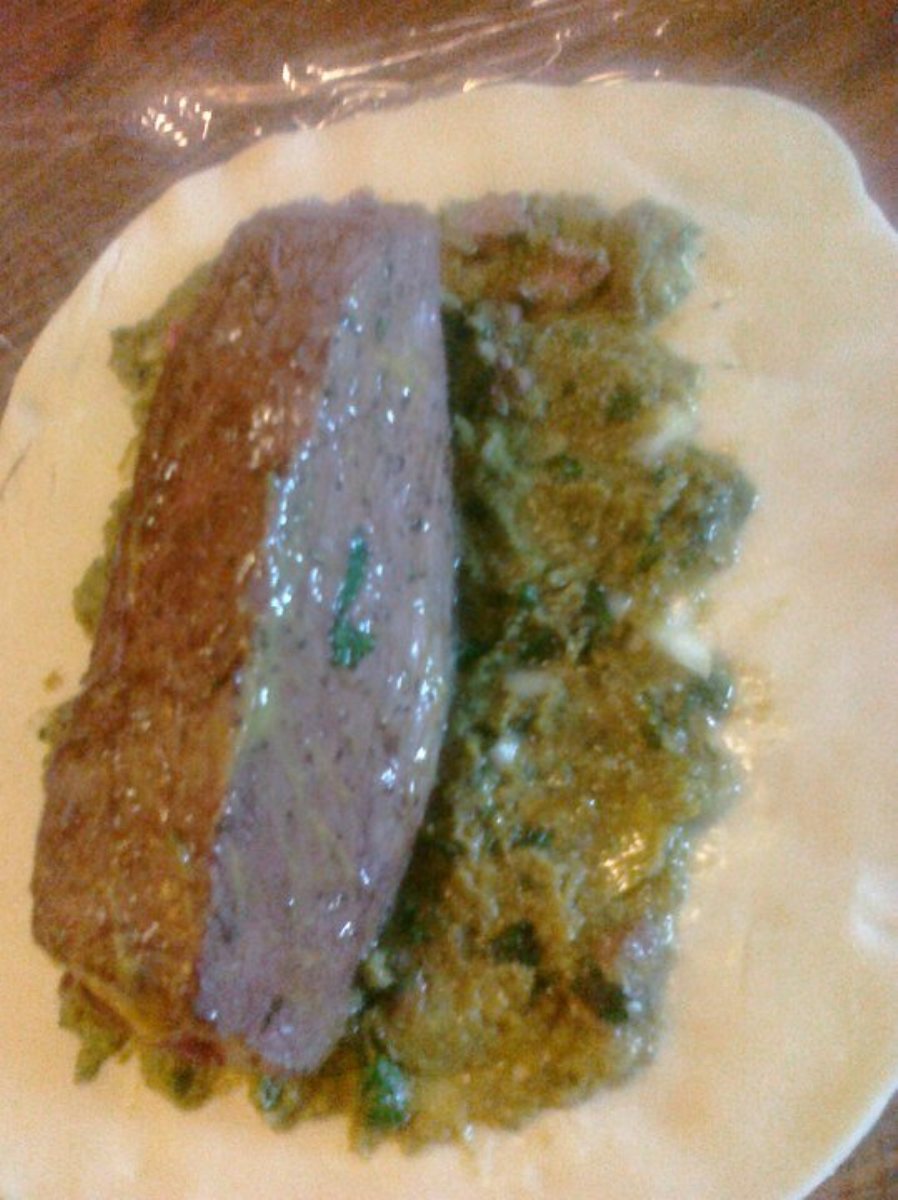
- Then take the mix (omit) as much liquid as you canand lay generously on dough leaving an inch around the sides free of filling.
- Massage the beef with english mustard as a coating.
- Place the meat in the middle and with the assistance of the cling film roll as best you can.
- Don't worry if small tears another layer of pastry will go on later.
- Tightly wrap in cling film and chill for 30 minutes. Lay out the other piece of dough on cling film take chilled "wellington dough roll" and wrap again seam side down. Use the egg wash to seal the ends and tuck.
- Egg wash the "top" slightly scratch a design if you feel fancy. Sprinkle some salt(rock is nice) & pepper
- Preheat oven at 425 and place in the middle rack for time -Rare =20 min.
- I like it rare, though invest in thermometer to check temp is 140! And you are ready to eat after you take it out and let it rest for 20 minutes!
Golden pastry encases seared beef, herbal aromatics, and a sharp vegetable filling that replaces the traditional mushroom duxelles.
Managing Moisture and Texture
Pastry relies on dry heat and fat to create distinct layers, meaning excessive liquid in any internal filling ruins the crust. Squeezing excess moisture from the boiled asparagus mixture before wrapping prevents the pastry from becoming soggy during baking. Sear the beef thoroughly in a smoking hot pan to lock in exterior juices while keeping the interior raw enough for final oven cooking.
Monitoring Internal Temperature
Relying purely on oven timers often results in overcooked meat because oven temperatures fluctuate significantly. Insert an instant-read probe into the thickest part of the tenderloin, targeting 140 degrees Fahrenheit for a rare finish. Pull the pastry from the oven promptly when the target temperature registers to avoid residual heat graying the center of the cut.
The Importance of Rest Time
Carving meat straight from a high-heat environment causes muscle fibers to contract forcefully and expel their moisture onto the board. Allowing the assembled pastry roll to rest undisturbed for twenty minutes lets internal temperatures stabilize and juices redistribute evenly. Slice the portions using a serrated knife operated with gentle sawing motions to prevent crushing the delicate pastry shell.



