Basic Chocolate Cake
Delicious moist cake that can be utilized as a two-layer sponge cooked in two tins, a large whole cake that you can split into two or three layers and add your favorite filling, cupcakes, or add chocolate chips and make into muffins. Decorate as you desire. The cake is nice plain too or you can dress it up and serve slices with strawberries and whipped cream, dusted with a little sprinkle of icing sugar.
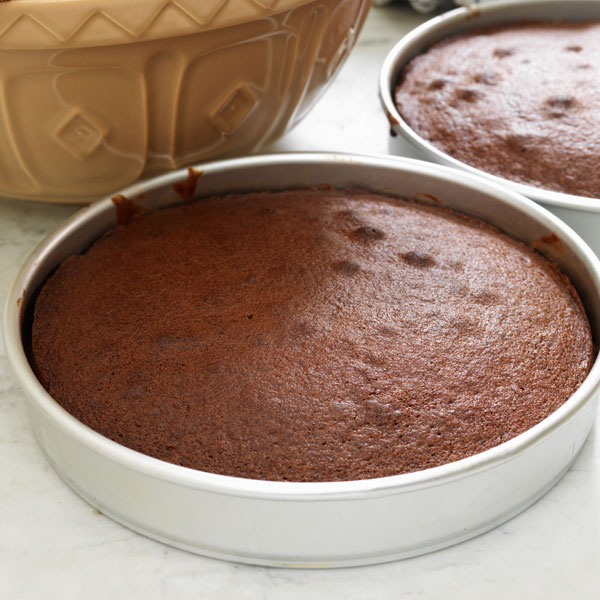
Delicious moist cake that can be utilized as a two-layer sponge cooked in two tins, a large whole cake that you can split into two or three layers and add your favorite filling, cupcakes, or add chocolate chips and make into muffins. Decorate as you desire. The cake is nice plain too or you can dress it up and serve slices with strawberries and whipped cream, dusted with a little sprinkle of icing sugar.
- 2 eggs lightly beaten
- 1 cup milk in a small jug
- 1 tbsp vinegar add to milk & mix gently
- 11/2 cups plain flour sift with cocoa & bicarb
- 1/2 cup cocoa as above
- 11/2 tsp's bicarb soda as above
- 11/4 cups raw sugar add to other dry ingredients
- 185 gms butter melted
- 1 tspn vanilla extract
- ganache
- 450 gms dark chocolate
- 250 mls pouring cream
- 30 gms butter optional
- Carbohydrate 145.40399505322 g
- Cholesterol 1085.47875 mg
- Fat 316.917250000683 g
- Fiber 2.42175004372548 g
- Protein 20.2303625072043 g
- Saturated Fat 198.318518750108 g
- Serving Size 1 1 Serving (618g)
- Sodium 2316.93350000139 mg
- Sugar 142.982245009494 g
- Trans Fat 22.9944275002266 g
- Calories 3449 calories
Step-by-step
- Stir and set aside the milk and vinegar allowing it time to sour.
- Sift flour, cocoa & bicarb into a medium sized mixing bowl. Add the sugar and combine. Make a well in the centre and pour in the melted butter and half the soured milk mixture. Beat well for about three minutes. Add the vanilla essence, rest of the soured milk and the eggs. Beat for another two minutes.
- Pour into your prepared tin/s.
- Bake in mod oven (180 degrees Celsius), for approximately 35 minutes.
- Adjust the time for cupcakes and muffins (shorter), or a larger cake, longer - I lower the temperature by about 20 degrees once the cake has risen and has firmed on the top.
- When cooked, (bounces back on top when gently depressed with one finger, or sharp knife comes out clean when inserted in the middle, or the cake is leaving the sides of the tin), stand for ten minutes before removing from tin.
- Allow to cool completely before decorating.
- Melt chocolate and cream together, with the butter if using (gives a nice gloss to ganache)
- I melt ingredients in a glass jug in the microwave on medium. Starting with five minutes, stirring the mixture well with a rounded knife - this may be enough to finish the melting process, if not put back in microwave for a further 2-3 minutes. Stir again.
- Allow to cool to luke warm before pouring over the cake. Pours better when slightly warm. Turn thhe cake upside down, then, If you wish split the cake before pouring and sandwich each layer together with ganache, then pour over the cake.
Standard recipes rarely explain why souring milk with vinegar alters crumb structure, but this chemical reaction is the primary driver behind a tender, open crumb rather than a dense, rubbery sponge. Combining acetic acid with whole milk creates homemade buttermilk, which weakens gluten strands as they form while simultaneously activating the sodium bicarbonate for maximum lift. This dual action yields moisture without heaviness, provided the batter is beaten thoroughly to incorporate air before hitting the heat.
Overbeating once the eggs go in introduces too much aeration, leading to large tunnels inside the baked crumb, whereas underbeating leaves the heavy fat of melted butter and whole milk stranded without adequate emulsification. Monitoring the baking progress requires watching for the precise moment when the sides pull away from the pan and the center springs back instantly under a fingertip pressure test at 180 degrees Celsius. Lowering the oven temperature by twenty degrees after the initial rise prevents the outer edges from scorching before the deep center finishes setting.
Ganache behaves similarly regarding temperature thresholds, requiring cooling to lukewarm before application so it maintains enough viscosity to coat evenly without melting the crumb beneath it. Bakers working in restricted kitchen spaces can easily adapt this versatile batter into cupcakes, muffins, or layered sponges by scaling baking times down to fifteen minutes for smaller portions while utilizing the exact same mixing technique.


