Awesome Low Calorie Chicken Fingers
I twisted an old recipe of mine to reduce calories and the bad crap in regular chicken fingers. Kids LOVE to help make these. (And since they helped, they cant tell you that they dont like them) But our daughter loved them, ate well more than she regularly does!
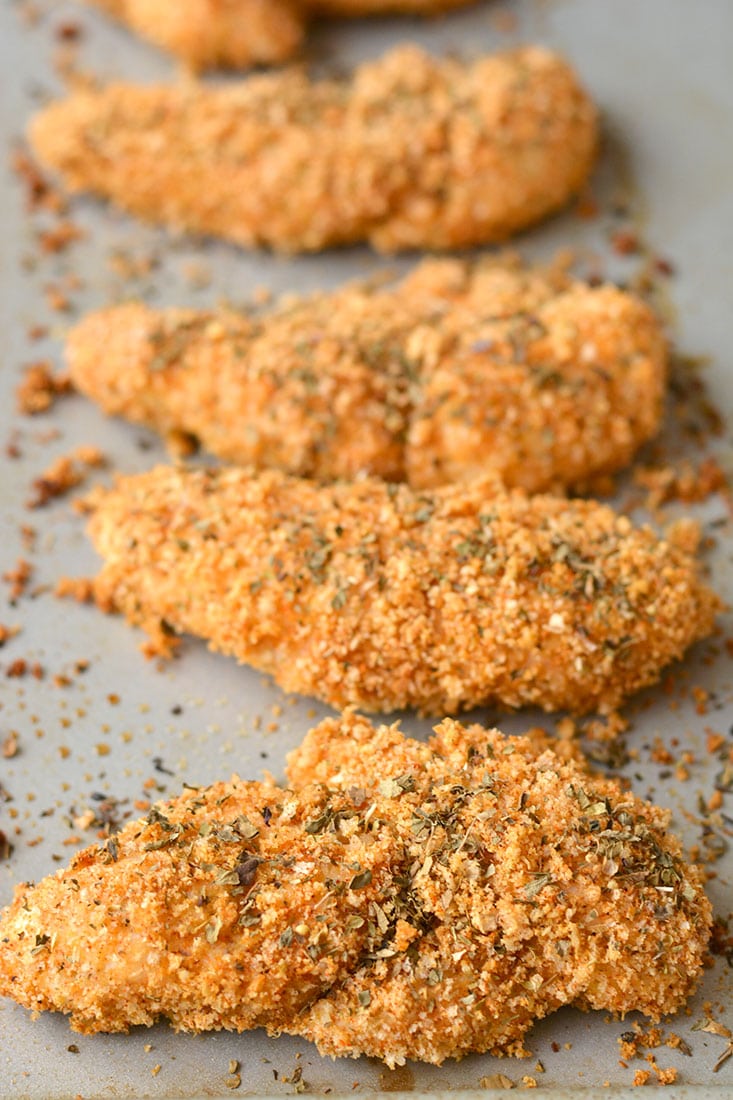
I twisted an old recipe of mine to reduce calories and the bad crap in regular chicken fingers. Kids LOVE to help make these. (And since they helped, they cant tell you that they dont like them) But our daughter loved them, ate well more than she regularly does!
- Carbohydrate 124.028275003738 g
- Cholesterol 48.0766666697884 mg
- Fat 4.50113333402012 g
- Fiber 16.1280002848307 g
- Protein 35.1248416692499 g
- Saturated Fat 1.08506333376102 g
- Serving Size 1 1 Serving (289g)
- Sodium 1369.84583341528 mg
- Sugar 107.900274718908 g
- Trans Fat 1.17121583336845 g
- Calories 649 calories
Step-by-step
- Preheat oven to 400 degrees
- For those of you that are new to cooking, whenever you cook with raw chicken, especially when you are around small kids helping in the kitchen, make sure you wash your hands often!! Use a anti-bacterial soap and have your kids wash as often as you do. The best rule of how long to wash for is sing "Happy birthday" while you scrub.
- Pour 3/4 cup of buttermilk into deep dish.
- Slice your chicken into about 1/2 inch slices. If it a thick breast, butterfly it to make it easier and faster to cook. (Butterfly means to cut in half, lengthwise). After slicing, place chicken into buttermilk. Salt and pepper lightly. Let marinade in buttermilk for a minimum of 15 minutes.
- Grab your kid... Hopefully it's the one running around the kitchen. If this is not your child, return it to driveway and find the one that looks similar to yourself. Help them count four cups of Chex cereal, pouring each into a gallon ziploc bag.
- Have your child beat the cereal into a pulp, make sure all large squares are knocked down. Don't go overboard on this step, you don't want a powder. (By not giving them a rolling pin... it keeps their hands out of trouble for a while).
- While child is pounding the bag... grab a beer.. enjoy the peace and quiet.
- Strain the chicken in a colander, dredge each piece individually in cereal mix and place on non-stick or greased cookie sheet. Cook for 8 to 9 minutes.
- Serve and enjoy!
Home cooks frequently commit the error of applying breadcrumbs directly to raw, dry poultry without an intervening acidic dairy wash, resulting in a desolate, patchy crust that detaches instantly during the heat of baking. Historically, home kitchens utilized whatever dry starches or crushed grains were at hand to extend limited supplies of wheat flour, a practice that evolved into modern alternative breading techniques designed to maximize crispness while altering nutritional profiles. Utilizing a 3/4 cup measure of cultured buttermilk serves a dual chemical purpose: the natural acidity gently denatures surface proteins on the boneless chicken breast halves to tenderize the meat, while simultaneously acting as an adhesive matrix that binds particulate coatings firmly to the protein. When substituting traditional breadcrumbs with four cups of crushed rice cereal, achieving the correct mechanical texture requires deliberate restraint. Crushing the cereal inside a sealed polyethylene bag until it resembles coarse sand rather than fine flour ensures the trapped air pockets within the lattice structure can expand rapidly in a 400 degree oven, generating maximum crunch. Because thin, half-inch slices of poultry cook through rapidly at high heat, baking them for precisely eight to nine minutes prevents the interior moisture from evaporating and leaving behind dry, stringy fibers. Assessing doneness without inserting a probe thermometer relies on observing firm tactile resistance when pressed with tongs alongside completely opaque juices running clear from the thickest part of the meat.


