Al's Legendary Collards
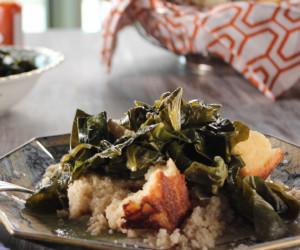
Al's collards are famous, having been featured in a cookbook and documented on film. If you don't like collards, try these anyway: You may change your mind. People passing by on the sidewalk in front of our house have followed the enticing aroma inside to see what was cooking. It is best to cook this the day before serving. Leave them in the refrigerator overnight (with ham hock) and reheat before serving. Abby's Note: I usually make these vegetarian, so anyone can eat them. Instead of ham hock, I use a few drops of liquid smoke. Also, I hate white pepper, so I just use all black. I've used honey when I didn't have corn syrup. Tobasco is what Al means, but I've used other brands of hot sauce. I never cook them 3 whole hours, usually only about 1 or so, but you want enough time to get good pot likker. Without cornbread, don't even bother with this! You have to have something to soak up the likker. YUM
Al's collards are famous, having been featured in a cookbook and documented on film. If you don't like collards, try these anyway: You may change your mind. People passing by on the sidewalk in front of our house have followed the enticing aroma inside to see what was cooking. It is best to cook this the day before serving. Leave them in the refrigerator overnight (with ham hock) and reheat before serving. Abby's Note: I usually make these vegetarian, so anyone can eat them. Instead of ham hock, I use a few drops of liquid smoke. Also, I hate white pepper, so I just use all black. I've used honey when I didn't have corn syrup. Tobasco is what Al means, but I've used other brands of hot sauce. I never cook them 3 whole hours, usually only about 1 or so, but you want enough time to get good pot likker. Without cornbread, don't even bother with this! You have to have something to soak up the likker. YUM
- 1/8 teaspoon black pepper
- 1/8 teaspoon white pepper
- 2 teaspoons salt or to taste
- 1/3 cup onion chopped
- 2 1/2 pounds collard greens about 6 cups
- 1 ham hock smoked
- 2 1/2 tablespoons corn syrup
- 2/3 cup vinegar
- 1 3/4 tablespoons worcestershire sauce
- 2/3 teaspoon hot sauce
- 1/3 teaspoon garlic powder
- 1/3 teaspoon red pepper flakes
- Carbohydrate 14.0623297705729 g
- Cholesterol 19.4551875 mg
- Fat 3.79686048541667 g
- Fiber 5.51926743028899 g
- Protein 10.549768521875 g
- Saturated Fat 1.10833535041667 g
- Serving Size 1 1 Serving (191g)
- Sodium 339.08595078125 mg
- Sugar 8.54306234028392 g
- Trans Fat 0.531668274583333 g
- Calories 122 calories
Step-by-step
- Cut off the tough root ends of the collard greens and discard.
- Wash greens thoroughly, rinsing several times.
- Coarsely chop leaves and stems.
- Fill a large stockpot about half full of water.
- In a food processor, blend about 1/2 cups of the collards and 1/2 cup of the water together, then add it to the pot.
- Add the ham hock, onion, corn syrup, salt, vinegar, Worcestershire, hot sauce, garlic powder, red pepper flakes and white and black pepper to the pot and bring to a boil.
- Add the chopped collards in batches, letting them cook down between additions so there is room to add more.
- When all the collards have been added, reduce heat and simmer for about 3 hours.
The Role of Pot Likker
Pot likker is the highly concentrated, nutrient-dense broth remaining in the bottom of the pot after simmering. Vinegar, Worcestershire sauce, and red pepper flakes infuse this liquid with sharp, salty, and spicy notes that demand a starch capable of absorption. Traditional cornbread works best because its crumb structure absorbs the liquid without disintegrating. Bread slices or plain boiled potatoes also function as alternatives when cornmeal is unavailable. Spoon the greens generously over the starch so every drop of the seasoned liquid is captured.Equipment and Workarounds
A heavy-duty stockpot with a tight-fitting lid is essential to maintain a steady simmer over several hours without excessive evaporation. Aluminum pots can react negatively with acidic ingredients like vinegar, so enameled cast iron or stainless steel vessels are preferred. If a large enough stockpot is missing from the kitchen inventory, divide the raw greens between two medium Dutch ovens. Reduce the liquid proportions evenly across both pots and combine the cooked batches before serving to ensure uniform flavor distribution.


