Tuna and Salted Egg Salad
A relatively quick and simple salad that I ended up making because I felt lazy to cook something up with the limited ingredients that I had back then. Originally created with just two ingredients - a can of tuna chunks and a salted egg - I have improved upon it by adding other stuff to improve its texture and taste. Many of my friends gave it a positive reaction. It goes well with hot rice.
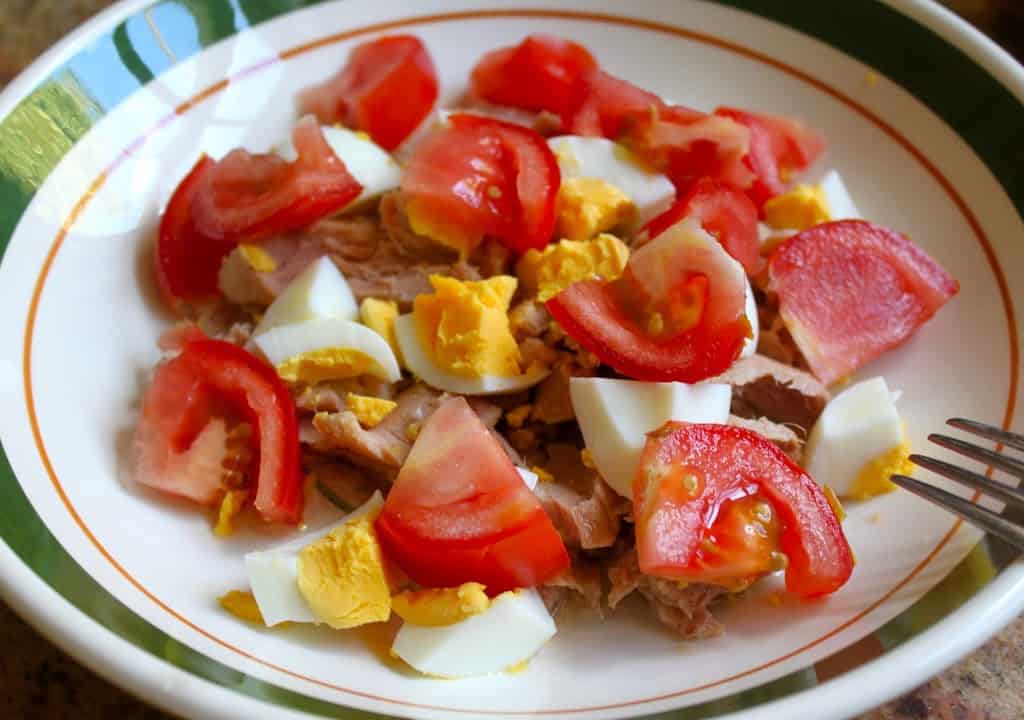
A relatively quick and simple salad that I ended up making because I felt lazy to cook something up with the limited ingredients that I had back then. Originally created with just two ingredients - a can of tuna chunks and a salted egg - I have improved upon it by adding other stuff to improve its texture and taste. Many of my friends gave it a positive reaction. It goes well with hot rice.
- ground black pepper
- additional ingredients
- basic ingredients
- 1 can tuna chunks in oil
- 1 salted egg you can get them from asian supermarkets. duck or chicken? it doesn't matter. they are usually dyed red or magenta but plain ones are sold too.
- 1 medium or large onion i prefer yellow onions but the red ones are good too. mince it up.
- 1 stalk scallion remove any wilted parts then chop off the root and tips of the greens. mince.
- 1 medium or large tomato chop into small pieces.
- Carbohydrate 1.16581 g
- Cholesterol 0 mg
- Fat 0.03176 g
- Fiber 0.416499985694885 g
- Protein 0.28545 g
- Saturated Fat 0.00578 g
- Serving Size 1 1 Serving (15g)
- Sodium 2.444 mg
- Sugar 0.749310014305115 g
- Trans Fat 0.00869000000000001 g
- Calories 5 calories
Step-by-step
- Put the tuna chunks into a large enough bowl - you'll be mixing several ingredients later so make sure they'll all fit. I recommend not to drain the oil as I learned by experience that it tastes better when moist with oil but drain it if you think it's necessary.
- With a knife, slice through the middle of the salted egg then use a spoon to scoop out its contents into the bowl where you placed the tuna in a while ago. Be wary of shell fragments. You wouldn't want some crunchy calcium bits in your salad, right?
- If you used a dyed egg be prepared to have dye stains on your fingers. Don't worry, they can be removed with a few hand washes with some soap but let's continue with the dish first.
- Using the same spoon that you scooped the egg with, chop the egg into small pieces while gently mixing it with the tuna. Slowly add the onions, scallions and tomatoes and sprinkle some ground black pepper to taste while mixing. Gently mix them all together until they are distributed well within the tuna chunks. I prefer to have larger chunks of tuna and salted egg but you may continue mixing to turn them into tiny pieces if you wish.
- You're done! You may wash the dye off your hands now (assuming you used a dyed egg), get some rice and start om nom noming. The recipe should be enough for two to four people depending on how hungry they are. Enjoy!
Preserved Foundations and Fat Retention
Swapping canned tuna packed in water for oil-packed varieties fundamentally alters the emulsion capability of this dish, because the natural lipids coat the aromatics rather than washing them out. Retaining the oil from the can provides the continuous phase necessary to suspend the moisture released by fresh vegetables, preventing the mixture from becoming watery. When combining the ingredients in a wide, shallow mixing bowl rather than a deep cylinder, mechanical force is distributed evenly without pulverizing the protein chunks into a paste.
The Salt Chemistry of Cured Yolks
Salted duck eggs undergo a heavy brine curing process that denatures the proteins and concentrates sodium, creating a firm yolk texture that acts as a natural seasoning agent. Incorporating this cured element directly replaces the need for added table salt, while the high mineral content draws out surface moisture from diced tomatoes within approximately ten minutes of mixing. Mincing yellow onions finely before introduction ensures that harsh allicin compounds distribute uniformly without overwhelming the palate with raw sulfur notes.
Textural Contrast and Fresh Integration
Scallions and tomatoes introduce high water activity that contrasts sharply with the dense, saline density of the preserved egg and the dense muscular structure of canned fish. Folding these components gently with a rounded spoon maintains distinct particle sizes rather than homogenizing the textures into an indistinguishable spread. Serve this preparation immediately at room temperature over freshly steamed rice to maximize the thermal contrast against the cold salad ingredients.


