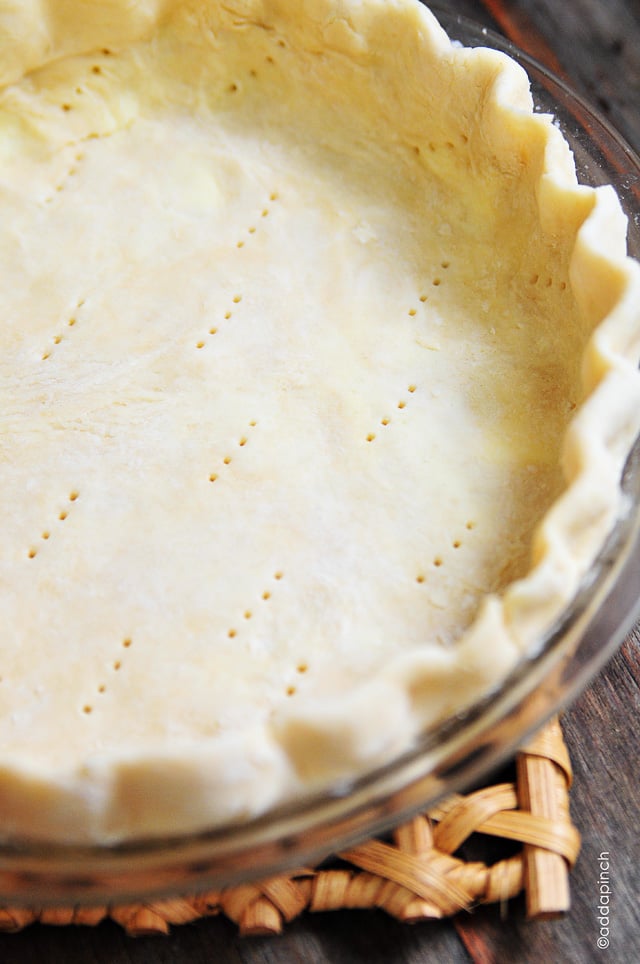
Try this Perfect Pie Crust recipe, or contribute your own.
- Carbohydrate 503.52066 g
- Cholesterol 412.4 mg
- Fat 369.9912 g
- Fiber 19.3800002861023 g
- Protein 69.584 g
- Saturated Fat 147.17335 g
- Serving Size 1 1 Serving (1132g)
- Sodium 89.3555 mg
- Sugar 484.140659713898 g
- Trans Fat 18.5853 g
- Calories 5663 calories
Step-by-step
- Mix flour, sugar, and salt.
- Add shortening and mix with fork until consistency of coarse meal.
- In small bowl, mix 1/2 cup water with vinegar and egg.
- Combine with flour mixture and stir around until all is moistened thoroughly.
- Do this quickly to moisten evenly.
- Spatula the moistened dough out onto well floured surface.
- With floured hands, squeeze entire mixture into one big ball and then separate into five equal-sized portions of dough.
- When equal in size, pat out and shape into large hamburger-sized patties.
- Prick bottom of unbaked pie crust with a fork in several places and then put a waxed paper lining in it.
- Place a cup or more of dried beans on top of waxed paper, spreading to edge of crust before baking.
- Bake in preheated, 475-degree oven for 12 to 15 minutes.
Using shortening instead of butter alters the fundamental physics of pastry, yielding a dough that resists melting during handling yet bakes into an intensely delicate structure. Shortening possesses a higher melting point than butter, meaning solid fat pockets remain trapped within the flour matrix longer in the oven, creating distinct steam pockets rather than leaking out onto the pan. Introducing a tablespoon of white vinegar further alters the final texture by lowering the pH of the dough, which inhibits gluten development and ensures the baked pastry remains tender rather than tough. Working the cold water, egg, and acid mixture into the dry ingredients requires speed; over-mixing hydrates the flour proteins fully, destroying the desired crumbly consistency.
Dividing the massive dough batch into five equal portions requires precise weighing rather than estimation, as uneven discs bake inconsistently. Wrapping those individual patties in waxed paper allows for efficient freezer storage, where the dough holds its structural integrity for months while defrosting in just fifteen to twenty minutes at room temperature. Freshly mixed dough handles differently than frozen variants that have undergone the thaw cycle, demanding slightly less flour dusting on the counter because the moisture has fully distributed through the resting period. Blind baking this crust demands weighted support, utilizing dried beans or ceramic weights over a parchment lining inside a 475-degree oven for 12 to 15 minutes to prevent unwanted bubbling across the base.



