Grandma's Apple Crisp with Maple Cream Sauce
I LOVE this dessert. It feels so homey and warm. I generally use mostly or all Granny Smith apples, so the tartness balances out the sweet of the topping and the cream sauce.
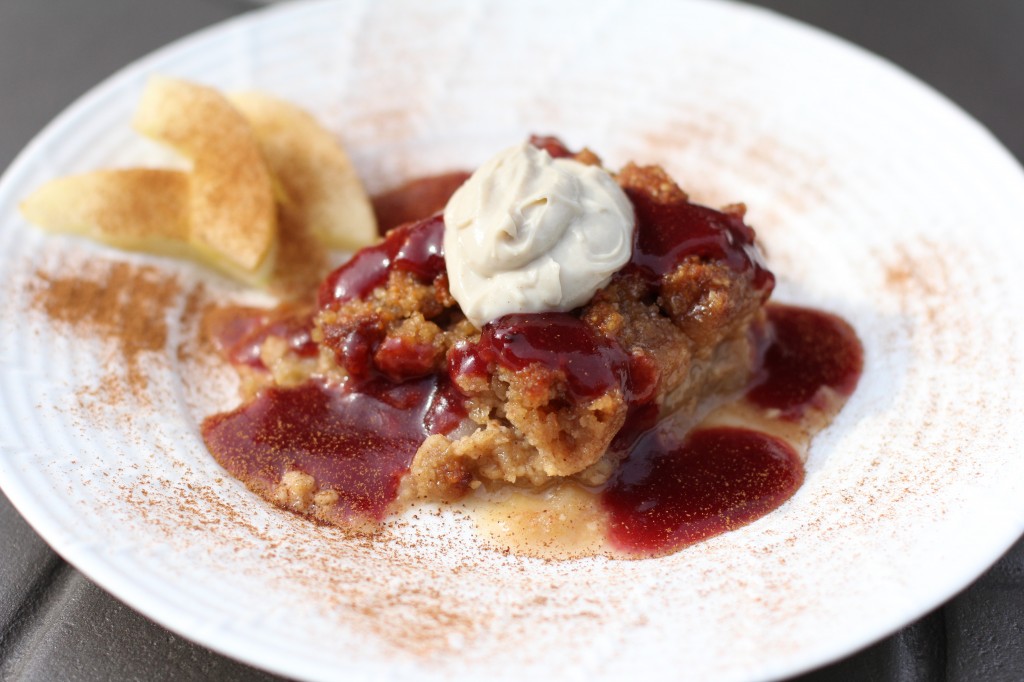
I LOVE this dessert. It feels so homey and warm. I generally use mostly or all Granny Smith apples, so the tartness balances out the sweet of the topping and the cream sauce.
- Carbohydrate 184.468629690989 g
- Cholesterol 91.305625 mg
- Fat 33.5014861305213 g
- Fiber 6.50865021216869 g
- Protein 7.75091625 g
- Saturated Fat 20.0563443217955 g
- Serving Size 1 1 Serving (348g)
- Sodium 191.014243373794 mg
- Sugar 177.95997947882 g
- Trans Fat 2.46546250943523 g
- Calories 1039 calories
Step-by-step
- In a large bowl, mix sugar, cinnamon and salt until uniform.
- Put in apple slices and mix with hands to coat.
- Place in greased 8x8 or 9x9 pan.
- Mix brown sugar, oats, and flour.
- Add softened butter and mix until crumbly.
- Crumble over apple mixture.
- Seal with tin foil and let sit.
- Remove foil and bake on 350 degrees for 30-45 minutes or until top is brown and crisp and apples are desired texture.
- Stir and cook ingredients on medium heat until thickened and reduced (about 15 minutes.)
- Chill until thick.
Resting the Fruit and Topping
Allowing the assembled crisp to rest tightly sealed under foil for three hours prior to baking initiates essential osmotic action. Salt and sugar draw moisture from the apple slices, creating a syrup while softening the flesh before heat ever hits the pan. Old-fashioned rolled oats maintain better structural integrity during this prolonged maceration than instant varieties do. Scaling quantities upward for larger pans requires maintaining the ratio of one stick of butter per cup of dry topping components to ensure proper browning.
Baking Dynamics and Crispness
Baking at 350 degrees Fahrenheit ensures the sugar does not burn before the fruit softens completely. Leaving the foil on for the initial phase traps steam to cook the interior apples thoroughly. Removing the cover for the final fifteen minutes allows the butter, brown sugar, and flour matrix to dehydrate into a shatteringly crisp crust. Watch for bubbling juices around the perimeter of the baking dish as a visual indicator that the starches have gelatinized.
Sauce Reduction and Storage
Reducing the heavy cream, maple syrup, and corn syrup over medium heat requires fifteen minutes of active stirring to evaporate excess water content. Corn syrup acts as an interfering agent that prevents sugar crystals from forming during the chilling process. Store the cooled sauce in a sealed glass jar in the refrigerator for up to five days. Reheat gently on the stovetop over low heat rather than the microwave to prevent the dairy solids from separating.


