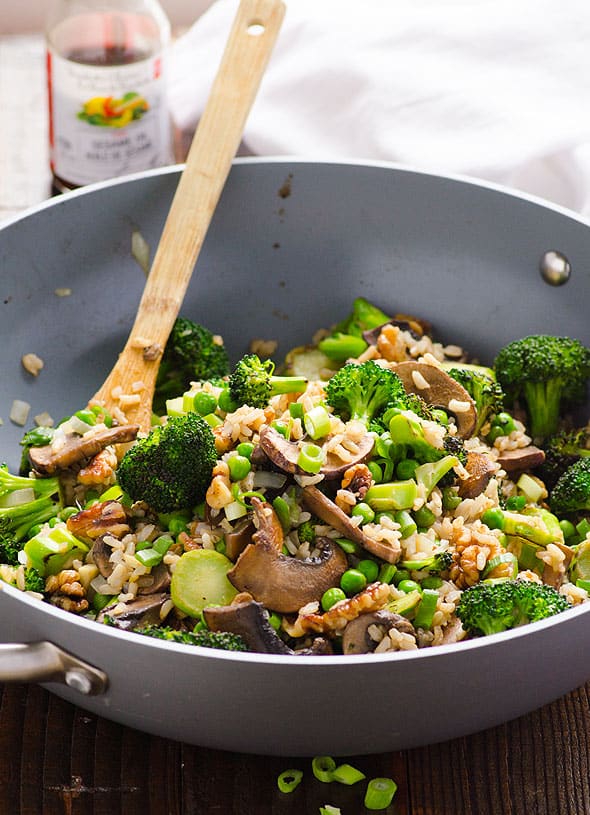
Chinese-esque Broccoli & Mushroom Stir Fry
I love Chinese food but my husband and kids would rather starve than eat it. Needless to say I don't get to enjoy it as much as I'd like. Today I had a craving for it and so I decided to make a vegetable stir fry thingamajig. Is it authentic? Heck no! But it was darn good! Please note that the measurements are approximations only. I didn't actually measure anything out. So you may have to tweak the numbers here and there.
I love Chinese food but my husband and kids would rather starve than eat it. Needless to say I don't get to enjoy it as much as I'd like. Today I had a craving for it and so I decided to make a vegetable stir fry thingamajig. Is it authentic? Heck no! But it was darn good! Please note that the measurements are approximations only. I didn't actually measure anything out. So you may have to tweak the numbers here and there.
- 1/4 cup water
- 1/2 tsp sesame oil
- 1 tsp vegetable oil
- 2 cups uncooked broccoli florets or gai lan, bite size
- 1/4 small onion, chopped
- 1-2 cloves garlic, minced
- 1 cup mushrooms, sliced (shitake, crimini, button, king oyster, any kind will do but i used the king oyster mushrooms)
- 3 tbsp water or vegetable/chicken broth
- 1 tbsp cornstarch
- 1/2 - 1 tbsp oyster sauce
- 1 tsp light soy sauce
- 1/2 tsp fish sauce
- salt and peper to taste
- Carbohydrate 16.5786171319679 g
- Cholesterol 0 mg
- Fat 3.52253942062216 g
- Fiber 5.27616540974532 g
- Protein 6.62995714474772 g
- Saturated Fat 0.363597117617997 g
- Serving Size 1 1 Serving (276g)
- Sodium 3183.52923994198 mg
- Sugar 11.3024517222225 g
- Trans Fat 0.489049069753721 g
- Calories 111 calories
Step-by-step
- Heat saute pan on medium-high to high. Add vegetable oil.
- Add onions and broccoli to the hot pan and saute for 2-3 minutes. Season lightly with salt to keep broccoli bright green. Add 1/4 cup of water to the pan and let steam vegetables for 2 minutes then add garlic and mushrooms to the pan. Continue cooking for another 2 minutes or until vegetables are about 1-2 minutes away from being cooked to your liking.
- Meanwhile, in a small bowl, add water or broth and cornstarch. Mix until dissolved. Stir in remaining ingredients except salt and pepper. Mix until blended. Add to the hot saute pan. Stir as the sauce thickens and coats the vegetables. If the sauce is too thick add some more water or broth. Taste with salt and pepper to taste. Serve over rice or noodles.
The Danger of Overcrowding the Pan
Home cooks frequently dump too much cold produce into a skillet at once, which immediately drops the cooking surface temperature and turns a crisp stir-fry into a steamed stew. Keeping heat at medium-high to high allows water to evaporate rapidly while oil conducts thermal energy directly to the vegetables. When cooking dense florets like broccoli or gai lan alongside sliced mushrooms, maintaining high heat ensures the exterior caramelizes before the interior turns mushy.
Fresh Versus Preserved Elements
Utilizing fresh garlic and raw mushrooms introduces vibrant cell structures that release moisture during cooking, whereas preserved items like oyster sauce and fish sauce contribute concentrated glutamates and stable sodium without adding excess water volume. Combining fresh aromatics with fermented umami liquids creates deep savory complexity that dry spice powders simply cannot replicate. Dissolving cornstarch into cold liquid before adding it to the pan prevents lumpy starches from forming when heat activates the thickening agents.
Judging Doneness Visually
Relying on timing alone fails because produce sizes vary wildly, so checking doneness requires observing both color changes and physical resistance. Broccoli is ready when it reaches a bright emerald hue and yields slightly to the poke of a fork while retaining a slight crunch at the core. Once the starch-thickened sauce turns glossy and coats the back of a spoon rather than pooling watery at the bottom of the pan, remove the skillet from the burner immediately.


