Kontomire with Chicken & Yam
Ghanaians enjoy a wide variety of meats and fish, both freshwater and marine, and often combine them in a single dish. This Kontomire stew recipe uses only chicken, as it's believed to not mix well with other meats.
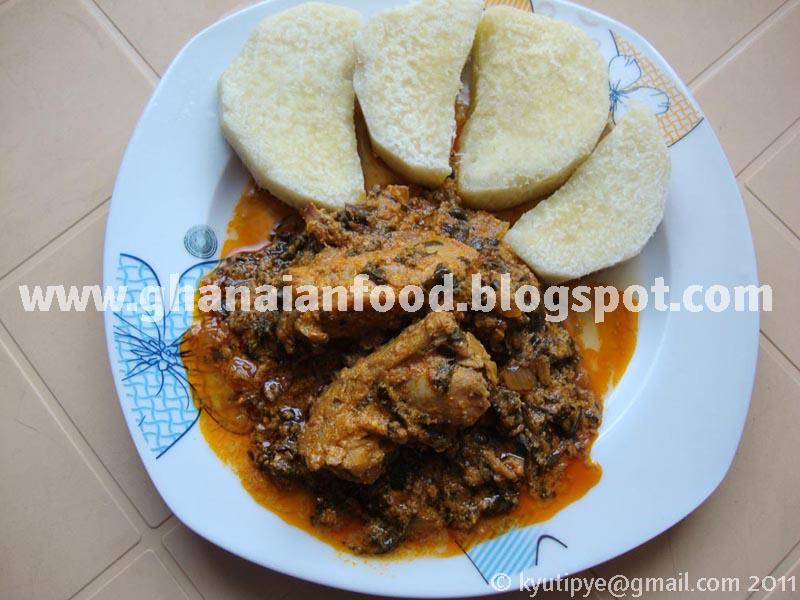
Ghanaians enjoy a wide variety of meats and fish, both freshwater and marine, and often combine them in a single dish. This Kontomire stew recipe uses only chicken, as it's believed to not mix well with other meats.
- Carbohydrate 0 g
- Cholesterol 680.388555 mg
- Fat 352.622021844 g
- Fiber 0 g
- Protein 168.73636164 g
- Saturated Fat 145.587662294 g
- Serving Size 1 1 Recipe (1577g)
- Sodium 635.029318 mg
- Sugar 0 g
- Trans Fat 21.115964672 g
- Calories 3860 calories
Step-by-step
- Start by removing the chicken skin, cutting it into desired sizes and washing it thoroughly.
- Spice the chicken with 1/2 a blended onion, 1 maggi cube, some salt and black pepper. mix it all in and steam the chicken, just until it turns white and produces stock.
- Chop the onions ...
- ... and blend the tomatoes together with the pepper.
- Pour the Agushi into a bowl and add about 1/2 a teaspoon of salt to it,
- then pour in enough water to cover it and leave it to soak.
- The kontomire could be shredded from the stalks, boiled and mashed, or just chopped like i prefer.
- Heat the palm oil in a pot and add onions. Fry until the onions are soft, then add the tomatoes and cover. Simmer it all down till it starts to fry. Stir it for about 3 minutes then add the chicken pieces. Fry a little more until it starts to stick.
- Stir gently then add the kontomire.
- Stir it in, add the stock and leave it to simmer
- Add the soaked Agushi, stir it in gently and leave it to simmer. After a few minutes, the agushi starts to clump in the sauce. Stirring too much will break up the clumps, so either stir gently or lift the pot and 'shake' it to move this around.
- Simmer it on a very low heat for 10 to 15 minutes. Only add extra salt after the stock and Agushi are in since they both contain salt.
- Turn it off sooner if you reach your preferred thickness.
- Peel the tuber of yam and cut into even pieces. Add enough water to cover all the yam, add some salt and boil. When a fork can pass through, it is ready. Pour off the excess water and serve with the knotomire stew.
Swapping taro leaves for standard spinach alters the final texture entirely, resulting in a lighter sauce that lacks the characteristic body of true kontomire. Preparing this dish relies heavily on managing moisture across multiple components. Start by steaming the poultry rather than browning it directly. This initial steam extracts natural stock while turning the flesh opaque. For this task, a heavy-bottomed Dutch oven provides even heat distribution and prevents scorching during the subsequent frying phase. When building the tomato base in palm oil, simmer the blended vegetables until the liquid completely evaporates and the oil separates back to the surface. This visual cue indicates that the raw tomato taste has cooked out. Agushi requires careful handling once introduced to the simmering pot. Soaking the ground melon seeds in water creates a paste that must form distinct curds. Stirging too vigorously at this stage breaks those curds apart, ruining the desired textural contrast. Instead, lift the vessel and agitate it gently. Maintain a low heat setting for ten to fifteen minutes to thicken the sauce without burning the bottom. Meanwhile, boil the yam pieces in salted water until a fork slides easily through the center with zero resistance. Fresh greens demand thorough washing and careful management of cooking times to retain vibrancy, whereas preserved alternatives require a longer rinse to remove excess salt before hitting the pot.



