Grandma Olga's Homemade Noodles with Chicken
One of my favorite things to do with Ms. T is to help her make her famous homemade noodles. When she visited this spring we went up to the cabin and carted all the ingredients we needed to make Chicken and Homemade Noodles. It's one of my most desired comfort foods and I also have it with leftover turkey during the holidays. The recipe is from Ms. T's family; Grandma Olga who was of German heritage. It is fun to think that this recipe has been passed on through multiple generations and I'm now sharing it with you. I usually cheat when it comes to the noodles and buy fresh packaged linguini noodles and toss them in flour. But, Ms. T showed me again how to make them and I have the evidence to prove it.
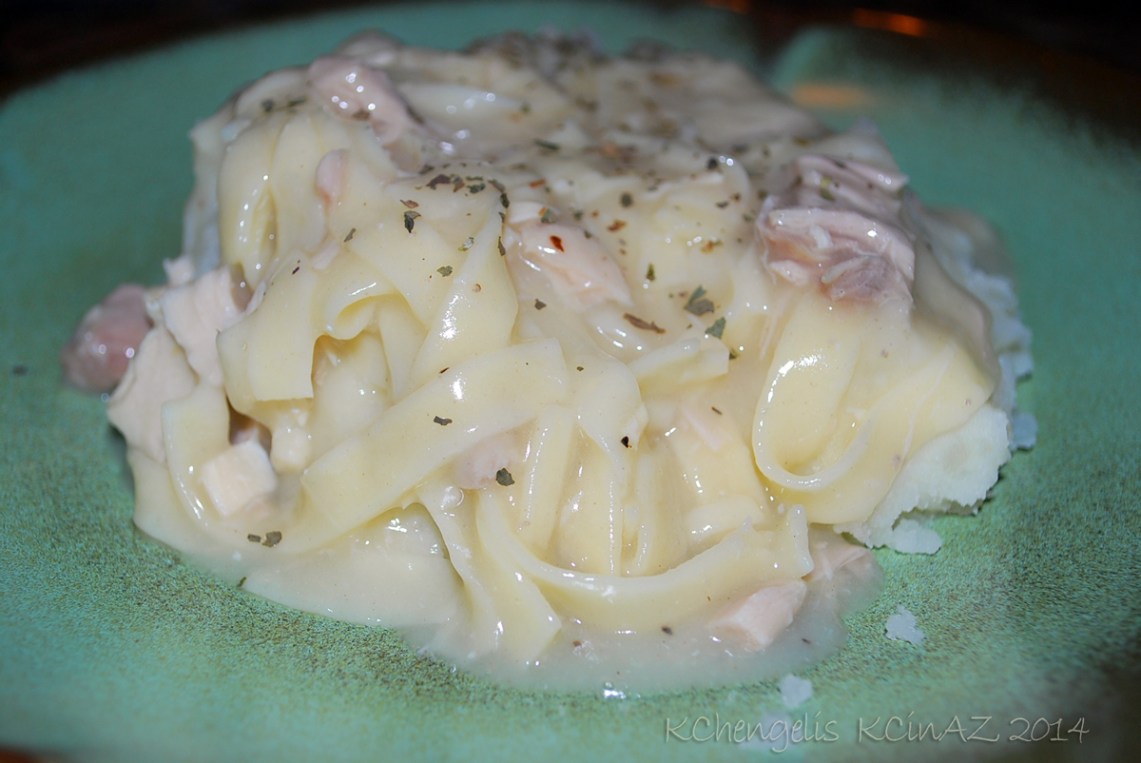
One of my favorite things to do with Ms. T is to help her make her famous homemade noodles. When she visited this spring we went up to the cabin and carted all the ingredients we needed to make Chicken and Homemade Noodles. It's one of my most desired comfort foods and I also have it with leftover turkey during the holidays. The recipe is from Ms. T's family; Grandma Olga who was of German heritage. It is fun to think that this recipe has been passed on through multiple generations and I'm now sharing it with you. I usually cheat when it comes to the noodles and buy fresh packaged linguini noodles and toss them in flour. But, Ms. T showed me again how to make them and I have the evidence to prove it.
- Carbohydrate 6.26174378565865 g
- Cholesterol 28.028 mg
- Fat 0.697824888991886 g
- Fiber 0.226177782038114 g
- Protein 1.30394000105015 g
- Saturated Fat 0.226893888905241 g
- Serving Size 1 1 Serving (12g)
- Sodium 108.984622357074 mg
- Sugar 6.03556600362054 g
- Trans Fat 0.0722552222562005 g
- Calories 37 calories
Step-by-step
- Assemble all your ingredients and tools that you will need before beginning.
- Place the flour and salt in a large mixing bowl and mix together.
- Form a pocket hole in the flour to place the next few ingredients.
- You may notice that many of the kitchen items are antiques such as the large mixing bowl.
- I love antiques and have quite a few in use at the cabin including the mixing bowl, green glass measure cups and large green glass measure for water.
- Place the eggs in the center of the pocket.
- First place in the whole egg.
- Then separate 3 eggs from yolks reserving the whites.
- As you separate the yolk, place it in the pocket along with the first whole egg.
- Next, add water a little at a time until the dough become firm and you are able to handle the dough.
- Knead the dough for approximately 10 minutes.
- Press your hands into a dough ball and flatten it.
- Fold the flattened dough back into itself and press flat again, repeat for 10 minutes.
- Whew... you have to be able to get you hands into the work.
- After kneading for 10 minutes, form a dough ball and cover with a light towel.
- Let rest for 10 minutes.
- You can now rest for a few minutes, too.
- Cut the dough into four pieces and form individual balls.
- Take one ball at a time, leaving the remaining balls covered with a towel or plastic wrap in the bowl.
- Add a little flour to the top of the first ball and begin rolling the dough flat.
- Turn over, add more flour if necessary and press with rolling-pin to continue flattening.
- Repeat until you reach the desire thinness.
- The dough should be relatively thin.
- We used a pasty cutter with multiple blades to cut the dough.
- Take your time and take it slow when cutting.
- You need to press fairly hard down on the cutter to make clean cuts.
- You can also roll the thin dough up like a tube and then cut the roll into individual slices with a knife if you prefer.
- The difference is that you will not achieve uniform pieces of noodles when using the second method.
- Place each individual noodle on a cookie rack and allow to dry for 2 hours.
- All the while we were preparing the noodles, we started to cook a whole chicken.
- Place cut up chicken in large stock pot.
- Add water to cover.
- Season with salt, onion powder (except for Mr. B.) and allow to simmer for several hours until tender and fully cooked.
- After cooked, remove chicken from pot and refrigerate until cool to touch.
- Retain broth to cook noodles later.
- After chicken is cooled, remove skin and bone.
- Cut into small bite size pieces.
- Add noodles to boiling chicken broth and cook until tender.
- Add chicken.
- Make it the ultimate indulgence.
- Serve along with a simple green salad as you won’t need much more.
How much water should be added to the flour and egg mixture to build a workable pasta dough? Precision matters here because adding liquid too quickly ruins the structural integrity of the flour matrix. Pour the water in gradually, stopping when the mass turns firm enough to handle without sticking to the work surface.
Kneading requires ten full minutes of continuous folding and pressing to develop the gluten strands properly. Without this mechanical action, the resulting ribbons break apart during the boiling stage. Letting the formed ball rest under a light towel for ten minutes allows the starches to hydrate fully and relaxes the tight protein bonds before rolling.
Serving this heavy, comforting dish demands a sharp, acidic contrast on the table. Dress bitter greens like endive or arugula in a bright vinaigrette containing three parts neutral oil to one part sharp vinegar. This acidity cuts through the rich poultry fat and coats the palate between bites of dense pasta. Alternatively, substitute the chicken with roasted turkey carcass during winter holidays, simmering the bones for at least two hours to extract maximum gelatin for the poaching liquid.


