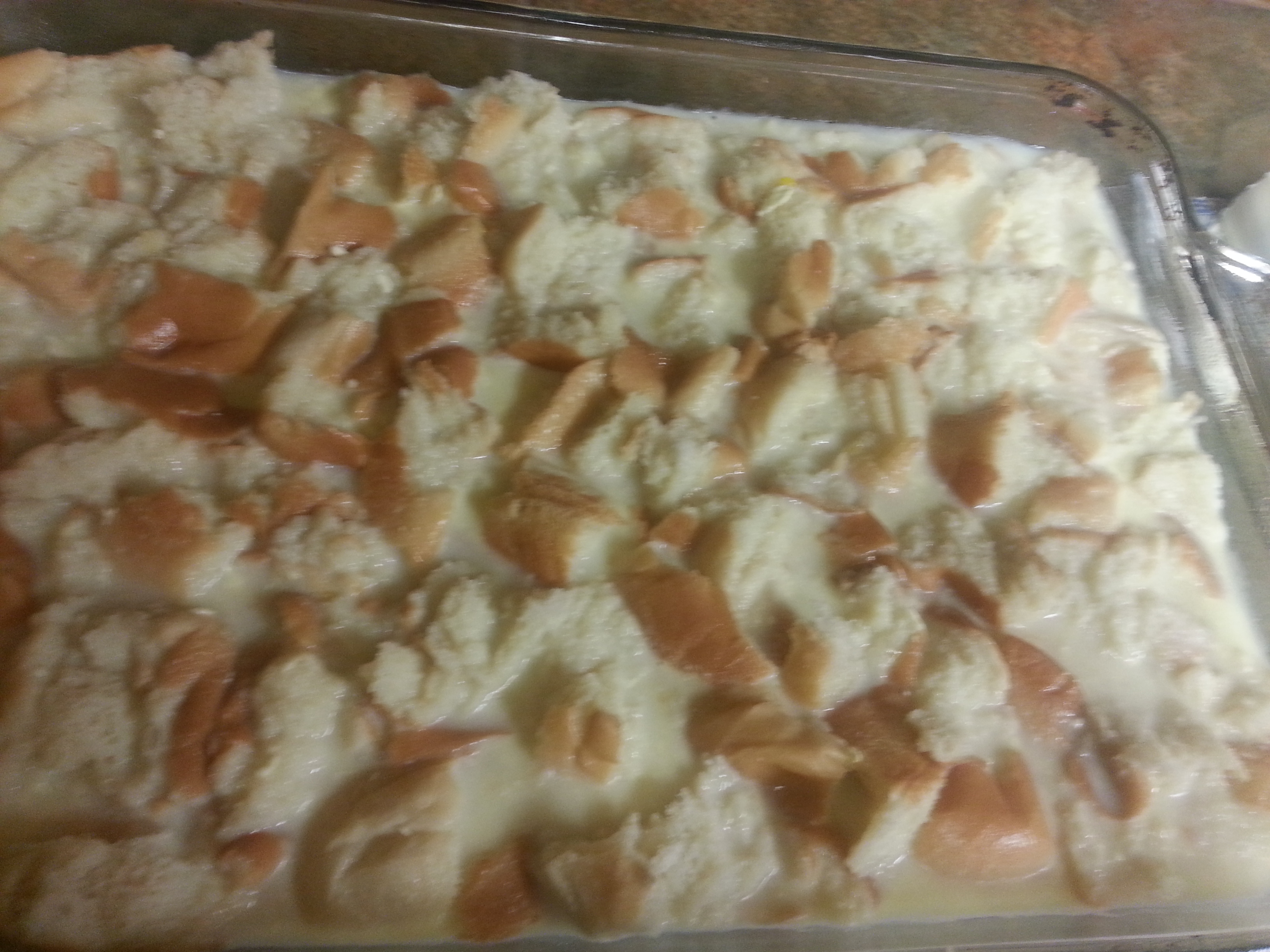
Try this Bread Pudding recipe, or contribute your own.
- Carbohydrate 26.1352532402232 g
- Cholesterol 60.5344884542551 mg
- Fat 4.4572314308185 g
- Fiber 1.55144273058573 g
- Protein 7.70822564382574 g
- Saturated Fat 1.69389315266527 g
- Serving Size 1 1 Serving (127g)
- Sodium 185.42665745347 mg
- Sugar 24.5838105096374 g
- Trans Fat 1.46921930082746 g
- Calories 172 calories
Step-by-step
- Tear bread into pieces
- combine melted butter, milk,sugar, and eggs
- pour over bread and let soak until most of liquid is absorbed into bread -about 45 min
- bake on 350 until golden, about 45 min
The Stale Bread Variable
Swapping commercial buns for crusty artisanal sourdough alters the internal hydration rate entirely. Dense sandwich rolls absorb liquids quickly due to an open, soft crumb structure. Harder crusts require a longer soak of sixty minutes to soften properly. Stale starches tolerate excess moisture better than fresh loaves do because retrograded starch molecules trap liquid without dissolving into mush.The Hydration Phase
Whisking dairy, melted fat, and eggs creates a custard base that must penetrate the crumb before heat hits the pan. Tearing pieces uniformly ensures even absorption throughout the baking dish. Allowing the mixture to rest for forty-five minutes lets the dry matrix swell fully. Skipping this hydration window leaves hard centers inside baked cubes.Browning and Heat Management
Bake the dish at 350 degrees Fahrenheit until the surface achieves a deep golden brown. Protein coagulation in the eggs sets the structural network while the sugar caramelizes on top. Remove the pan when the internal center reaches 160 degrees to prevent rubbery textures. Cool completely before slicing portions cleanly.


